
 | 26 Feb 2026
Decoding loess geochemical signals of the Schwalbenberg – a key to terrestrial system response to millennial-timescale Upper Pleistocene climate changes in western central Europe


Supervisor: Andreas Vött (University of Mainz)
Co-supervisor: Peter Fischer (University of Mainz)
Dissertation online: https://ubmz.hds.hebis.de/Record/HEB
515494348
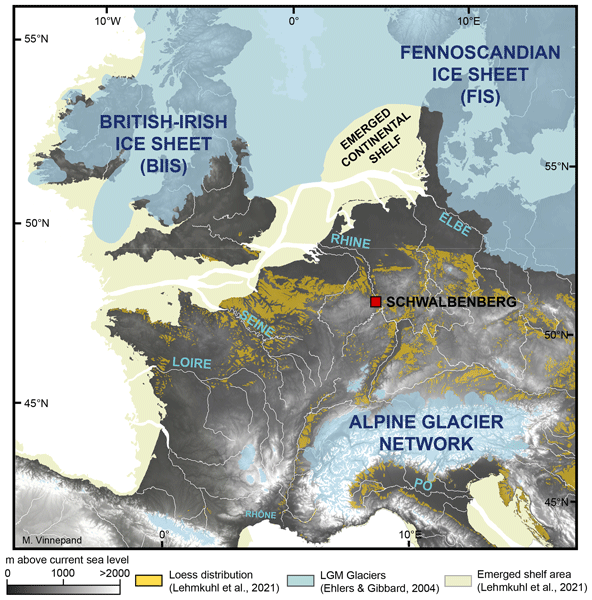
Loess–palaeosol sequences (LPSs) are the most extensive Quaternary sediment archives of climate and environmental changes across continents (e.g. Pye, 1995, and references therein). To valorize the information recorded in LPSs, their complexity needs to be acknowledged. This includes processes in the dust source(s), transport modes, and syn- and post-depositional changes, which lead to interfering signals. If these signals and processes are deconvoluted, the complexity of LPSs yields an enormous potential for reconstructing past environments. This dissertation aims to test proxy combinations and to develop multivariate statistical approaches that integrate established geochemical and geophysical methods to deconvolute interfering information in LPSs. The Schwalbenberg LPS (Middle Rhine Valley, Germany), covering the Upper Pleistocene (the last ∼ 127 000 years) at an unprecedented resolution (thickness: 30 m) for loess deposits in western central Europe, constitutes an ideal testing setting (Fischer et al., 2021; Lehmkuhl et al., 2021). It is located at the core of the Upper Pleistocene periglacial realm in central Europe and, thus, it is very sensitive to climatic changes (Fig. 1).
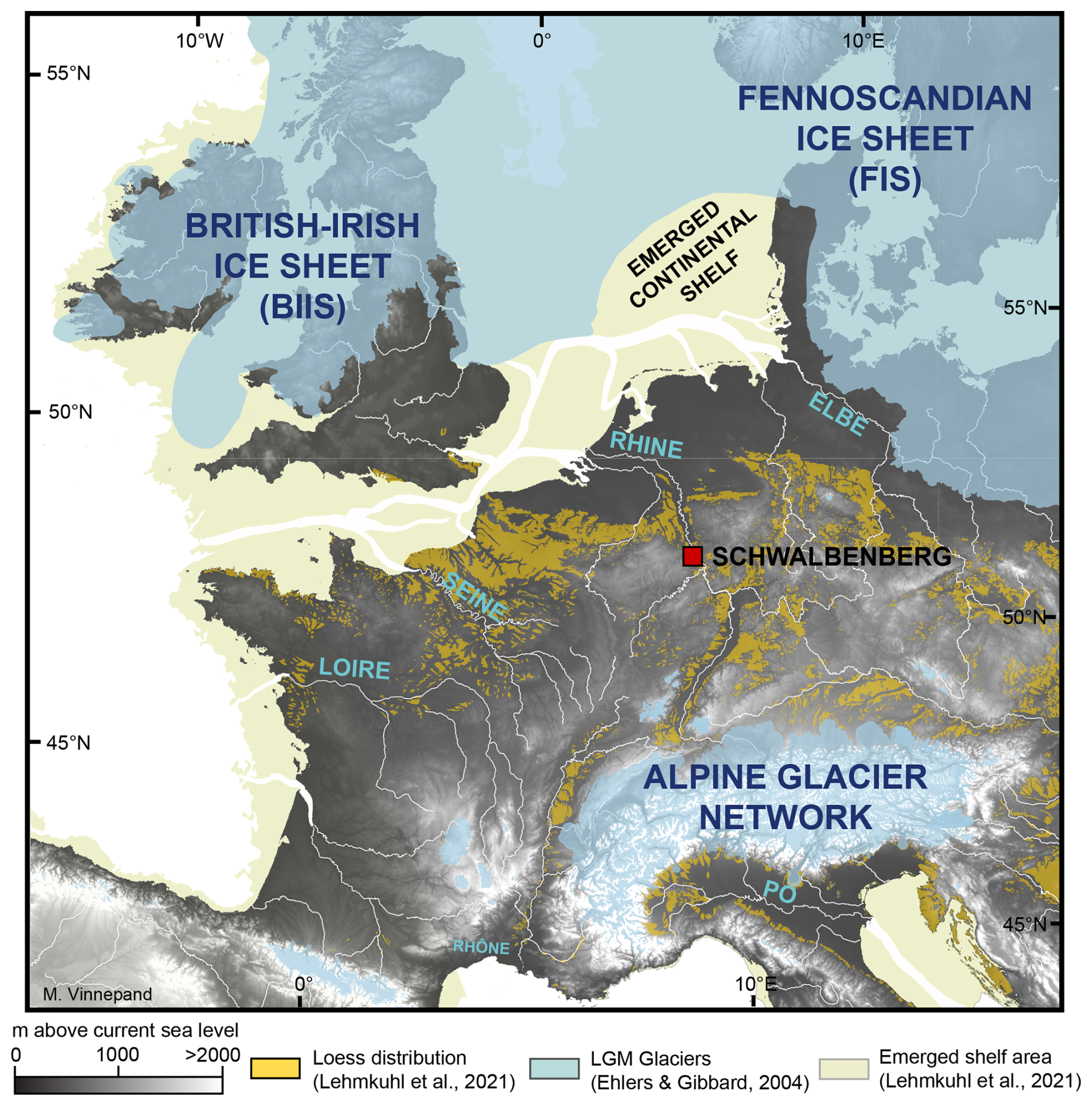
Figure 1Location map of the Schwalbenberg in the periglacial corridor between the northern ice sheets and the alpine glacier network during the LGM. Overall, this position makes the site very sensitive to North Atlantic climatic changes. DGM: GLOBE 1.0.
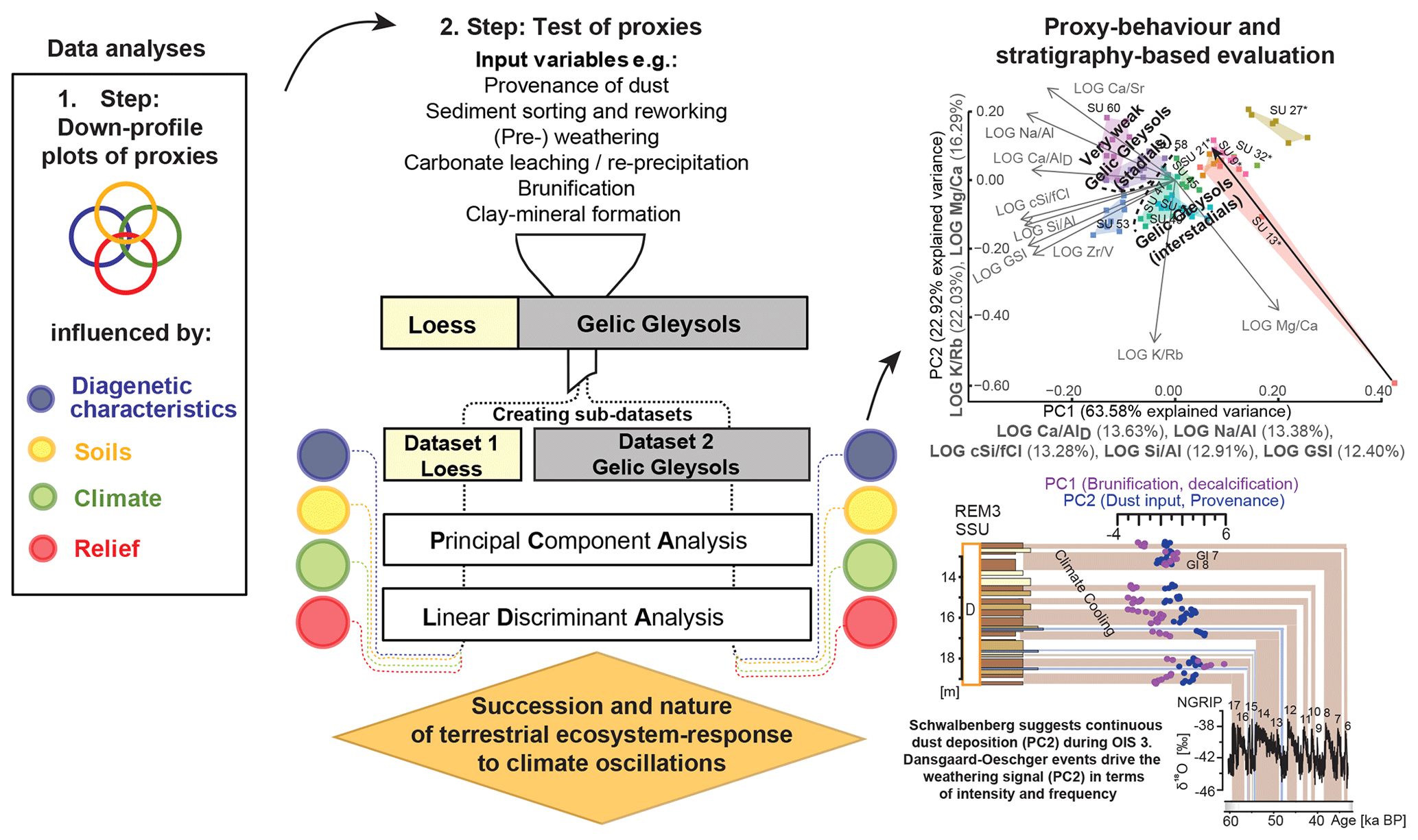
Figure 2Decoding-strategy scheme for LPSs (Vinnepand et al., 2022). Proxies are tested through multivariate statistics applied to (stratigraphically) filtered datasets. This increases their explanatory potential and allows for assessing the timing and nature of terrestrial system responses to climate oscillations.
Since precipitation is the key driver of chemical alterations, although permafrost-related waterlogging may also play a relevant role, the first dissertation chapter focusses on soil/sediment–moisture reconstructions through combining interpretations of the organic and inorganic stable carbon isotope signatures (δ13C) (Vinnepand et al., 2020). The aim is to simultaneously address carbonate dissolution and precipitation governing the inorganic δ13C signature and drought stress of the formerly prevailing vegetation. During drought stress, plants reduce their evapotranspiration through enhanced (partial) stomatal closure. This comes at the expense of CO2 diffusion limitations in the leaves reducing the photosynthesis efficiency and forcing plants – especially C3 plants – to increasingly take up 13C. If a C3 vegetation prevails and other effects are constrained, the difference in diffusivity between 12CO2 and 13CO2 in air (4.4 ‰) and the effect of stomatal (partial) closure lead to a discrimination of up to 4 ‰ (∼ deviation from the δ13C mean of C3 plants (∼ −27 ‰)), providing information on water availability (Farquhar et al., 1982). The inorganic δ13C can be used to estimate the primary carbonate (PC, δ13C close to zero ‰; West et al., 1988) and secondary carbonate (SC, δ13C close to −12 ‰ under C3 vegetation) contents via a mass balance calculation (Cerling and Quade, 2013). Through combined inorganic and organic δ13C interpretations, a more holistic picture can be drawn for LPSs that experienced permafrost conditions (Vinnepand et al., 2020). In such environments, a precipitation-centred interpretation of the organic δ13C signature alone can be misleading, as exemplified for the Schwalbenberg REM3 core. While a laminated loess layer underlying a very weak Gelic Gleysol (ca. 25 ka) (Fischer et al., 2021) in the REM3 core shows low SC quantities (weight %), pointing towards dry conditions and/or depletion of SC by (initially) thawing permafrost, this section exhibits an organic δ13C signature that indicates moist conditions. This shows that permafrost-induced moisture may govern water availability for plants and not necessarily precipitation (Vinnepand et al., 2020).
The second dissertation chapter highlights that plotting element ratios down the profile can only be the first data-analytical step when investigating palaeo-environmental conditions recorded in LPSs (Fig. 2). When element ratios are applied, one and the same proxy may reflect different processes in different environmental settings (e.g. loess and palaeosols) (Vinnepand et al., 2022). Furthermore, the use of element ratios to derive weathering indices may be complicated since dust sources change through time and since ecosystems respond differently to changing conditions (Vinnepand et al., 2022). This study provides a strategy that integrates a suite of weathering, provenance (element ratios), and grain size proxies in principal component analyses (PCAs) and linear discriminant analyses (LDAs) to disentangle recorded information. Prior to these analyses, the dataset is filtered according to stratigraphic units to process data from samples of the same nature (e.g. all loess, Gelic Gleysols) separately. This key step allows us to compare similar environmental conditions and strongly increases the explanatory potential of the proxies (Vinnepand et al., 2022). Whilst PCA helps to reduce the data dimensionality and summarizes the most relevant information along uncorrelated, first-rank-ordered axes, LDA tries to minimize the intra-group variance and to maximize the in-between-group variance to re-detect pre-defined stratigraphic units in a dataset (Venables et al., 2002). Through these different data treatments, both analyses facilitate a thorough understanding of the integrated LPSs with respect to the nature and temporal progression of ecosystem responses to climatic changes. This strategy is currently being tested further on other LPSs and is most promising to provide a key for spatial analyses across continents (Vinnepand et al., 2022).
The third dissertation chapter combines geochemistry (including Sr and Nd isotopes) with geophysical proxies (magnetic susceptibility (χ) and its frequency dependency (Δχ) and anisotropy (AMS)) to achieve a synthetic interpretation of LPS formation, integrating steps in the sedimentary cascade from dust source to sink (Vinnepand et al., 2023). It focusses on the RP1 profile covering the late oxygen isotope stage (OIS) 3 (∼ 40–30 ka) and the Last Glacial Maximum (LGM, ∼ 24–22 ka). Both parts are separated by an erosional unconformity. For the OIS 3 part, sedimentological proxies indicative of wind dynamics (U-ratio) and pedogenesis (finest clay <0.2 µm) show comparable and mostly synchronous patterns compared to those of Greenland ice core dust and climate proxies. This synchroneity cannot be observed for parts coeval with the LGM. Instead, local to regional conditions play a more important role – testified to by an increase in particles from the Rhenish Massif. Starting from the oldest to the youngest parts, a distinct shift towards increased input of “Rhine dust” and reduced weathering intensity occurs simultaneously with an overall cooling and aridification trend in Europe towards the end of OIS 3. In particular, between the Greenland Interstadial (GI) 6 and GI 5.1, magnetic enhancement through accumulation of coarse iron mineral-bearing particles in the loess may testify to increasing wind vigour (Vinnepand et al., 2023). AMS-based reconstructions of near-surface wind trends may indicate the temporal influence of northeasterly winds beside the overall dominance of westerlies, causing high dust accumulation rates. Applying the presented approaches in this work to different geographic areas and topographical contexts may allow for a more comprehensive understanding of LPS formation, including changes in dust composition and associated circulation patterns during climate changes.