
Articles | Volume 75, issue 1
https://doi.org/10.5194/egqsj-75-85-2026
© Author(s) 2026. This work is distributed under
the Creative Commons Attribution 4.0 License.
the Creative Commons Attribution 4.0 License.
https://doi.org/10.5194/egqsj-75-85-2026
© Author(s) 2026. This work is distributed under
the Creative Commons Attribution 4.0 License.
the Creative Commons Attribution 4.0 License.
Research article
| 
19 Mar 2026
Research article |
| 19 Mar 2026
| 19 Mar 2026
An MIS 8 terrestrial record retrieved from a glacially overdeepened basin in the northern foreland of the European Alps
Institute of Applied Geology, University of Natural Resources and Life Sciences Vienna (BOKU), Vienna, 1190, Austria
Christopher Lüthgens
Institute of Applied Geology, University of Natural Resources and Life Sciences Vienna (BOKU), Vienna, 1190, Austria
Thomas Burschil
Federal Institute for Geosciences and Resources (BGR), Hanover, 30655, Germany
Stephanie Neuhuber
Institute of Applied Geology, University of Natural Resources and Life Sciences Vienna (BOKU), Vienna, 1190, Austria
Roberta Pini
CNR IGAG, Laboratory of Palynology and Palaeoecology, Milano, 20126, Italy
Oscar Marchhart
Isotope Physics, University of Vienna, Vienna, 1090, Austria
Alexander Wieser
Isotope Physics, University of Vienna, Vienna, 1090, Austria
Clemens Schmalfuss
Institute of Applied Geology, University of Natural Resources and Life Sciences Vienna (BOKU), Vienna, 1190, Austria
Ernst Kroemer
Bavarian Environment Agency (LfU), Hof/Saale, 95030, Germany
Markus Fiebig
Institute of Applied Geology, University of Natural Resources and Life Sciences Vienna (BOKU), Vienna, 1190, Austria
Related authors
Thomas Burschil, Daniel Köhn, Matthias Körbe, Gerald Gabriel, Johannes Großmann, Gustav Firla, and Markus Fiebig
Solid Earth, 16, 1493–1507, https://doi.org/10.5194/se-16-1493-2025, https://doi.org/10.5194/se-16-1493-2025, 2025
Short summary
Short summary
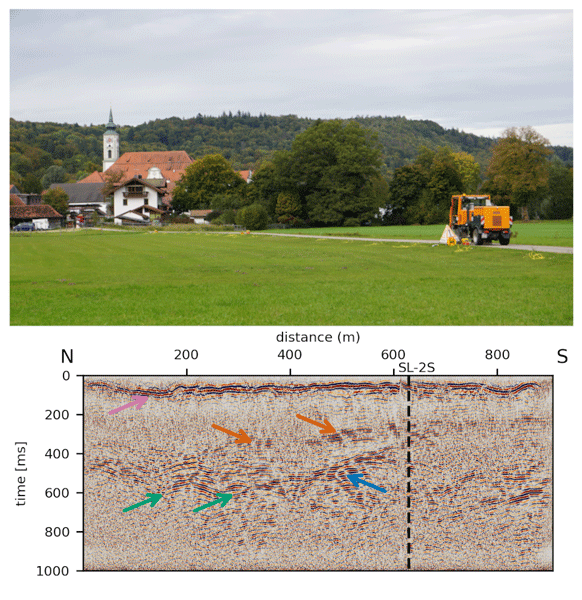
The study investigates a glacially overdeepened basin near the town of Schäftlarn, Germany, to provide the datasets for the methodological developmonet of combining high-resolution seismic reflection (HRSR) and full-waveform inversion (FWI). Seismic data with different source and receiver configurations reveal detailed basin structures, including previously unknown internal reflectors. HRSR with S-waves show more details than P-waves. First FWI delivers consistent velocity models.
Gustav Firla, Markus Fiebig, Titus Rauter, and Christopher Lüthgens
E&G Quaternary Sci. J., 74, 213–218, https://doi.org/10.5194/egqsj-74-213-2025, https://doi.org/10.5194/egqsj-74-213-2025, 2025
Short summary
Short summary
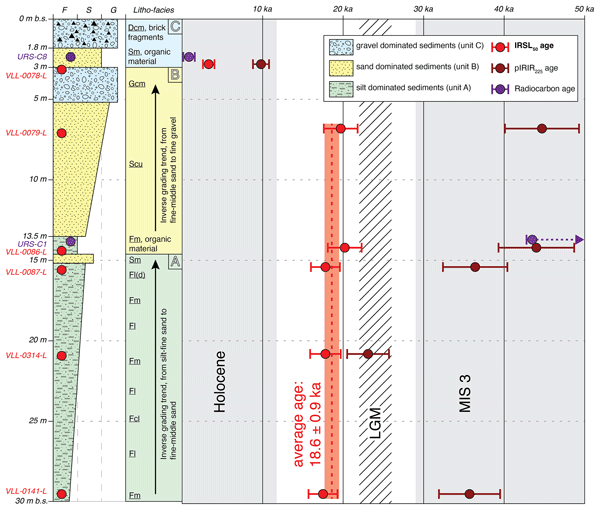
Glacio-lacustrine sediments from the overdeepened lower Salzach Valley were investigated. A 30 m long core retrieved sediments that could be identified as the “Salzburger Seeton”. Single-grain luminescence dating methods were applied on six samples spread over the whole depth of the core. The depositional age of these sediments was calculated to be 18.6 ± 0.9 ka. This time frame suggests that at least some shallow parts were filled by post-LGM (Last Glacial Maximum) lacustrine fine sediments.

Lianqing Zhang, Yingkui Li, Oscar Marchhart, Silke Merchel, Alexander Wieser, and Roland Zech
E&G Quaternary Sci. J., 75, 19–32, https://doi.org/10.5194/egqsj-75-19-2026, https://doi.org/10.5194/egqsj-75-19-2026, 2026
Short summary
Short summary
This study presents cosmogenic 10Be-derived denudation rates from the Roda Catchment, central Germany. Denudation rates in Europe are generally higher than in other regions globally, indicating the influence of periglacial dynamics on denudation. Short-term erosion rates are lower than long-term denudation rates, despite intensive recent human activity. Differences between local and catchment-wide denudation imply a relief change of 0–28 mm kyr‒1 in the Roda Catchment over the past 10 ka.
Thomas Burschil, Daniel Köhn, Matthias Körbe, Gerald Gabriel, Johannes Großmann, Gustav Firla, and Markus Fiebig
Solid Earth, 16, 1493–1507, https://doi.org/10.5194/se-16-1493-2025, https://doi.org/10.5194/se-16-1493-2025, 2025
Short summary
Short summary
The study investigates a glacially overdeepened basin near the town of Schäftlarn, Germany, to provide the datasets for the methodological developmonet of combining high-resolution seismic reflection (HRSR) and full-waveform inversion (FWI). Seismic data with different source and receiver configurations reveal detailed basin structures, including previously unknown internal reflectors. HRSR with S-waves show more details than P-waves. First FWI delivers consistent velocity models.
Gustav Firla, Markus Fiebig, Titus Rauter, and Christopher Lüthgens
E&G Quaternary Sci. J., 74, 213–218, https://doi.org/10.5194/egqsj-74-213-2025, https://doi.org/10.5194/egqsj-74-213-2025, 2025
Short summary
Short summary
Glacio-lacustrine sediments from the overdeepened lower Salzach Valley were investigated. A 30 m long core retrieved sediments that could be identified as the “Salzburger Seeton”. Single-grain luminescence dating methods were applied on six samples spread over the whole depth of the core. The depositional age of these sediments was calculated to be 18.6 ± 0.9 ka. This time frame suggests that at least some shallow parts were filled by post-LGM (Last Glacial Maximum) lacustrine fine sediments.
Zsófia Ruszkiczay-Rüdiger, Stephanie Neuhuber, Esther Hintersberger, and Jesper Nørgaard
E&G Quaternary Sci. J., 74, 59–78, https://doi.org/10.5194/egqsj-74-59-2025, https://doi.org/10.5194/egqsj-74-59-2025, 2025
Short summary
Short summary
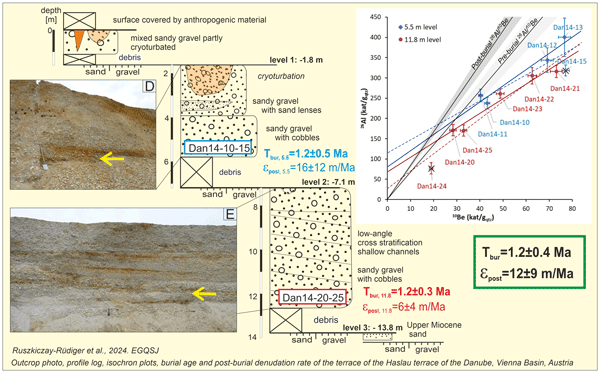
Accurateness of dates and rates of landscape evolution depends on the precision of the geochronological data. This study offers a robust methodology of outlier identification for modelling the cosmogenic nuclide isochron burial age of fluvial sediments. The method is tested on a fluvial terrace of the Danube River in the Vienna Basin and provides novel information for the quantification of the uplift rate of the area. The presented methodology is applicable in other fluvial settings as well.
Sarah Beraus, Thomas Burschil, Hermann Buness, Daniel Köhn, Thomas Bohlen, and Gerald Gabriel
Sci. Dril., 33, 237–248, https://doi.org/10.5194/sd-33-237-2024, https://doi.org/10.5194/sd-33-237-2024, 2024
Short summary
Short summary
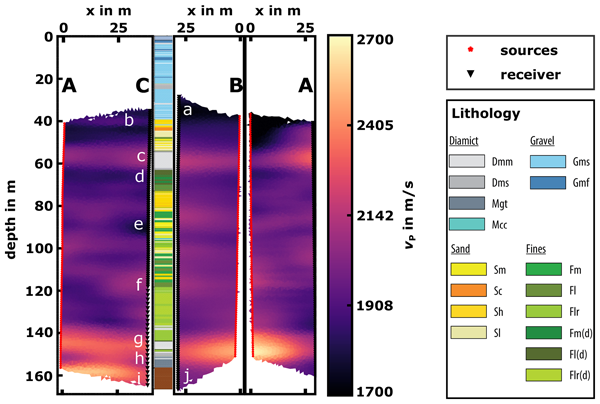
We conducted seismic crosshole experiments with a sparker source in order to obtain a high-resolution subsurface velocity model in the glacially overdeepened Tannwald Basin (ICDP site 5068_1). The data show complex wave fields that contain a lot of information but also present challenges. Nevertheless, isotropic first-arrival travel-time tomography provides the first high-resolution subsurface models that correlate well with the sonic logs and the core recovered from one of the three boreholes.
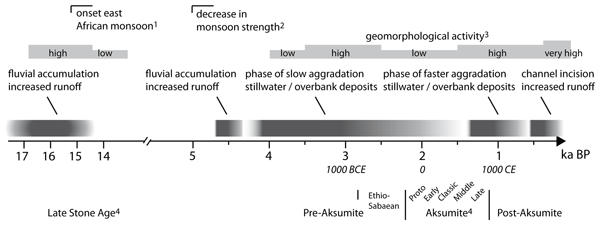
Jacob Hardt, Nadav Nir, Christopher Lüthgens, Thomas M. Menn, and Brigitta Schütt
E&G Quaternary Sci. J., 72, 37–55, https://doi.org/10.5194/egqsj-72-37-2023, https://doi.org/10.5194/egqsj-72-37-2023, 2023
Short summary
Short summary
We investigated the geomorphological and geological characteristics of the archaeological sites Hawelti–Melazo and the surroundings. We performed sedimentological analyses, as well as direct (luminescence) and indirect (radiocarbon) sediment dating, to reconstruct the palaeoenvironmental conditions, which we integrated into the wider context of Tigray.
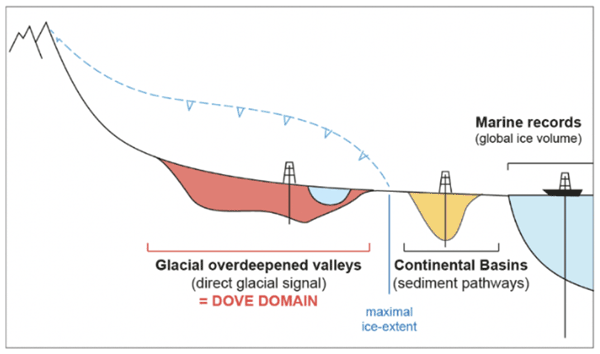
Flavio S. Anselmetti, Milos Bavec, Christian Crouzet, Markus Fiebig, Gerald Gabriel, Frank Preusser, Cesare Ravazzi, and DOVE scientific team
Sci. Dril., 31, 51–70, https://doi.org/10.5194/sd-31-51-2022, https://doi.org/10.5194/sd-31-51-2022, 2022
Short summary
Short summary
Previous glaciations eroded below the ice deep valleys in the Alpine foreland, which, with their sedimentary fillings, witness the timing and extent of these glacial advance–retreat cycles. Drilling such sedimentary sequences will thus provide well-needed evidence in order to reconstruct the (a)synchronicity of past ice advances in a trans-Alpine perspective. Eventually these data will document how the Alpine foreland was shaped and how the paleoclimate patterns varied along and across the Alps.

Christopher Lüthgens and Jacob Hardt
DEUQUA Spec. Pub., 4, 29–39, https://doi.org/10.5194/deuquasp-4-29-2022, https://doi.org/10.5194/deuquasp-4-29-2022, 2022
Roberta Pini
E&G Quaternary Sci. J., 70, 239–242, https://doi.org/10.5194/egqsj-70-239-2021, https://doi.org/10.5194/egqsj-70-239-2021, 2021
Short summary
Short summary
Menke (1970) presented a clear overview of the state of the art of Pleistocene stratigraphy for Schleswig-Holstein. After 50 years, a reconsideration of the original paper is needed to check if statements are still valid. Four issues were selected and reconsidered in the light of research progress made in the past decades.
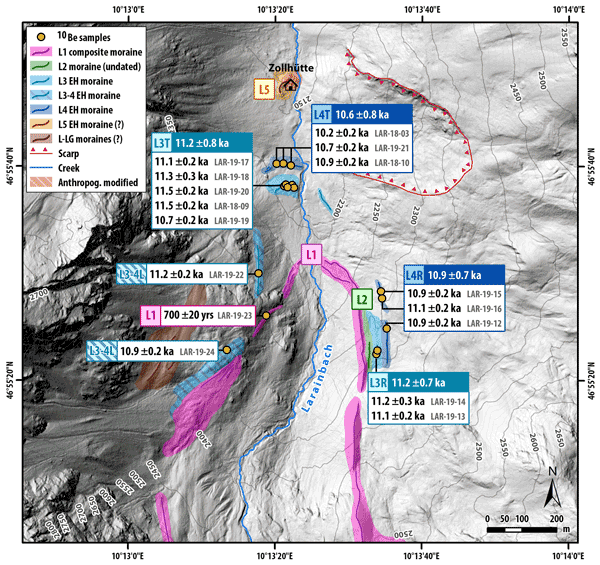
Sandra M. Braumann, Joerg M. Schaefer, Stephanie M. Neuhuber, Christopher Lüthgens, Alan J. Hidy, and Markus Fiebig
Clim. Past, 17, 2451–2479, https://doi.org/10.5194/cp-17-2451-2021, https://doi.org/10.5194/cp-17-2451-2021, 2021
Short summary
Short summary
Glacier reconstructions provide insights into past climatic conditions and elucidate processes and feedbacks that modulate the climate system both in the past and present. We investigate the transition from the last glacial to the current interglacial and generate beryllium-10 moraine chronologies in glaciated catchments of the eastern European Alps. We find that rapid warming was superimposed by centennial-scale cold phases that appear to have influenced large parts of the Northern Hemisphere.
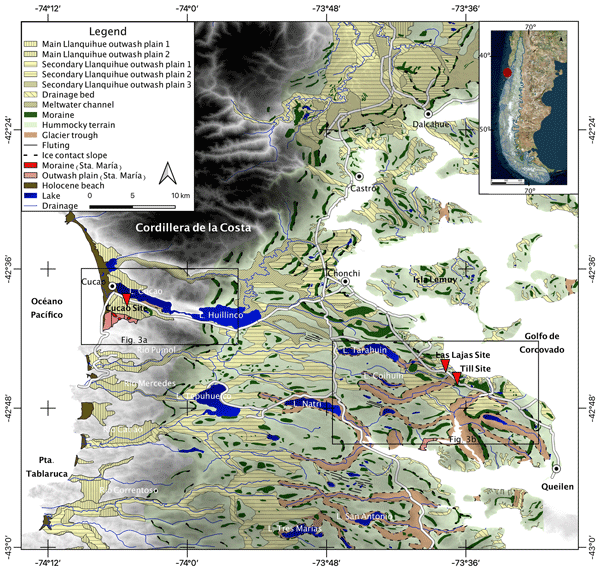
Juan-Luis García, Christopher Lüthgens, Rodrigo M. Vega, Ángel Rodés, Andrew S. Hein, and Steven A. Binnie
E&G Quaternary Sci. J., 70, 105–128, https://doi.org/10.5194/egqsj-70-105-2021, https://doi.org/10.5194/egqsj-70-105-2021, 2021
Short summary
Short summary
The Last Glacial Maximum (LGM) about 21 kyr ago is known to have been global in extent. Nonetheless, we have limited knowledge during the pre-LGM time in the southern middle latitudes. If we want to understand the causes of the ice ages, the complete glacial period must be addressed. In this paper, we show that the Patagonian Ice Sheet in southern South America reached its full glacial extent also by 57 kyr ago and defies a climate explanation.
Cited articles
Anselmetti, F. S., Bavec, M., Crouzet, C., Fiebig, M., Gabriel, G., Preusser, F., Ravazzi, C., and DOVE scientific team: Drilling Overdeepened Alpine Valleys (ICDP-DOVE): quantifying the age, extent, and environmental impact of Alpine glaciations, Sci. Dril., 31, 51–70, https://doi.org/10.5194/sd-31-51-2022, 2022.
Auclair, M., Lamothe, M., and Huot, S.: Measurement of anomalous fading for feldspar IRSL using SAR, Radiat. Meas., 37, 487–492, https://doi.org/10.1016/S1350-4487(03)00018-0, 2003.
Balco, G. and Rovey, C. W.: An isochron method for cosmogenicnuclide dating of buried soils and sediments, Am. J. Sci., 308, 1083–1114, https://doi.org/10.2475/10.2008.02, 2008
Bates, M. R., Wenban-Smith, F. F., Bello, S. M., Bridgland, D. R., Buck, L. T., Collins, M. J., Keen, D. H., Leary, J., Parfitt, S. A., Penkman, K., Rhodes, E., Ryssaert, C., and Whittaker, J. E.: Late persistence of the Acheulian in southern Britain in an MIS 8 interstadial: evidence from Harnham, Wiltshire, Quat. Sci. Rev., 101, 159–176, https://doi.org/10.1016/j.quascirev.2014.07.002, 2014.
Batten, D. J.: Reworking of plant microfossils and sedimentary provenance, Geological Society, London, Special Publications, 57, 79–90, https://doi.org/10.1144/GSL.SP.1991.057.01.08, 1991.
Bickel, L., Lüthgens, C., Lomax, J., and Fiebig, M.: Luminescence dating of glaciofluvial deposits linked to the penultimate glaciation in the Eastern Alps, Quat. Int., 357, 110–124, https://doi.org/10.1016/j.quaint.2014.10.013, 2015a.
Bickel, L., Lüthgens, C., Lomax, J., and Fiebig, M.: The timing of the penultimate glaciation in the northern Alpine Foreland: new insights from luminescence dating, Proceedings of the Geologists' Association, 126, 536–550, https://doi.org/10.1016/j.pgeola.2015.08.002, 2015b.
Braucher, R., Del Castillo, P., Siame, L., Hidy, A. J., and Bourles, D. L.: Determination of both exposure time and denudation rate from an in situ-produced 10Be depth profile: A mathematical proof of uniqueness. Model sensitivity and applications to natural cases, Quat. Geochronol., 4, 56–64, https://doi.org/10.1016/j.quageo.2008.06.001, 2009.
Braumann, S. M., Neuhuber, S., Fiebig, M., Schaefer, J. M., Hintersberger, E., and Lüthgens, C.: Challenges in constraining ages of fluvial terraces in the Vienna Basin (Austria) using combined isochron burial and pIRIR225 luminescence dating, Quat. Int., 509, 87–102, https://doi.org/10.1016/j.quaint.2018.01.009, 2019.
Buechi, M. W., Lowick, S. E., and Anselmetti, F. S.: Luminescence dating of glaciolacustrine silt in overdeepened basin fills beyond the last interglacial, Quaternary Geochronology, 37, 55–67, https://doi.org/10.1016/j.quageo.2016.09.009, 2017.
Buechi, M. W., Landgraf, A., Madritsch, H., Mueller, D., Knipping, M., Nyffenegger, F., Preusser, F., Schaller, S., Schnellmann, M., and Deplazes, G.: Terminal glacial overdeepenings: Patterns of erosion, infilling and new constraints on the glaciation history of Northern Switzerland, Quat. Sci. Rev., 344, 108970, https://doi.org/10.1016/j.quascirev.2024.108970, 2024.
Burschil, T.: Seismic measurements, DOVE site 5068_3 (Schäftlarn), Project Chatseis, Survey report, 26 p., Hannover, https://doi.org/10.25928/xpwx-y503, 2024.
Burschil, T., Tanner, D. C., Reitner, J. M., Buness, H., and Gabriel, G.: Unravelling the shape and stratigraphy of a glacially-overdeepened valley with reflection seismic: the Lienz Basin (Austria), Swiss Journal of Geosciences, 112, 341–355, https://doi.org/10.1007/s00015-019-00339-0, 2019.
Buylaert, J. P., Murray, A. S., Thomsen, K. J., and Jain, M.: Testing the potential of an elevated temperature IRSL signal from K-feldspar, Radiation Measurements, 44, 560–565, https://doi.org/10.1016/j.radmeas.2009.02.007, 2009.
Buylaert, J. P., Jain, M., Murray, A. S., Thomsen, K. J., Thiel, C., and Sohbati, R.: A robust feldspar luminescence dating method for Middle and Late Pleistocene sediments, Boreas, 41, 435–451, https://doi.org/10.1111/j.1502-3885.2012.00248.x, 2012.
Chmeleff, J., von Blanckenburg, F., Kossert, K., and Jakob, D.: Determination of the 10Be half-life by multicollector ICP-MS and liquid scintillation counting, Nuclear Instruments and Methods in Physics Research, Section B, Beam Interactions with Materials and Atoms, 268, 192–199, https://doi.org/10.1016/j.nimb.2009.09.012, 2010.
Cunningham, A. C. and Wallinga, J.: Realizing the potential of fluvial archives using robust OSL chronologies, Quaternary Geochronology, 12, 98–106, https://doi.org/10.1016/j.quageo.2012.05.007, 2012.
Davies, B. J., Roberts, D. H., Bridgland, D. R., Cofaigh, C.Ó, Riding, J. B., Demarchi, B., Penkman, K. E. H., and Pawley, S. M.: Timing and depositional environments of a Middle Pleistocene glaciation of northeast England: New evidence from Warren House Gill, County Durham, Quat. Sci. Rev., 44, 180–212, https://doi.org/10.1016/j.quascirev.2010.02.003, 2012.
Dehnert, A., Lowick, S. E., Preusser, F., Anselmetti, F. S., Drescher-Schneider, R., Graf, H. R., Heller, F., Horstmeyer, H., Kemna, H. A., Nowaczyk, N. R., Züger, A., and Furrer, H.: Evolution of an overdeepened trough in the northern Alpine Foreland at Niederweningen, Switzerland, Quat. Sci. Rev., 34, 127–145, https://doi.org/10.1016/j.quascirev.2011.12.015, 2012.
Doben, K., Doppler, G., Freudenberger, W., Jerz, H., Meyer, R. K. F., Mielke, H., Ott, W.-D., Rohrmüller, J., Schmidt-Kaler, H., Schwerd, K., and Unger, H. J.: Geologische Karte von Bayern 1:500 000, 4. Auflage, München, 1996.
Doppler, G., Kroemer, E., Rögner, K., Wallner, J., Jerz, H., and Grottenthaler, W.: Quaternary Stratigraphy of Southern Bavaria, E&G Quaternary Sci. J., 60, 23, https://doi.org/10.3285/eg.60.2-3.08, 2011.
Dreesbach, R.: Sedimentpetrographische Untersuchungen zur Stratigraphie des Würmglazials im Bereich des Isar-Loisachgletschers, Dissertation Ludwig-Maximilians-Universität München, 1985.
Dreesbach, R.: Zur Lithostratigraphie des Würmglazials im Gebiet des Isar-Loisach-Gletschers / Oberbayern, Z. dt. geol. Ges., 137, 553–572, 1986.
Duller, G. A. T.: Single-grain optical dating of Quaternary sediments: why aliquot size matters in luminescence dating, Boreas, 37, 589–612, https://doi.org/10.1111/j.1502-3885.2008.00051.x, 2008.
Ellwanger, D., Wielandt-Schuster, U., Franz, M., and Simon, T.: The Quaternary of the southwest German Alpine Foreland (Bodensee-Oberschwaben, Baden-Württemberg, Southwest Germany), E&G Quaternary Sci. J., 60, 22, https://doi.org/10.3285/eg.60.2-3.07, 2011.
Erlanger, E. D., Granger, D. E., and Gibbon, R. J.: Rock uplift rates in South Africa from isochron burial dating of fluvial and marine terraces, Geology, 40, 1019–1022, https://doi.org/10.1130/G33172.1, 2012.
Fenton, C. R., Binnie, S. A., Dunai, T., and Niedermann, S.: The SPICE project: Calibrated cosmogenic 26Al production rates and cross-calibrated 26Al/10Be, 26Al/14C, and 26Al/21Ne ratios in quartz from the SP basalt flow, AZ, USA, Quat. Geochron., 67, 101218, https://doi.org/10.1016/j.quageo.2021.101218, 2022.
Fernández Mosquera, D., Marti, K., Vidal Romaní, J. R., and Weigel, D.: Late Pleistocene deglaciation chronology in the NW of the Iberian Peninsula using cosmic-ray produced 21Ne in quartz, Nuclear Instruments and Methods in Physical Research B: Beam Interactions with Materials and Atoms, 172, 832–837, https://doi.org/10.1016/S0168-583X(00)00339-6, 2000.
Firla, G., Lüthgens, C., Neuhuber, S., Schmalfuss, C., Kroemer, E., Preusser, F., and Fiebig, M.: Analyzing complex single grain feldspar equivalent dose distributions for luminescence dating of glacially derived sediments, Quaternary Geochronology, 85, 101627, https://doi.org/10.1016/j.quageo.2024.101627, 2024a.
Firla, G., Lüthgens, C., Preusser, F., and Fiebig, M.: Unravelling the chronology of the infill of glacially overdeepened structures in the northern foreland of the European Alps [Poster], 37th International Geological Congress, Busan, Republic of Korea (South Korea), 25–31 August 2024, T2 Quaternary Geology – S3 Current and future directions in Quaternary chronostratigraphy, 2024b.
Galbraith, R., Roberts, R., Laslett, G., Yoshida, H., and Olley, J.: Optical dating of single and multiple grains of quartz from Jinmium Rock Shelter, Northern Australia: part I, experimental design and statistical models, Archaeometry, 41, 339–364, https://doi.org/10.1111/j.1475-4754.1999.tb00987.x, 1999.
Gegg, L. and Preusser, F.: Comparison of overdeepened structures in formerly glaciated areas of the northern Alpine foreland and northern central Europe, E&G Quaternary Sci. J., 72, 23–36, https://doi.org/10.5194/egqsj-72-23-2023, 2023.
Gegg, L., Salcher, B. C., Pollhammer, T., Cohen, D., Fischer, U. H., and Landgraf, A.: An inventory of subglacial overdeepenings in southern Germany and Austria, Boreas, https://doi.org/10.1111/bor.12693, 2025.
Giraudi, C. and Giaccio, B.: Middle Pleistocene glaciations in the Apennines, Italy: new chronological data and preservation of the glacial record, Geological Society, London, Special Publications, 433, 161–178, https://doi.org/10.1144/SP433.1, 2017.
Granger, D. E.: A review of burial dating methods using 26Al and 10Be, Geological Society of America Special Papers, 415, 1–16, https://doi.org/10.1130/2006.2415(01), 2006.
Granger, D. E.: Cosmogenic nuclide burial dating in archaeology and paleoanthropology, in: Treatise on Geochemistry (2nd edn.), edited by: Holland H. D. and Turekian K. K., Oxford: Elsevier, 14, 81–97, https://doi.org/10.1016/B978-0-08-095975-7.01208-0, 2014.
Heisinger, B., Lal, D., Jull, A. J. T., Kubik, P., Ivy-Ochs, S., Neumaier, S., Knie, K., Lazarev, V., and Nolte, E.: Production of selected cosmogenic radionuclides by muons: 1. Fast muons, Earth and Planetary Science Letters, 200, 345–355, https://doi.org/10.1016/S0012-821X(02)00640-4, 2002a.
Heisinger, B., Lal, D., Jull, A. J. T., Kubik, P., Ivy-Ochs, S., Knie, K., and Nolte, E.: Production of selected cosmogenic radionuclides by muons: 2. Capture of negative muons, Earth and Planetary Sci. Lett. , 200, 357–369, https://doi.org/10.1016/S0012-821X(02)00641-6, 2002b.
Hughes, P. D., Woodward, J. C., van Calsteren, P. C., and Thomas, L. E.: The glacial history of the Dinaric Alps, Montenegro, Quat. Sci. Rev., 30, 3393–3412, https://doi.org/10.1016/j.quascirev.2011.08.016, 2011.
Hughes, P. D., Gibbard, P. L., and Ehlers, J.: The “missing glaciations” of the Middle Pleistocene, Quaternary Res., 96, 161–183, https://doi.org/10.1017/qua.2019.76, 2020.
Huntley, D. and Baril, M.: The K content of the K-feldspars being measured in optical dating or in thermoluminescence dating, Ancient TL, 15, 11–13, 1997.
Jenkins, G. T. H., Duller, G. A. T., Roberts, H. M., Chiverrell, R. C., and Glasser, N. F.: A new approach for luminescence dating glaciofluvial deposits – High precision optical dating of cobbles, Quat. Sci. Rev., 192, 263–273, https://doi.org/10.1016/j.quascirev.2018.05.036, 2018.
Jerz, H.: Das Wolfratshausener Becken: seine glaziale Anlage und Übertiefung, E&G Quaternary Sci. J., 29, 63–70, https://doi.org/10.3285/eg.29.1.06, 1979.
Jerz, H.: Das Eiszeitalter in Bayern – Erdgeschichte, Gesteine, Wasser, Boden. – Geologie von Bayern, 2, Stuttgart, 1993.
Jerz, H., Bader, K., Baumann, H. J., Kovanda, J., Müller, J., Kleinmann, A., Schauer, T., Schmeidl, H., and Wrobel, J.-P.: Geologische Karte von Bayern 1:25 000 – Erläuterungen zum Blatt Nr. 8034 Starnberg Süd, München, 1987.
Kars, R. H., Busschers, F. S., and Wallinga, J.: Validating post IR-IRSL dating on K-feldspars through comparison with quartz OSL ages, Quat. Geochron., 12, 74–86, https://doi.org/10.1016/j.quageo.2012.05.001, 2012.
Klasen, N.: Lumineszenzdatierung glazifluvialer Sedimente im nördlichen Alpenvorland (Luminescence Dating of Glaciofluvial Sediments in the Northern Alpine Foreland), Dissertation Universität zu Köln, 2008.
Korschinek, G., Bergmaier, A., Faestermann, T., Gerstmann, U. C., Knie, K., Rugel, G., Wallner, A., Dillmann, I., Dollinger, G., Lierse von Gostomski, Ch., Kossert, K., Maiti, M., Poutivtsev, M., and Remmert, A.: A new value for the half-life of 10Be by heavy-ion elastic recoil detection and liquid scintillation counting, Nuclear Instruments and Methods in Physics Research, Section B, Beam Interactions with Materials and Atoms, 268, 187–191, https://doi.org/10.1016/j.nimb.2009.09.020, 2010.
Kreutzer, S., Schmidt, C., Fuchs, M. C., Dietze, M., and Fuchs, M.: Introducing an R package for luminescence dating analysis, Ancient TL, 30, 1–8, 2012.
Kulig, G.: Erstellung einer Auswertesoftware zur Altersbestimmung mittels Lumineszenzverfahren unter spezieller Berücksichtigung des Einflusses radioaktiver Ungleichgewichte in der 238-U-Zerfallsreihe, in: Bakkalaureusarbeit Network Computing, TU Freiberg, 2005.
Lachner, J., Martschini, M., Kalb, A., Kern, M., Marchhart, O., Plasser, F., Priller, A., Steier, P., Wieser, A., and Golser, R.: Highly sensitive 26Al measurements by Ion-Laser-InterAction Mass Spectrometry, International Journal of Mass Spectrometry, 465, 116576, https://doi.org/10.1016/j.ijms.2021.116576, 2021.
Lauer, T. and Weiss, M.: Timing of the Saalian- and Elsterian glacial cycles and the implications for Middle – Pleistocene hominin presence in central Europe, Sci. Rep., 8, 5111, https://doi.org/10.1038/s41598-018-23541-w, 2018.
Lisiecki, L. E. and Raymo, M. E.: A Pliocene-Pleistocene stack of 57 globally distributed benthic δ18O records, Paleoceanography, 20, PA1003, https://doi.org/10.1029/2004PA001071, 2005.
Lomax, J., Wolf, D., Meliksetian, K., Wolpert, T., Sahakyan, L., Hovakimyan, H., Faust, D., and Fuchs, M.: Testing post-IR-IRSL dating on Armenian loess-palaeosol sections against independent age control, Quat. Geochron., 69, 101265, https://doi.org/10.1016/j.quageo.2022.101265, 2022.
Lowick, S. E., Buechi, M. W., Gaar, D., Graf, H. R., and Preusser, F.: Luminescence dating of middle pleistocene proglacial deposits from northern Switzerland: methodological aspects and stratigraphical conclusions, Boreas, 44, 459–482, https://doi.org/10.1111/bor.12114, 2015.
Marks, L., Woronko, B., Majecka, A., Rylova, T., Orłowska, A., Hrachanik, M., Rychel, J., Zbucki, L., Bahdasarau, M., Hradunova, A., Nitychoruk, J., Nowacki, L., and Pochocka-Szwarc, K.: Middle Pleistocene deposits at Rechitsa, western Belarus, and their input to MIS 12-6 stratigraphy in central Europe, Quat. Int., 553, 34–52, https://doi.org/10.1016/j.quaint.2020.07.022, 2020.
Mueller, D., Gegg, L., Fülling, A., Buechi, M. W., Deplazes, G., and Preusser, F.: Luminescence dating of glacially sourced deposits from northern Switzerland: Comparing multigrain aliquots and single grains of quartz and feldspar, Quaternary Geochronology, 82, 101551, https://doi.org/10.1016/j.quageo.2024.101551, 2024.
Nishiizumi, K.: Preparation of 26Al AMS standards, Nuclear Instruments and Methods in Physics Research, Section B, Beam Interactions with Materials and Atoms, 223–224, 388–392, https://doi.org/10.1016/s0168-583x(04)00600-7, 2004.
Penck, A. and Brückner, E.: Die Alpen im Eiszeitalter. Tauchnitz, Leipzig, 1909.
Pini, R. and Bertuletti, P.: Palaeoecological analysis of terrestrial biological proxies on sediment samples from the Schäftlarn core (ICDP core 5068_3_A), Scientific report IGAG Milano, 2023.
Prescott, J. and Stephan, L.: The contribution of cosmic radiation to the environmental dose for thermoluminescence dating - Latitude, altitude and depth dependencies, PACT, 6, 17–25, 1982.
Prescott, J. R. and Hutton, J. T.: Cosmic ray contributions to dose rates for luminescence and ESR dating: Large depths and long-term time variations, Radiat. Meas., 23, 497–500, https://doi.org/10.1016/1350-4487(94)90086-8, 1994.
Preusser, F. and Kasper, H. U.: Comparison of dose rate determination using high-resolution gamma spectrometry and inductively coupled plasma-mass spectrometry, Ancient TL, 19, 19–23, https://doi.org/10.26034/la.atl.2001.329, 2001.
Preusser, F., Drescher-Schneider, R., Fiebig, M., and Schlüchter, C.: Re-interpretation of the Meikirch pollen record, Swiss Alpine Foreland, and implications for Middle Pleistocene chronostratigraphy, J. Quaternary Sci., 20, 607–620, https://doi.org/10.1002/jqs.930, 2005.
Preusser, F., Reitner, J. M., and Schlüchter, C.: Distribution, geometry, age and origin of overdeepened valleys and basins in the Alps and their foreland, Swiss J. Geosci., 103, 407–426, https://doi.org/10.1007/s00015-010-0044-y, 2010.
Preusser, F., Graf, H. R., Keller, O., Krayss, E., and Schlüchter, C.: Quaternary glaciation history of northern Switzerland, E&G Quaternary Sci. J., 60, 21, https://doi.org/10.3285/eg.60.2-3.06, 2011.
Rades, E. F., Fiebig, M., and Lüthgens, C.: Luminescence dating of the Rissian type section in southern Germany as a base for correlation, Quat. Int., 478, 38–50, https://doi.org/10.1016/J.QUAINT.2016.07.055, 2018.
Reimann, T., Thomsen, K. J., Jain, M., Murray, A. S., and Frechen, M.: Single-grain dating of young sediments using the pIRIR signal from feldspar, Quaternary Geochronology, 11, 28–41, https://doi.org/10.1016/j.quageo.2012.04.016, 2012.
Reitner, J. M.: The Imprint of Quaternary Processes on the Austrian Landscape, in: Landscapes and Landforms of Austria, edited by: Embleton-Hamann, C., World Geomorphological Landscapes, Springer, Cham, https://doi.org/10.1007/978-3-030-92815-5_3, 2022.
Reuther, A. U., Fiebig, M., Ivy-Ochs, S., Kubik, P. W., Reitner, J. M., Jerz, H., and Heine, K.: Deglaciation of a large piedmont lobe glacier in comparison with a small mountain glacier – new insight from surface exposure dating. Two studies from SE Germany, E&G Quaternary Sci. J., 60, 18, https://doi.org/10.3285/eg.60.2-3.03, 2011.
Roskosch, J., Winsemann, J., Polom, U., Brandes, C., Tsukamoto, S., Weitkamp, A., Bartholomäus, W. A., Henningsen, D., and Frechen, M.: Luminescence dating of ice-marginal deposits in northern Germany: evidence for repeated glaciations during the Middle Pleistocene (MIS 12 to MIS 6), Boreas, 44, 103–126, https://doi.org/10.1111/bor.12083, 2014.
Rugel, G., Pavetich, S., Akhmadaliev, S., Enamorado-Baez, S. M., Scharf, A., Ziegenrücker, R., and Merchel, S.: The first four years of the AMS-facility DREAMS: Status and developments for more accurate radionuclide data, Nuclear Instruments and Methods in Physics Research Section B: Beam Interactions with Materials and Atoms, 370, 94–100, https://doi.org/10.1016/j.nimb.2016.01.012, 2016.
Ruszkiczay-Rüdiger, Z., Neuhuber, S., Hintersberger, E., and Nørgaard, J.: Iterative outlier identification for robust cosmogenic burial dating of fluvial terraces: a case study from the Danube River (Vienna Basin, Austria), E&G Quaternary Sci. J., 74, 59–78, https://doi.org/10.5194/egqsj-74-59-2025, 2025.
Ruszkiczay-Rüdiger, Zs., Neuhuber, S., Braucher, R., Lachner, J., Steier, P., Wieser, A., Braun, M., and ASTER Team.: Comparison and performance of two cosmogenic nuclide sample preparation procedures of in situ produced 10Be and 26Al, Journal of Radioanalytical and Nuclear Chemistry, 329, 1523–1536, https://doi.org/10.1007/s10967-021-07916-4, 2021.
Salcher, B. C., Starnberger, R., and Götz, J.: The last and penultimate glaciation in the North Alpine Foreland: New stratigraphical and chronological data from the Salzach Glacier, Quat. Int., 388, 218–231, https://doi.org/10.1016/j.quaint.2015.09.076, 2015.
Schaller, S., Buechi, M. W., Schuster, B., and Anselmetti, F. S.: Drilling into a deep buried valley (ICDP DOVE): a 252 m long sediment succession from a glacial overdeepening in northwestern Switzerland, Sci. Dril., 32, 27–42, https://doi.org/10.5194/sd-32-27-2023, 2023.
Schuster, B., Gegg, L., Schaller, S., Buechi, M. W., Tanner, D. C., Wielandt-Schuster, U., Anselmetti, F. S., and Preusser, F.: Shaped and filled by the Rhine Glacier: the overdeepened Tannwald Basin in southwestern Germany, Sci. Dril., 33, 191–206, https://doi.org/10.5194/sd-33-191-2024, 2024.
Schuster, R., Egger, H., Krenmayr, H. G., Linner, M., Mandl, G. W., Matura, A., Nowotny, A., Pascher, G., Pestal, G., Pistotnik, J., Rockenschaub, M., and Schnabel, W.: Geologische Übersichtskarte der Republik Österreich 1:1 500 000, Geologische Bundesanstalt, Wien, 2015.
Serra, E., Mueller, D., Gegg, L., Firla, G., Piccoli, F., Hergarten, S., Margirier, A., and Preusser, F.: Combined single grain and cobble luminescence dating of poorly bleached glaciofluvial deposits from the Swiss Alpine foreland, Quaternary Geochronology, 87, 101650, https://doi.org/10.1016/j.quageo.2025.101650, 2025.
Steier, P., Martschini, M., Buchriegler, J., Feige, J., Lachner, J., Merchel, S., Michlmayr, L., Priller, A., Rugel, G., Schmidt, E., Wallner, A., Wild, E. M., and Golser, R.: Comparison of methods for the detection of 10Be with AMS and a new approach based on a silicon nitride foil stack, International Journal of Mass Spectrometry, 444, 116175, https://doi.org/10.1016/j.ijms.2019.116175, 2019.
Stockmarr, J.: Tablets with spores used for absolute pollen analysis, Pollen et Spores, 13, 615–620, 1971.
Streel, M. and Bless, M. J. M.: Occurrence and significance of reworked palynomorphs, Med. Rijks. Geol. Dienst., 32–10, 69–80, 1980.
Thiel, C., Buylaert, J.-P., Murray, A., Terhorst, B., Hofer, I., Tsukamoto, S., and Frechen, M.: Luminescence dating of the Stratzing loess profile (Austria) – Testing the potential of an elevated temperature post-IR IRSL protocol, Quat. Int., 234, 23–31, https://doi.org/10.1016/j.quaint.2010.05.018, 2011.
van Husen, D.: Geological Processes during the Quaternary, Mittl. Österreichischen Geol. Ges., 92, 135–156, 2000.
Vidal, R., Fernández Mosquera, D., and Marti, K.: The glaciation of Serra de Queixa-Invernadoiro and Serra do Gerês-Xurés, NW Iberia. A critical review and a cosmogenic nuclide (10Be and 21Ne) chronology, Cadernos Laboratorio Xeolóxico de Laxe, 38, 27–45, https://doi.org/10.17979/cadlaxe.2015.38.0.3681, 2015.
White, T. S., Bridgland, D. R., Westaway, R., and Straw, A.: Evidence for late Middle Pleistocene glaciation of the British margin of the southern North Sea, J. Quat. Sci., 32, 261–275, https://doi.org/10.1002/jqs.2826, 2017.
Wintle, A. G. and Murray, A. S.: A review of quartz optically stimulated luminescence characteristics and their relevance in single-aliquot regeneration dating protocols, Radiation Measurements, 41, 369–391, https://doi.org/10.1016/j.radmeas.2005.11.001, 2006.
Short summary
Depositional single-grain feldspar luminescence ages reveal the filling of a glacially overdeepened basin during Marine Isotope Stage 8, representing rare evidence of this time frame in the northern Alpine foreland. Reflection seismic surveys revealed two cross-cutting glacial basins. The dated sediments reveal significantly younger ages than previously assumed. This represents a first step in a re-evaluation of the established Quaternary depositional chronology of the Bavarian Alpine foreland.
Depositional single-grain feldspar luminescence ages reveal the filling of a glacially...


