
Articles | Volume 75, issue 1
https://doi.org/10.5194/egqsj-75-131-2026
© Author(s) 2026. This work is distributed under
the Creative Commons Attribution 4.0 License.
the Creative Commons Attribution 4.0 License.
https://doi.org/10.5194/egqsj-75-131-2026
© Author(s) 2026. This work is distributed under
the Creative Commons Attribution 4.0 License.
the Creative Commons Attribution 4.0 License.
Research article
| 
30 Jun 2026
Research article |
| 30 Jun 2026
| 30 Jun 2026
Review of numerical methods for dating Quaternary volcanism
William McCreary
CORRESPONDING AUTHOR

Institute of Earth and Environmental Science, University of Freiburg, 79098 Freiburg, Germany
Venera May
School of Geography, Earth, and Atmospheric Sciences, University of Melbourne, Parkville, 3010, Australia
Daniela Mueller
Institute of Earth and Environmental Science, University of Freiburg, 79098 Freiburg, Germany
School of Environmental Sciences, University of Liverpool, Liverpool, L69 7ZT, United Kingdom
Elena Serra
Institute of Earth Surface Dynamics, University of Lausanne, Lausanne, 1015, Switzerland
Frank Preusser
Institute of Earth and Environmental Science, University of Freiburg, 79098 Freiburg, Germany
Related authors
No articles found.
Johannes E. Pomper, Christian Zeeden, Frank Preusser, Ulrike Wielandt-Schuster, and Lukas Gegg
Sci. Dril., 35, 193–209, https://doi.org/10.5194/sd-35-193-2026, https://doi.org/10.5194/sd-35-193-2026, 2026
Short summary
Short summary
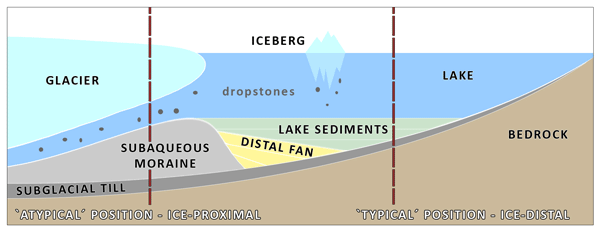
The research focuses on overdeepenings in the former Rhine glacier domain north from Lake Constance in southwestern Germany. We expand the current knowledge of the Quaternary stratigraphy of the Lake Constance Amphitheatre by revealing two new drill cores, both reaching the quaternary base of two different overdeepened basins. As a result, we show that our investigated sediment successions are quite atypical for alpine foreland overdeepenings.
Charlotte E. Engelmann, Frank Preusser, Alexander Fülling, Jakob Wilk, Elisabeth Eiche, Dennis Quandt, Stefan Hergarten, and Jan H. Blöthe
E&G Quaternary Sci. J., 74, 235–262, https://doi.org/10.5194/egqsj-74-235-2025, https://doi.org/10.5194/egqsj-74-235-2025, 2025
Short summary
Short summary
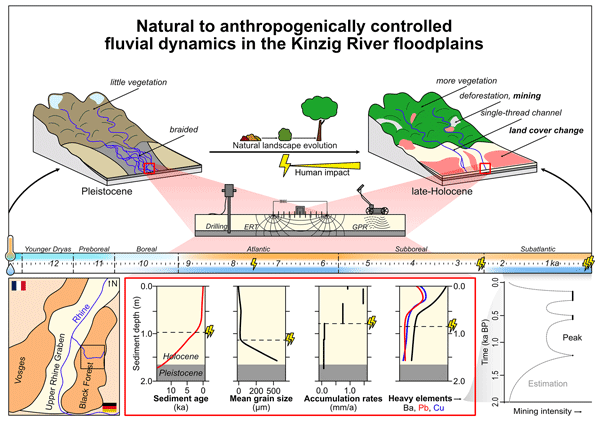
It is unclear since when and how meso-scale central European river systems have been dominated by human instead of natural influences. Here, the floodplain sediments of the Kinzig River, southwestern Germany, were studied as they recorded natural and human landscape changes. Sediment deposition phases were found, the modern phase of which coincides with increased deposition and heavy metal contaminations that correlate with mining records, indicating that the river system has shifted intensely over 1000 years.
Madhurima Marik, Elena Serra, Gilles Rixhon, and Frank Preusser
E&G Quaternary Sci. J., 74, 169–192, https://doi.org/10.5194/egqsj-74-169-2025, https://doi.org/10.5194/egqsj-74-169-2025, 2025
Short summary
Short summary
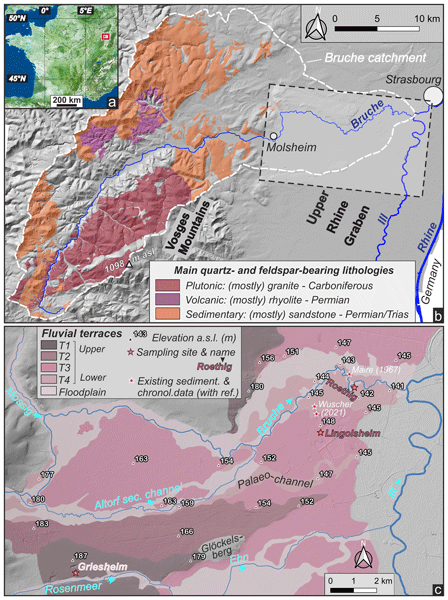
This study examines the evolution of the lower Bruche River valley in north-eastern France through its fluvial terraces, reflecting past river dynamics and environmental changes. Terrace formations are dated using luminescence to ~ 12–14 ka, ~ 27–35 ka, and at least 200 ka. Methodological improvements over conventional luminescence dating techniques are also discussed and refined in this study.
Felix Martin Hofmann and Frank Preusser
E&G Quaternary Sci. J., 74, 1–35, https://doi.org/10.5194/egqsj-74-1-2025, https://doi.org/10.5194/egqsj-74-1-2025, 2025
Short summary
Short summary
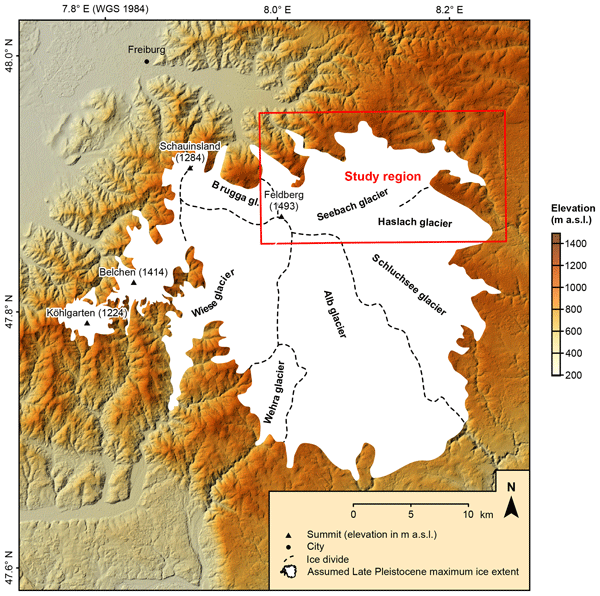
Previous reconstructions conclude that the southern Black Forest, south-west Germany, temporarily hosted four ice caps during the Late Pleistocene (129 000–11 700 years before present). This work reviews existing studies on glacial landforms north-east of its highest summit, Feldberg (1493 m above sea level), in the light of new observations. Whilst this study largely confirms previous work, we reject and newly describe several glacial landforms.
Alexander Fülling, Hans Rudolf Graf, Felix Martin Hofmann, Daniela Mueller, and Frank Preusser
E&G Quaternary Sci. J., 73, 203–216, https://doi.org/10.5194/egqsj-73-203-2024, https://doi.org/10.5194/egqsj-73-203-2024, 2024
Short summary
Short summary
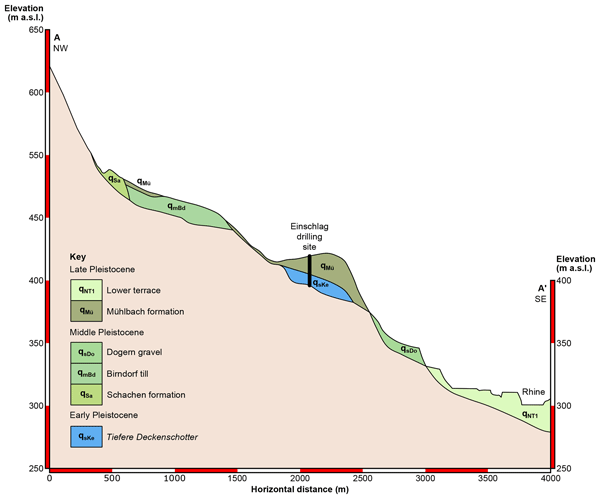
The Mühlbach series has been given as evidence for a Late Pliocene/Early Pleistocene Aare–Rhine fluvial system in northern Switzerland and southwest Germany. We show that these deposits represent a variety of different units. At the type location, luminescence dating indicates an age of 55 ka, and we interpret the deposits as slope reworking. Beside methodological implications, our studies recommend caution regarding the interpretation of stratigraphic units for which limited data are available.
Bennet Schuster, Lukas Gegg, Sebastian Schaller, Marius W. Buechi, David C. Tanner, Ulrike Wielandt-Schuster, Flavio S. Anselmetti, and Frank Preusser
Sci. Dril., 33, 191–206, https://doi.org/10.5194/sd-33-191-2024, https://doi.org/10.5194/sd-33-191-2024, 2024
Short summary
Short summary
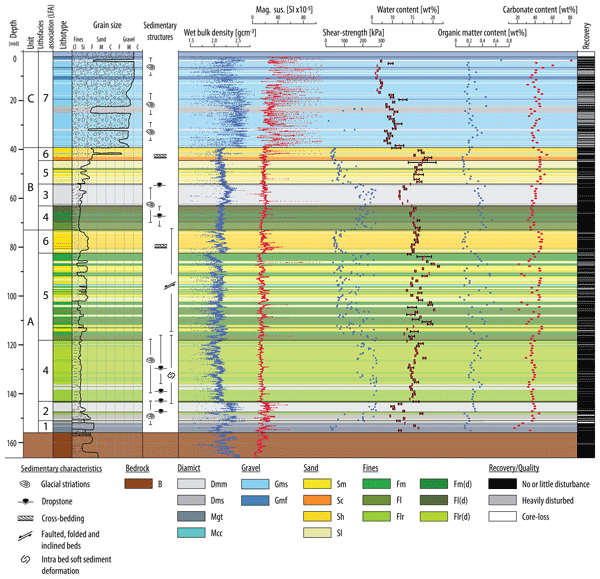
The Tannwald Basin, explored by drilling and formed by repeated advances of the Rhine Glacier, reveals key geological insights. Ice-contact sediments and evidence of deformation highlight gravitational and glaciotectonic processes. ICDP DOVE 5068_1_C core data define lithofacies associations, reflecting basin infill cycles, marking at least three distinct glacial advances. Integrating these findings aids understanding the broader glacial evolution of the Lake Constance amphitheater.
Felix Martin Hofmann, Claire Rambeau, Lukas Gegg, Melanie Schulz, Martin Steiner, Alexander Fülling, Laëtitia Léanni, Frank Preusser, and ASTER Team
Geochronology, 6, 147–174, https://doi.org/10.5194/gchron-6-147-2024, https://doi.org/10.5194/gchron-6-147-2024, 2024
Short summary
Short summary
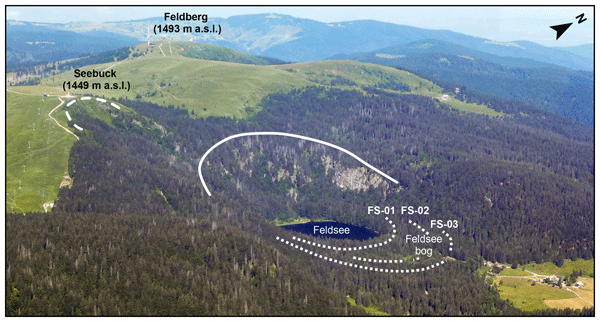
We determined 10Be concentrations in moraine boulder surfaces in the southern Black Forest, SW Germany. We applied three independent dating methods to younger lake sediments. With the aid of independent age datasets, we calculated the growth of 10Be concentrations in moraine boulder surfaces.
Lea Schwahn, Tabea Schulze, Alexander Fülling, Christian Zeeden, Frank Preusser, and Tobias Sprafke
E&G Quaternary Sci. J., 72, 1–21, https://doi.org/10.5194/egqsj-72-1-2023, https://doi.org/10.5194/egqsj-72-1-2023, 2023
Short summary
Short summary
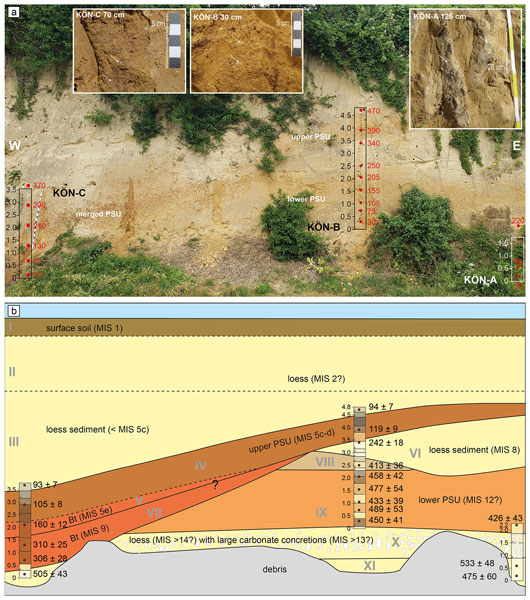
The loess sequence of Köndringen, Upper Rhine Graben, comprises several glacial–interglacial cycles. It has been investigated using a multi-method approach including the measurement of colour, grain size, organic matter, and carbonate content. The analyses reveal that the sequence comprises several fossil soils and layers of reworked soil material. According to luminescence dating, it reaches back more than 500 000 years.
Lukas Gegg and Frank Preusser
E&G Quaternary Sci. J., 72, 23–36, https://doi.org/10.5194/egqsj-72-23-2023, https://doi.org/10.5194/egqsj-72-23-2023, 2023
Short summary
Short summary
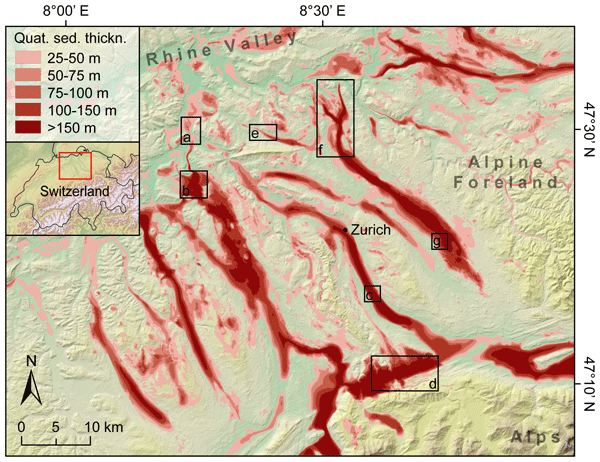
Erosion processes below glacier ice have carved large and deep basins in the landscapes surrounding mountain ranges as well as polar regions. With our comparison, we show that these two groups of basins are very similar in their shapes and sizes. However, open questions still remain especially regarding the sediments that later fill up these basins. We aim to stimulate future research and promote exchange between researchers working around the Alps and the northern central European lowlands.
Flavio S. Anselmetti, Milos Bavec, Christian Crouzet, Markus Fiebig, Gerald Gabriel, Frank Preusser, Cesare Ravazzi, and DOVE scientific team
Sci. Dril., 31, 51–70, https://doi.org/10.5194/sd-31-51-2022, https://doi.org/10.5194/sd-31-51-2022, 2022
Short summary
Short summary
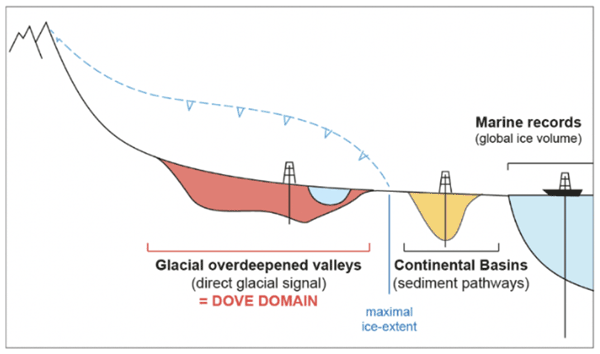
Previous glaciations eroded below the ice deep valleys in the Alpine foreland, which, with their sedimentary fillings, witness the timing and extent of these glacial advance–retreat cycles. Drilling such sedimentary sequences will thus provide well-needed evidence in order to reconstruct the (a)synchronicity of past ice advances in a trans-Alpine perspective. Eventually these data will document how the Alpine foreland was shaped and how the paleoclimate patterns varied along and across the Alps.
Mubarak Abdulkarim, Stoil Chapkanski, Damien Ertlen, Haider Mahmood, Edward Obioha, Frank Preusser, Claire Rambeau, Ferréol Salomon, Marco Schiemann, and Laurent Schmitt
E&G Quaternary Sci. J., 71, 191–212, https://doi.org/10.5194/egqsj-71-191-2022, https://doi.org/10.5194/egqsj-71-191-2022, 2022
Short summary
Short summary
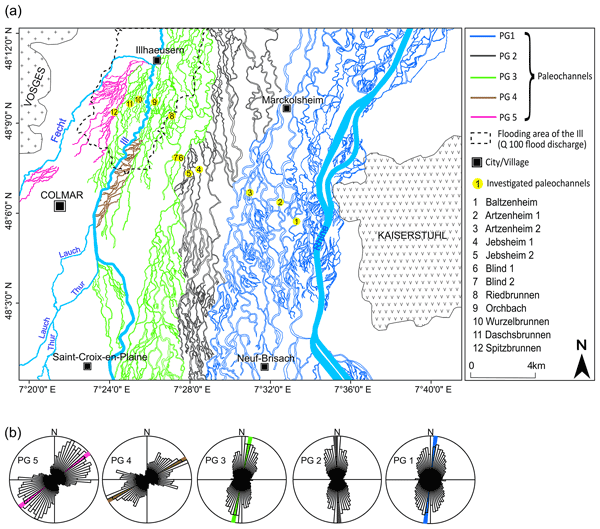
We used a combination of remote sensing, field investigations, and laboratory analysis to map and characterize abandoned river channels within the French Upper Rhine alluvial plain. Our results show five major paleochannel groups with significant differences in their pattern, morphological characteristics, and sediment filling. The formation of these paleochannel groups is attributed to significant changes in environmental processes in the area during the last ~ 11 700 years.
Tabea Schulze, Lea Schwahn, Alexander Fülling, Christian Zeeden, Frank Preusser, and Tobias Sprafke
E&G Quaternary Sci. J., 71, 145–162, https://doi.org/10.5194/egqsj-71-145-2022, https://doi.org/10.5194/egqsj-71-145-2022, 2022
Short summary
Short summary
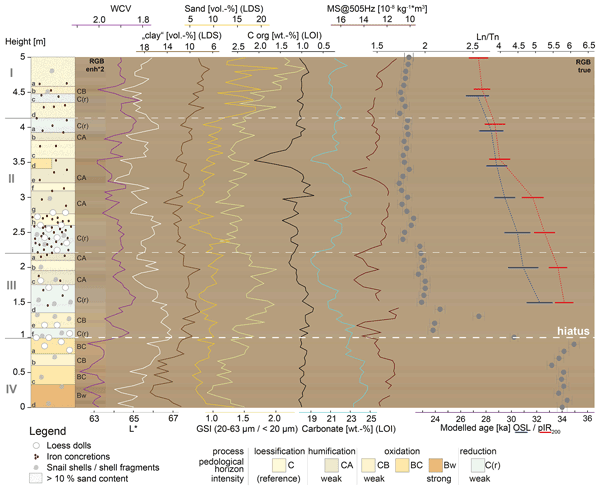
A loess sequence in SW Germany was investigated using a high-resolution multi-method approach. It dates to 34–27 ka and comprises layers of initial soil formation. Drier conditions and a different atmospheric circulation pattern during the time of deposition are expected as the soil layers are less strongly developed compared to similar horizons further north. Dust accumulation predates the last advance of Alpine glaciers, and no loess deposition is recorded for the time of maximum ice extent.
Elena Serra, Pierre G. Valla, Romain Delunel, Natacha Gribenski, Marcus Christl, and Naki Akçar
Earth Surf. Dynam., 10, 493–512, https://doi.org/10.5194/esurf-10-493-2022, https://doi.org/10.5194/esurf-10-493-2022, 2022
Short summary
Short summary
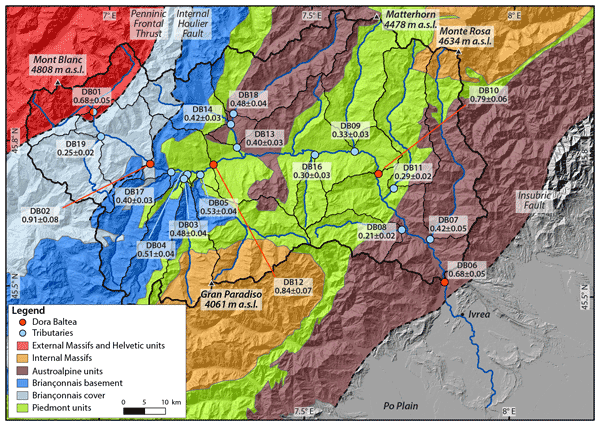
Alpine landscapes are transformed by several erosion processes. 10Be concentrations measured in river sediments at the outlet of a basin represent a powerful tool to quantify how fast the catchment erodes. We measured erosion rates within the Dora Baltea catchments (western Italian Alps). Our results show that erosion is governed by topography, bedrock resistance and glacial imprint. The Mont Blanc massif has the highest erosion and therefore dominates the sediment flux of the Dora Baltea river.
Frank Preusser, Markus Fuchs, and Christine Thiel
E&G Quaternary Sci. J., 70, 201–203, https://doi.org/10.5194/egqsj-70-201-2021, https://doi.org/10.5194/egqsj-70-201-2021, 2021
Frank Preusser, Markus Fuchs, and Christine Thiel
DEUQUA Spec. Pub., 3, 1–3, https://doi.org/10.5194/deuquasp-3-1-2021, https://doi.org/10.5194/deuquasp-3-1-2021, 2021
Cited articles
Abbott, P. M. and Davies, S. M.: Volcanism and the Greenland ice-cores: the tephra record, Earth Sci. Rev., 115, 173–191, https://doi.org/10.1016/j.earscirev.2012.09.001, 2012.
Aitken, M. J.: Thermoluminescence dating: Past progress and future trends, Nucl. Tracks Rad. Meas., 10, 3–6, https://doi.org/10.1016/0735-245X(85)90003-1, 1985.
Aitken, M. J.: Introduction to Optical Dating: The Dating of Quaternary Sediments by the Use of Photon-stimulated Luminescence, Clarendon Press, 282 pp., ISBN 978-0-19-158927-0, 1998.
Alcalá-Reygosa, J., Palacios, D., Schimmelpfennig, I., Vázquez-Selem, L., García-Sancho, L., Franco-Ramos, O., Villanueva, J., Zamorano, J. J., Aumaître, G., Bourlès, D., and Keddadouche, K.: Dating late Holocene lava flows in Pico de Orizaba (Mexico) by means of in situ-produced cosmogenic 36Cl, lichenometry and dendrochronology, Quat. Geochronol., 47, 93–106, https://doi.org/10.1016/j.quageo.2018.05.011, 2018.
Aldrich, L. T. and Nier, A. O.: Argon-40 in Potassium Minerals, Phys. Rev., 74, 876–877, https://doi.org/10.1103/PhysRev.74.876, 1948.
Allegre, C. L.: 230Th dating of volcanic rocks: A comment, Earth Planet. Sci. Lett., 5, 209–210, https://doi.org/10.1016/S0012-821X(68)80042-1, 1968.
Alves, E. Q., Macario, K., Ascough, P., and Bronk Ramsey, C.: The Worldwide Marine Radiocarbon Reservoir Effect: Definitions, Mechanisms, and Prospects, Rev. Geophys., 56, 278–305, https://doi.org/10.1002/2017RG000588, 2018.
Auclair, M., Lamothe, M., and Huot, S.: Measurement of anomalous fading for feldspar IRSL using SAR, Radiat. Meas., 37, 487–492, https://doi.org/10.1016/S1350-4487(03)00018-0, 2003.
Avram, A., Constantin, D., Veres, D., Kelemen, S., Obreht, I., Hambach, U., Marković, S. B., and Timar-Gabor, A.: Testing polymineral post-IR IRSL and quartz SAR-OSL protocols on Middle to Late Pleistocene loess at Batajnica, Serbia, Boreas, 49, 615–633, https://doi.org/10.1111/bor.12442, 2020.
Baksi, A. K.: Geochronological studies on whole-rock basalts, Deccan Traps, India: evaluation of the timing of volcanism relative to the K-T boundary, Earth Planet. Sci. Lett., 121, 43–56, https://doi.org/10.1016/0012-821X(94)90030-2, 1994.
Balco, G., Briner, J., Finkel, R. C., Rayburn, J. A., Ridge, J. C., and Schaefer, J. M.: Regional beryllium-10 production rate calibration for late-glacial northeastern North America, Quat. Geochronol., 4, 93–107, https://doi.org/10.1016/j.quageo.2008.09.001, 2009.
Balco, G., Stone, J., Śliwiński, M., and Todd, C.: Features of the glacial history of the Transantarctic Mountains inferred from cosmogenic 26Al, 10Be and 21Ne concentrations in bedrock surfaces, Antarct. Sci., 26, 708–723, https://doi.org/10.1017/S0954102014000261, 2014.
Ballarini, M., Wallinga, J., Wintle, A., and Bos, A.: A modified SAR protocol for optical dating of individual grains from young quartz samples, Radiat. Meas., 42, 360–369, https://doi.org/10.1016/j.radmeas.2006.12.016, 2007.
Balter-Kennedy, A., Bromley, G., Balco, G., Thomas, H., and Jackson, M. S.: A 14.5-million-year record of East Antarctic Ice Sheet fluctuations from the central Transantarctic Mountains, constrained with cosmogenic 3He, 10Be, 21Ne, and 26Al, The Cryosphere, 14, 2647–2672, https://doi.org/10.5194/tc-14-2647-2020, 2020.
Balter-Kennedy, A., Schaefer, J. M., Schwartz, R., Lamp, J. L., Penrose, L., Middleton, J., Hanley, J., Tibari, B., Blard, P.-H., Winckler, G., Hidy, A. J., and Balco, G.: Cosmogenic 10Be in pyroxene: laboratory progress, production rate systematics, and application of the 10Be–3He nuclide pair in the Antarctic Dry Valleys, Geochronology, 5, 301–321, https://doi.org/10.5194/gchron-5-301-2023, 2023.
Becquerel, H.: Émission de radiations nouvelles par l'uranium métallique, Gauthier-Villars, Paris, France, https://www.academie-sciences.fr/pdf/dossiers/Becquerel/Becquerel_pdf/CR1896_p1086.pdf (last access: 14 September 2025), 1896.
Berger, G. W.: The use of glass for dating volcanic ash by thermoluminescence, J. Geophys. Res.-Sol. Ea., 96, 19705–19720, https://doi.org/10.1029/91JB01899, 1991.
Berger, G. W.: Dating volcanic ash by use of thermoluminescence, Geology, 20, 11–14, https://doi.org/10.1130/0091-7613(1992)020<0011:DVABUO>2.3.CO;2, 1992.
Bietak, M.: Science versus Archaeology: Problems and Consequences of High Aegean Chronology, in: The synchronisation of civilisations in the Eastern Mediterranean in the second millennium B.C.: 2, Proceedings of the SCIEM 2000 – EuroConference, Haindorf, 23–34, ISBN 3-7001-3176-3, 2003.
Bietak, M.: Radiocarbon and the date of the Thera eruption, Antiquity, 88, 277–282, https://doi.org/10.1017/S0003598X00050389, 2014.
Biondi, F.: Dendrochronology, Volcanic Eruptions, in: Encyclopedia of Earth Sciences Series, Springer, 1–11, https://doi.org/10.1007/978-94-007-6326-5_24-1, 2014.
Biswas, R., Williams, M., Raj, R., Juyal, N., and Singhvi, A.: Methodological studies on luminescence dating of volcanic ashes, Quat. Geochronol., 17, 14–25, https://doi.org/10.1016/j.quageo.2013.03.004, 2013.
Biswas, R., Toyoda, S., Takada, M., and Shitaoka, Y.: Multiple approaches to date Japanese marker tephras using optical and ESR methods, Quat. Geochronol., 30, 350–356, https://doi.org/10.1016/j.quageo.2015.01.004, 2015.
Blard, P.-H.: Cosmogenic 3He in terrestrial rocks: A review, Chem. Geol., 586, 120543, https://doi.org/10.1016/j.chemgeo.2021.120543, 2021.
Blechschmidt, I., Matter, A., Preusser, F., and Rieke-Zapp, D.: Monsoon triggered formation of Quaternary alluvial megafans in the interior of Oman, Geomorphology, 110, 128–139, https://doi.org/10.1016/j.geomorph.2009.04.002, 2009.
Blockley, S. P. E., Lane, C. S., Hardiman, M., Rasmussen, S. O., Seierstad, I. K., Steffensen, J. P., Svensson, A., Lotter, A. F., Turney, C. S. M., and Bronk Ramsey, C.: Synchronisation of palaeoenvironmental records over the last 60 000 years, and an extended INTIMATE1 event stratigraphy to 48 000 b2k, Quat. Sci. Rev., 36, 2–10, https://doi.org/10.1016/j.quascirev.2011.09.017, 2012.
Bogaard, P. V. D. and Schmincke, H.-U.: Laacher See Tephra: A widespread isochronous late Quaternary tephra layer in central and northern Europe, Geol. Soc. Am. Bull., 96, 1554–1571, https://doi.org/10.1130/0016-7606(1985)96<1554:LSTAWI>2.0.CO;2, 1985.
Bonde, A., Murray, A., and Friedrich, W. L.: Santorini: Luminescence dating of a volcanic province using quartz?, Quat. Sci. Rev., 20, 789–793, https://doi.org/10.1016/S0277-3791(00)00034-2, 2001.
Bösken, J. J. and Schmidt, C.: Direct and indirect luminescence dating of tephra: A review, J. Quat. Sci., 35, 39–53, https://doi.org/10.1002/jqs.3160, 2020.
Bourdon, B. and Sims, K. W. W.: U-series Constraints on Intraplate Basaltic Magmatism, Rev. Mineral. Geochem., 52, 215–254, https://doi.org/10.2113/0520215, 2003.
Bourdon, B., Zindler, A., and Wörner, G.: Evolution of the Laacher See magma chamber: Evidence from SIMS and TIMS measurements of U–Th disequilibria in minerals and glasses, Earth Planet. Sci. Lett., 126, 75–90, https://doi.org/10.1016/0012-821X(94)90243-7, 1994.
Bourdon, B., Henderson, G. M., Lundstrom, C. C., and Turner, S.: Uranium-series Geochemistry, Walter de Gruyter GmbH & Co KG, 676 pp., ISBN 978-1-5015-0930-8, 2018.
Bowen, N. L.: The Reaction Principle in Petrogenesis, J. Geol., 30, 177–198, https://doi.org/10.1086/622871, 1922.
Brauer, A., Endres, C., Günter, C., Litt, T., Stebich, M., and Negendank, J. F. W.: High resolution sediment and vegetation responses to Younger Dryas climate change in varved lake sediments from Meerfelder Maar, Germany, Quat. Sci. Rev., 18, 321–329, https://doi.org/10.1016/S0277-3791(98)00084-5, 1999.
Brock, F., Higham, T., Ditchfield, P., and Bronk Ramsey, C.: Current Pretreatment Methods for AMS Radiocarbon Dating at the Oxford Radiocarbon Accelerator Unit (ORAU), Radiocarbon, 52, 103–112, https://doi.org/10.1017/S0033822200045069, 2010.
Bromley, G. R. M., Thouret, J.-C., Schimmelpfennig, I., Mariño, J., Valdivia, D., Rademaker, K., del Pilar Vivanco Lopez, S., Team, A., Aumaître, G., Bourlès, D., and Keddadouche, K.: In situ cosmogenic 3He and 36Cl and radiocarbon dating of volcanic deposits refine the Pleistocene and Holocene eruption chronology of SW Peru, Bull. Volcanol., 81, 64, https://doi.org/10.1007/s00445-019-1325-6, 2019.
Bronk Ramsey, C., Manning, S. W., and Galimberti, M.: Dating the Volcanic Eruption at Thera, Radiocarbon, 46, 325–344, https://doi.org/10.1017/S0033822200039631, 2004.
Brousse, R., Maury, R., and Santoire, J. P.: L'Age de la coulée du Tartaret, C. R. Acad. Sci. Paris, Sér. D, 282, 531–532, 1976.
Brown, S., Sparks, R., Mee, K., Vye-Brown, C., Ilyinskaya, E., Jenkins, S., and Loughlin, S.: Appendix B Country and regional profiles of volcanic hazard and risk, in: Global Volcanic Hazards and Risk, Cambridge University Press, Cambridge, 1–789, https://doi.org/10.1017/cbo9781316276273, 2015.
Bruins, H. J. and van der Plicht, J.: The Minoan Thera eruption predates Pharaoh Ahmose: Radiocarbon dating of Egyptian 17th to early 18th Dynasty museum objects, PLOS ONE, 20, https://doi.org/10.1371/journal.pone.0330702, 2025.
Busacca, A. J., Nelstead, K. T., McDonald, E. V., and Purser, M. D.: Correlation of Distal Tephra Layers in Loess in the Channeled Scabland and Palouse of Washington state, Quat. Res., 37, 281–303, https://doi.org/10.1016/0033-5894(92)90067-S, 1992.
Buylaert, J., Jain, M., Murray, A. S., Thomsen, K. J., Thiel, C., and Sohbati, R.: A robust feldspar luminescence dating method for Middle and Late Pleistocene sediments, Boreas, 41, 435–451, https://doi.org/10.1111/j.1502-3885.2012.00248.x, 2012.
Buylaert, J. P., Vandenberghe, D., Murray, A. S., Huot, S., De Corte, F., and Van Den Haute, P.: Luminescence dating of old (> 70 ka) Chinese loess: A comparison of single-aliquot OSL and IRSL techniques, Quat. Geochronol., 2, 9–14, https://doi.org/10.1016/j.quageo.2006.05.028, 2007.
Buylaert, J.-P., Murray, A. S., Thomsen, K. J., and Jain, M.: Testing the potential of an elevated temperature IRSL signal from K-feldspar, Radiat. Meas., 44, 560–565, https://doi.org/10.1016/j.radmeas.2009.02.007, 2009.
Calderoni, G. and Turi, B.: Major Constraints on the Use of Radiocarbon Dating for Tephrochronology, Quatern. Int., 47–48, 153–159, https://doi.org/10.1016/S1040-6182(97)00082-7, 1998.
Camus, G., Herve, A., Kieffer, G., Mergoil, J., and Vincent, P. M.: Mise au point sur la dynamisme at la chronologie des volcans holocènes de la région de Besse-en-Chandesse, C. R. Acad. Sci. Paris, 277, 629–632, 1973.
Cañón-Tapia, E.: Reappraisal of the significance of volcanic fields, J. Volcanol. Geotherm. Res., 310, 26–38, https://doi.org/10.1016/j.jvolgeores.2015.11.010, 2016.
Capra, L., Macías, J. L., Espíndola, J. M., and Siebe, C.: Holocene plinian eruption of La Virgen volcano, Baja California, Mexico, J. Volcanol. Geotherm. Res., 80, 239–266, https://doi.org/10.1016/S0377-0273(97)00049-8, 1998.
Cerrai, E.: Il Metodo ionio/urano per la determinazione dell'eta' di minerali vulcanici recenti, Rend. Soc. Mineral. Ital., 21, 47–62, 1965.
Cersoy, S., Zazzo, A., Rofes, J., Tresset, A., Zirah, S., Gauthier, C., Kaltnecker, E., Thil, F., and Tisnerat-Laborde, N.: Radiocarbon dating minute amounts of bone (3–60 mg) with ECHoMICADAS, Sci. Rep., 7, 7141, https://doi.org/10.1038/s41598-017-07645-3, 2017.
Cheng, H., Lawrence Edwards, R., Shen, C.-C., Polyak, V. J., Asmerom, Y., Woodhead, J., Hellstrom, J., Wang, Y., Kong, X., Spötl, C., Wang, X., and Calvin Alexander, E.: Improvements in 230Th dating, 230Th and 234U half-life values, and U–Th isotopic measurements by multi-collector inductively coupled plasma mass spectrometry, Earth Planet. Sci. Lett., 371–372, 82–91, https://doi.org/10.1016/j.epsl.2013.04.006, 2013.
Chernyshev, I. V., Lebedev, V. A., and Arakelyants, M. M.: K-Ar dating of quaternary volcanics: Methodology and interpretation of results, Petrology, 14, 62–80, https://doi.org/10.1134/S0869591106010061, 2006.
Clark-Balzan, L., May, V. R., and Preusser, F.: Luminescence Characteristics of Intraplate-Derived Olivines, Geochronometria, 48, 73–94, https://doi.org/10.2478/geochr-2021-0006, 2021.
Condomines, M.: Dating recent volcanic rocks through 230Th–238U disequilibrium in accessory minerals: Example of the Puy de Dôme (French Massif Central), Geology, 25, 375–378, https://doi.org/10.1130/0091-7613(1997)025<0375:DRVRTT>2.3.CO;2, 1997.
Condomines, M., Gauthier, P.-J., and Sigmarsson, O.: Timescales of Magma Chamber Processes and Dating of Young Volcanic Rocks, Rev. Mineral. Geochem., 52, 125–174, https://doi.org/10.2113/0520125, 2003.
Connor, C. B., Stamatakos, J. A., Ferrill, D. A., Hill, B. E., Ofoegbu, G. I., Conway, F. M., Sagar, B., and Trapp, J.: Geologic factors controlling patterns of small-volume basaltic volcanism: Application to a volcanic hazards assessment at Yucca Mountain, Nevada, J. Geophys. Res.-Sol. Ea., 105, 417–432, https://doi.org/10.1029/1999JB900353, 2000.
Cox, A.: Analysis of Present Geomagnetic Field for Comparison with Paleomagnetic Results, J. Geomag. Geoelec., 13, 101–112, https://doi.org/10.5636/jgg.13.101, 1962.
Craig, H.: The Natural Distribution of Radiocarbon and the Exchange Time of Carbon Dioxide Between Atmosphere and Sea, Tellus, 9, 1–17, https://doi.org/10.1111/j.2153-3490.1957.tb01848.x, 1957.
Curie, M. A.: du texte: Recherches sur les substances radioactives/par Mme Sklodowska Curie, Gauthier-Villars, Paris, ark:/12148/btv1b8626316v, 1903.
Daniels, F., Boyd, C. A., and Saunders, D. F.: Thermoluminescence as a research tool, Science, 117, 343–349, https://doi.org/10.1126/science.117.3040.343, 1953.
Danišík, M., Shane, P., Schmitt, A. K., Hogg, A., Santos, G. M., Storm, S., Evans, N. J., Keith Fifield, L., and Lindsay, J. M.: Re-anchoring the late Pleistocene tephrochronology of New Zealand based on concordant radiocarbon ages and combined 238U
Danišík, M., Schmitt, A. K., Stockli, D. F., Lovera, O. M., Dunkl, I., and Evans, N. J.: Application of combined U–Th-disequilibrium/U–Pb and (U–Th)
Davies, S. M.: Cryptotephras: the revolution in correlation and precision dating, J. Quat. Sci., 30, 114–130, https://doi.org/10.1002/jqs.2766, 2015.
Davies, S. M., Abbott, P. M., Pearce, N. J. G., Wastegård, S., and Blockley, S. P. E.: Integrating the INTIMATE records using tephrochronology: rising to the challenge, Quat. Sci. Rev., 36, 11–27, https://doi.org/10.1016/j.quascirev.2011.04.005, 2012.
Deevey, E. S., Gross, M. S., Hutchinson, G. E., and Kraybill, H. L.: The natural c14 contents of materials from hard-water lakes, P. Natl. Acad. Sci. USA, 40, 285–288, https://doi.org/10.1073/pnas.40.5.285, 1954.
Delunel, R., Bourlès, D. L., van der Beek, P. A., Schlunegger, F., Leya, I., Masarik, J., and Paquet, E.: Snow shielding factors for cosmogenic nuclide dating inferred from long-term neutron detector monitoring, Quat. Geochronol., 24, 16–26, https://doi.org/10.1016/j.quageo.2014.07.003, 2014.
Doll, P., Eaves, S. R., Kennedy, B. M., Blard, P.-H., Nichols, A. R. L., Leonard, G. S., Townsend, D. B., Cole, J. W., Conway, C. E., Baldwin, S., Fénisse, G., Zimmermann, L., and Tibari, B.: Cosmogenic 3He chronology of postglacial lava flows at Mt Ruapehu, Aotearoa / New Zealand, Geochronology, 6, 365–395, https://doi.org/10.5194/gchron-6-365-2024, 2024.
Duller, G. A. T.: A new method for the analysis of infrared stimulated luminescence data from potassium feldspars, Radiat. Meas., 23, 281–285, https://doi.org/10.1016/1350-4487(94)90053-1, 1994.
Duller, G. A. T.: Luminescence dating using single aliquots: methods and applications, Radiat. Meas., 24, 217–226, https://doi.org/10.1016/1350-4487(95)00150-D, 1995.
Duller, G. A. T.: What date is it? Should there be an agreed datum for luminescence ages?, Ancient TL, 29, 1–3, https://doi.org/10.26034/la.atl.2011.442, 2011.
Dunai, T. J.: Cosmogenic Nuclides: Principles, Concepts and Applications in the Earth Surface Sciences, Cambridge University Press, 199 pp., ISBN 978-1-139-48718-4, 2010.
Dunai, T. J. and Stuart, F. M.: Reporting of cosmogenic nuclide data for exposure age and erosion rate determinations, Quat. Geochronol., 4, 437–440, https://doi.org/10.1016/j.quageo.2009.04.003, 2009.
Dutton, A., Rubin, K. H., McLean, N., Bowring, J., Bard, E., Edwards, R. L., Henderson, G. M., Reid, M. R., Richards, D. A., Sims, K. W. W., Walker, J. D., and Yokoyama, Y.: Data reporting standards for publication of U-series data for geochronology and timescale assessment in the earth sciences, Quat. Geochronol., 39, 142–149, https://doi.org/10.1016/j.quageo.2017.03.001, 2017.
Erdil, P., Kuitems, M., Scifo, A., Brown, D., and Dee, M. W.: Investigating potential radiocarbon anomalies around the time of the Minoan eruption of Thera: A new high-resolution dataset from Groningen, Radiocarbon, 1–17, https://doi.org/10.1017/RDC.2025.10186, 2026.
Espanon, V. R., Honda, M., and Chivas, A. R.: Cosmogenic 3He and 21Ne surface exposure dating of young basalts from Southern Mendoza, Argentina, Quat. Geochronol., 19, 76–86, https://doi.org/10.1016/j.quageo.2013.09.002, 2014.
Evin, J.: Les datations par le radiocarbone en géologie et en archéologie, Fiabilité de la méthode selon l'origine et l'état des matériaux, Docum. Lab. Géol. Lyon, 122, 3–99, https://www.persee.fr/doc/geoly_0750-6635_1992_mon_122_1 (last access: 27 October 2025), 1992.
Fabel, D., Stroeven, A. P., Harbor, J., Kleman, J., Elmore, D., and Fink, D.: Landscape preservation under Fennoscandian ice sheets determined from in situ produced 10Be and 26Al, Earth Planet. Sci. Lett., 201, 397–406, https://doi.org/10.1016/S0012-821X(02)00714-8, 2002.
Faïn, J., Miallier, D., Montret, M., and Sanzelle, S.: Zircon dating: Regeneration and evaluation of the external dose, Int. J. Radiat. Appl. Instrum. Part D, 14, 333–337, https://doi.org/10.1016/1359-0189(88)90085-4, 1988.
Faïn, J., Erramli, H., Miallier, D., Montret, M., and Sanzelle, S.: Datation par Thermoluminescence d'un Appareil Volcanique Trachytique: Le Puy de Dôme, in: Datation et Charactérisation des Millieux Pléistocènes, Centre National de la Recherche Scientifique, Paris, 53–62, ISBN 2-222-094567-3, 1991.
Farley, K. A.: (U–Th)
Farley, K. A., Wolf, R. A., and Silver, L. T.: The effects of long alpha-stopping distances on (U–Th)
Farley, K. A., Kohn, B. P., and Pillans, B.: The effects of secular disequilibrium on (U–Th)
Fattahi, M. and Stokes, S.: Extending the time range of luminescence dating using red TL (RTL) from volcanic quartz, Radiat. Meas., 32, 479–485, https://doi.org/10.1016/S1350-4487(00)00105-0, 2000.
Fattahi, M. and Stokes, S.: Dating volcanic and related sediments by luminescence methods: a review, Earth Sci. Rev., 62, 229–264, https://doi.org/10.1016/S0012-8252(02)00159-9, 2003.
Fenton, C., Webb, R., Pearthree, P., Cerling, T., Poreda, and Nash, B.: Cosmogenic 3He dating of western Grand Canyon basalts: implications for Quaternary incision of the Colorado River, in: Colorado River origin and evolution, Grand Canyon Association, Grand Canyon, 147–152, ISBN 9780938216797, 2004.
Fenton, C. R., Niedermann, S., Goethals, M. M., Schneider, B., and Wijbrans, J.: Evaluation of cosmogenic 3He and 21Ne production rates in olivine and pyroxene from two Pleistocene basalt flows, western Grand Canyon, AZ, USA, Quat. Geochronol., 4, 475–492, https://doi.org/10.1016/j.quageo.2009.08.002, 2009.
Féraud, G. and Courtillot, V.: Comment on: “did Deccan volcanism pre-date the Cretaceous-Tertiary transition?”, Earth Planet. Sci. Lett., 122, 259–262, https://doi.org/10.1016/0012-821X(94)90068-X, 1994.
Fleck, R. J., Hagstrum, J. T., Calvert, A. T., Evarts, R. C., and Conrey, R. M.: 40Ar
Fleischer, R. L., Price, P. B., and Walker, R. M.: Fission-track ages of zircons, J. Geophys. Res., 69, 4885–4888, https://doi.org/10.1029/JZ069i022p04885, 1964.
Forman, S. L., Pierson, J., Smith, R. P., Hackett, W. R., and Valentine, G.: Assessing the accuracy of thermoluminescence for dating baked sediments beneath late Quaternary lava flows, Snake River Plain, Idaho, J. Geophys. Res.-Sol. Ea., 99, 15569–15576, https://doi.org/10.1029/94JB00806, 1994.
Friedrich, R., Kromer, B., Wacker, L., Olsen, J., Remmele, S., Lindauer, S., Land, A., and Pearson, C.: A New Annual 14C Dataset for Calibrating the Thera Eruption, Radiocarbon, 62, 953–961, https://doi.org/10.1017/RDC.2020.33, 2020.
Friedrich, W. L., Kromer, B., Friedrich, M., Heinemeier, J., Pfeiffer, T., and Talamo, S.: Santorini Eruption Radiocarbon Dated to 1627–1600 B.C., Science, 312, 548–548, https://doi.org/10.1126/science.1125087, 2006.
Fukuoka, T. and Kigoshi, K.: Discordant Io-ages and the uranium and thorium distribution between zircon and host rocks, Geochem. J., 8, 117–122, https://doi.org/10.2343/geochemj.8.117, 1974.
Galbraith, R. F. and Roberts, R. G.: Statistical aspects of equivalent dose and error calculation and display in OSL dating: An overview and some recommendations, Quat. Geochronol., 11, 1–27, https://doi.org/10.1016/j.quageo.2012.04.020, 2012.
Ganzawa, Y. and Maeda, M.: 390–410 °C isothermal red thermoluminescence (IRTL) dating of volcanic quartz using the SAR method, Radiat. Meas., 44, 517–522, https://doi.org/10.1016/j.radmeas.2009.06.005, 2009.
Geyh, M. A.: Bomb Radiocarbon Dating of Animal Tissues and Hair, Radiocarbon, 43, 723–730, https://doi.org/10.1017/S0033822200041382, 2001.
Gill, E.: Potassium/argon age of basalt in floor of Hopkins River, Allansford, SW Victoria, Australia, Vic. Nat., 98, 188–190, 1981.
Gillen, D., Honda, M., Chivas, A. R., Yatsevich, I., Patterson, D. B., and Carr, P. F.: Cosmogenic 21Ne exposure dating of young basaltic lava flows from the Newer Volcanic Province, western Victoria, Australia, Quat. Geochronol., 5, 1–9, https://doi.org/10.1016/j.quageo.2009.08.004, 2010.
Gleadow, A. J. W. and Duddy, I. R.: A natural long-term track annealing experiment for apatite, Nuclear Tracks, 5, 169–174, https://doi.org/10.1016/0191-278X(81)90039-1, 1981.
Gordon, J. E. and Harkness, D. D.: Magnitude and geographic variation of the radiocarbon content in Antarctic marine life: Implications for reservoir corrections in radiocarbon dating, Quaternary Sci. Rev., 11, 697–708, https://doi.org/10.1016/0277-3791(92)90078-M, 1992.
Gosse, J. C. and Phillips, F. M.: Terrestrial in situ cosmogenic nuclides: theory and application, Quaternary Sci. Rev., 20, 1475–1560, https://doi.org/10.1016/S0277-3791(00)00171-2, 2001.
Grün, R.: Amino Acid Racemization Dating, Encyclopedia of Archaeology, 429–433, https://doi.org/10.1016/B978-012373962-9.00006-6, 2008.
Guerin, G.: La thermoluminescence des plagioclases: methode de datation du volcanisme: applications au domaine volcanique francais: Chaine des Puys, mont Dore et Cezallier, Bas Vivarais, Universite Pierre et Marie Curie, https://www.worldcat.org/oclc/38676602 (last access: 24 June 2026), 1983.
Guérin, G. and Visocekas, R.: Volcanic feldspars anomalous fading: Evidence for two different mechanisms, Radiat. Meas., 81, 218–223, https://doi.org/10.1016/j.radmeas.2015.08.009, 2015.
Guilderson, T. P., Reimer, P. J., and Brown, T. A.: The Boon and Bane of Radiocarbon Dating, Science, 307, 362–364, https://doi.org/10.1126/science.1104164, 2005.
Guillou, H., Carracedo, J. C., and Day, S. J.: Dating of the Upper Pleistocene–Holocene volcanic activity of La Palma using the unspiked K–Ar technique, J. Volcanol. Geotherm. Res., 86, 137–149, https://doi.org/10.1016/S0377-0273(98)00074-2, 1998.
Hajdas, I.: Radiocarbon dating and its applications in Quaternary studies, E&G Quaternary Sci. J., 57, 2–24, https://doi.org/10.3285/eg.57.1-2.1, 2008.
Hajdas, I., Ascough, P., Garnett, M. H., Fallon, S. J., Pearson, C. L., Quarta, G., Spalding, K. L., Yamaguchi, H., and Yoneda, M.: Radiocarbon dating, Nat. Rev. Methods Primers, 1, 62, https://doi.org/10.1038/s43586-021-00058-7, 2021.
Hall, V. A. and Pilcher, J. R.: Late-Quaternary Icelandic tephras in Ireland and Great Britain: detection, characterization and usefulness, Holocene, 12, 223–230, https://doi.org/10.1191/0959683602hl538rr, 2002.
Hamilton, W. D., Haselgrove, C., and Gosden, C.: The impact of Bayesian chronologies on the British Iron Age, World Archaeol., 47, 642–660, https://doi.org/10.1080/00438243.2015.1053976, 2015.
Harrison, T. M.: Diffusion of 40Ar in hornblende, Contr. Mineral. Petrol., 78, 324–331, https://doi.org/10.1007/BF00398927, 1982.
Hausback, B. P. and Abrams, M. J.: Plinian eruption of La Virgen Tephra, Volcán Las Tres Virgenes, Baja California Sur, Mexico, Eos, 77, 813–814, 1996.
Haynes, W. (Ed.): CRC Handbook Of Chemistry And Physics, 97th edn., CRC Press, Boca Raton, ISBN 1498754295, 2016.
Heaton, T. J., Köhler, P., Butzin, M., Bard, E., Reimer, R. W., Austin, W. E. N., Ramsey, C. B., Grootes, P. M., Hughen, K. A., Kromer, B., Reimer, P. J., Adkins, J., Burke, A., Cook, M. S., Olsen, J., and Skinner, L. C.: Marine20 – The Marine Radiocarbon Age Calibration Curve (0–55 000 cal BP), Radiocarbon, 62, 779–820, https://doi.org/10.1017/RDC.2020.68, 2020.
Heineke, C., Niedermann, S., Hetzel, R., and Akal, C.: Surface exposure dating of Holocene basalt flows and cinder cones in the Kula volcanic field (Western Turkey) using cosmogenic 3He and 10Be, Quat. Geochronol., 34, 81–91, https://doi.org/10.1016/j.quageo.2016.04.004, 2016.
Higham, T. F. G., Barton, H., Turney, C. S. M., Barker, G., Ramsey, C. B., and Brock, F.: Radiocarbon dating of charcoal from tropical sequences: results from the Niah Great Cave, Sarawak, and their broader implications, J. Quat. Sci., 24, 189–197, https://doi.org/10.1002/jqs.1197, 2009.
Hippe, K.: Constraining processes of landscape change with combined in situ cosmogenic 14C–10Be analysis, Quaternary Sci. Rev., 173, 1–19, https://doi.org/10.1016/j.quascirev.2017.07.020, 2017.
Hogg, A. G., Wilson, C. J. N., Lowe, D. J., Turney, C. S. M., White, P., Lorrey, A. M., Manning, S. W., Palmer, J. G., Bury, S., Brown, J., Southon, J., and Petchey, F.: Wiggle-match radiocarbon dating of the Taupo eruption, Nat. Commun., 10, 4669, https://doi.org/10.1038/s41467-019-12532-8, 2019.
Hogg, A. G., Heaton, T. J., Hua, Q., Palmer, J. G., Turney, C. S., Southon, J., Bayliss, A., Blackwell, P. G., Boswijk, G., Ramsey, C. B., Pearson, C., Petchey, F., Reimer, P., Reimer, R., and Wacker, L.: SHCal20 Southern Hemisphere Calibration, 0–55 000 Years cal BP, Radiocarbon, 62, 759–778, https://doi.org/10.1017/RDC.2020.59, 2020.
Holdaway, R. N., Duffy, B., and Kennedy, B.: Evidence for magmatic carbon bias in 14C dating of the Taupo and other major eruptions, Nat. Commun., 9, 4110, https://doi.org/10.1038/s41467-018-06357-0, 2018.
Holdaway, R. N., Duffy, B., and Kennedy, B.: Reply to “Wiggle-match radiocarbon dating of the Taupo eruption”, Nat. Commun., 10, 4668, https://doi.org/10.1038/s41467-019-12491-0, 2019.
Huntley, D. J. and Lamothe, M.: Ubiquity of anomalous fading in K-feldspars and the measurement and correction for it in optical dating, Can. J. Earth Sci., 38, 1093–1106, https://doi.org/10.1139/e01-013, 2001.
Huntley, D. J. and Lian, O. B.: Some observations on tunnelling of trapped electrons in feldspars and their implications for optical dating, Quat. Sci. Rev., 25, 2503–2512, https://doi.org/10.1016/j.quascirev.2005.05.011, 2006.
Huntley, D. J., Godfrey-Smith, D. I., and Thewalt, M. L. W.: Optical dating of sediments, Nature, 313, 105–107, https://doi.org/10.1038/313105a0, 1985.
Huntley, D. J., Hutton, J. T., and Prescott, J. R.: The stranded beach-dune sequence of south-east South Australia: A test of thermoluminescence dating, 0–800 ka, Quat. Sci. Rev., 12, 1–20, https://doi.org/10.1016/0277-3791(93)90045-N, 1993.
Hütt, G., Jaek, I., and Tchonka, J.: Optical dating: K-feldspars optical response stimulation spectra, Quaternary Sci. Rev., 7, 381–385, https://doi.org/10.1016/0277-3791(88)90033-9, 1988.
Ives, R. L.: Dating of the 1746 Eruption of Tres Virgenes Volcano, Baja California del Sur, Mexico, GSA Bull., 73, 647–648, https://doi.org/10.1130/0016-7606(1962)73[647:DOTEOT]2.0.CO;2, 1962.
Ivy-Ochs, S. and Kober, F.: Surface exposure dating with cosmogenic nuclides, E&G Quaternary Sci. J., 57, 179–209, https://doi.org/10.3285/eg.57.1-2.7, 2008.
Ivy-Ochs, S., Poschinger, A. v., Synal, H.-A., and Maisch, M.: Surface exposure dating of the Flims landslide, Graubünden, Switzerland, Geomorphology, 103, 104–112, https://doi.org/10.1016/j.geomorph.2007.10.024, 2009.
Jacobsson, P., Hamilton, W. D., Cook, G., Crone, A., Dunbar, E., Kinch, H., Naysmith, P., Tripney, B., and Xu, S.: Refining the Hallstatt Plateau: Short-Term 14C Variability and Small Scale Offsets in 50 Consecutive Single Tree-Rings from Southwest Scotland Dendro-Dated to 510–460 BC, Radiocarbon, 60, 219–237, https://doi.org/10.1017/RDC.2017.90, 2018.
Juvigné, É. and Gewelt, M.: La Narse d'Ampoix comme téphrostratotype dans la Chaîne des Puys méridionale (France), Quaternaire, 24, 37–48, https://doi.org/10.3406/quate.1987.1830, 1987.
Juvigné, E., Bastin, B., Delibrias, G., Evin, J., Gewelt, M., Gilot, E., and Streel, M.: A comprehensive pollen- and tephra-based chronostratigraphic model for the Late Glacial and Holocene period in the French Massif Central, Quat. Int., 34–36, 113–120, https://doi.org/10.1016/1040-6182(95)00075-5, 1996.
Kars, R., Wallinga, J., and Cohen, K.: A new approach towards anomalous fading correction for feldspar IRSL dating – tests on samples in field saturation, Radiat. Meas., 43, 786–790, https://doi.org/10.1016/j.radmeas.2008.01.021, 2008.
Kelley, S.: K–Ar and Ar–Ar Dating, Rev. Mineral. Geochem., 47, 785–818, https://doi.org/10.2138/rmg.2002.47.17, 2002.
Kigoshi, K.: Ionium Dating of Igneous Rocks, Science, https://doi.org/10.1126/science.156.3777.932, 1967.
Lacourse, T. and Gajewski, K.: Current practices in building and reporting age-depth models, Quat. Res., 96, 28–38, https://doi.org/10.1017/qua.2020.47, 2020.
Lakatos, S. and Miller, D. S.: Fission-track stability in volcanic glass of different water contents, J. Geophys. Res., 77, 6990–6993, https://doi.org/10.1029/JB077i035p06990, 1972.
Lal, D.: The present scope of the field of terrestrial cosmogenic nuclides, Curr. Sci., 61, 744–751, http://www.jstor.org/stable/24095301 (last access: 6 August 2024), 1991.
Lane, C. S., Brauer, A., Blockley, S. P. E., and Dulski, P.: Volcanic ash reveals time-transgressive abrupt climate change during the Younger Dryas, Geology, 41, 1251–1254, https://doi.org/10.1130/G34867.1, 2013.
Lane, C. S., Brauer, A., Martín-Puertas, C., Blockley, S. P. E., Smith, V. C., and Tomlinson, E. L.: The Late Quaternary tephrostratigraphy of annually laminated sediments from Meerfelder Maar, Germany, Quat. Sci. Rev., 122, 192–206, https://doi.org/10.1016/j.quascirev.2015.05.025, 2015.
Lane, C. S., Lowe, D. J., Blockley, S. P. E., Suzuki, T., and Smith, V. C.: Advancing tephrochronology as a global dating tool: Applications in volcanology, archaeology, and palaeoclimatic research, Quat. Geochronol., 40, 1–7, https://doi.org/10.1016/j.quageo.2017.04.003, 2017.
Laundal, K. M., Cnossen, I., Milan, S. E., Haaland, S. E., Coxon, J., Pedatella, N. M., Förster, M., and Reistad, J. P.: North–South Asymmetries in Earth's Magnetic Field, Space Sci. Rev., 206, 225–257, https://doi.org/10.1007/s11214-016-0273-0, 2017.
Le Corvec, N., Spörli, K. B., Rowland, J., and Lindsay, J.: Spatial distribution and alignments of volcanic centers: Clues to the formation of monogenetic volcanic fields, Earth Sci. Rev., 124, 96–114, https://doi.org/10.1016/j.earscirev.2013.05.005, 2013.
Lerner, G. A., Piispa, E. J., Bowles, J. A., and Ort, M. H.: Paleomagnetism and rock magnetism as tools for volcanology, Bull. Volcanol., 84, 24, https://doi.org/10.1007/s00445-022-01529-9, 2022.
Li, B. and Li, S.-H.: Luminescence dating of K-feldspar from sediments: A protocol without anomalous fading correction, Quat. Geochronol., 6, 468–479, https://doi.org/10.1016/j.quageo.2011.05.001, 2011.
Li, B. and Li, S.-H.: Luminescence dating of Chinese loess beyond 130 ka using the non-fading signal from K-feldspar, Quat. Geochronol., 10, 24–31, https://doi.org/10.1016/j.quageo.2011.12.005, 2012.
Libby, W. F., Anderson, E. C., and Arnold, J. R.: Age Determination by Radiocarbon Content: World-Wide Assay of Natural Radiocarbon, Science, 109, 227–228, https://doi.org/10.1126/science.109.2827.227, 1949.
Lifton, N., Sato, T., and Dunai, T. J.: Scaling in situ cosmogenic nuclide production rates using analytical approximations to atmospheric cosmic-ray fluxes, Earth Planet. Sci. Lett., 386, 149–160, https://doi.org/10.1016/j.epsl.2013.10.052, 2014.
Linick, T. W., Damon, P. E., Donahue, D. J., and Jull, A. J. T.: Accelerator mass spectrometry: The new revolution in radiocarbon dating, Quat. Int., 1, 1–6, https://doi.org/10.1016/1040-6182(89)90004-9, 1989.
Lockwood, J. P. and Lipman, P. W.: Recovery of datable charcoal beneath young lavas: Lessons from Hawaii, Bull. Volcanol., 43, 609–615, https://doi.org/10.1007/BF02597697, 1980.
Lougheed, B. C., Obrochta, S. P., Lenz, C., Mellström, A., Metcalfe, B., Muscheler, R., Reinholdsson, M., Snowball, I., and Zillén, L.: Bulk sediment 14C dating in an estuarine environment: How accurate can it be?, PALO, 32, 123–131, https://doi.org/10.1002/2016PA002960, 2017.
Lowe, D. J.: Tephrochronology and its application: A review, Quat. Geochronol., 6, 107–153, https://doi.org/10.1016/j.quageo.2010.08.003, 2011.
MacDonald, G. M., Beukens, R. P., Kieser, W. E., and Vitt, D. H.: Comparative radiocarbon dating of terrestrial plant macrofossils and aquatic moss from the “ice-free corridor” of western Canada, Geology, 15, 837–840, https://doi.org/10.1130/0091-7613(1987)15<837:CRDOTP>2.0.CO;2, 1987.
Mahan, S. A. and DeWitt, R.: Principles and history of luminescence dating, in: Handbook of Luminescence Dating, edited by: Bateman, M., Whittles Publishing, ISBN 978-1-84995-395-5, 2019.
Mahan, S. A., Rittenour, T. M., Nelson, M. S., Ataee, N., Brown, N., DeWitt, R., Durcan, J., Evans, M., Feathers, J., Frouin, M., Guérin, G., Heydari, M., Huot, S., Jain, M., Keen-Zebert, A., Li, B., López, G. I., Neudorf, C., Porat, N., Rodrigues, K., Sawakuchi, A. O., Spencer, J. Q. G., and Thomsen, K.: Guide for interpreting and reporting luminescence dating results, Geol. Soc. Am. Bull., 135, 1480–1502, https://doi.org/10.1130/B36404.1, 2022.
Malaguti, A. B., Rosi, M., Pistolesi, M., Speranza, F., and Menzies, M.: The contribution of palaeomagnetism, tephrochronology and radiocarbon dating to refine the last 1100 years of eruptive activity at Vulcano (Italy), Bull. Volcanol., 84, 12, https://doi.org/10.1007/s00445-021-01515-7, 2022.
Mangerud, J.: Radiocarbon dating of marine shells, including a discussion of apparent age of Recent shells from Norway, Boreas, 1, 143–172, https://doi.org/10.1111/j.1502-3885.1972.tb00147.x, 1972.
Manning, S. W.: Second Intermediate Period date for the Thera (Santorini) eruption and historical implications, PLOS ONE, 17, e0274835, https://doi.org/10.1371/journal.pone.0274835, 2022.
Manning, S. W., Kromer, B., Cremaschi, M., Dee, M. W., Friedrich, R., Griggs, C., and Hadden, C. S.: Mediterranean radiocarbon offsets and calendar dates for prehistory, Sci. Adv., 6, eaaz1096, https://doi.org/10.1126/sciadv.aaz1096, 2020.
Marinatos, S.: The Volcanic Destruction of Minoan Crete, Antiquity, 13, 425–439, https://doi.org/10.1017/S0003598X00028088, 1939.
Marsden, R. C., Danišík, M., Ahn, U. S., Friedrichs, B., Schmitt, A. K., Kirkland, C. L., McDonald, B. J., and Evans, N. J.: Zircon double-dating of Quaternary eruptions on Jeju Island, South Korea, J. Volcanol. Geoth. Res., 410, 107171, https://doi.org/10.1016/j.jvolgeores.2020.107171, 2021.
Martin, L. C. P., Blard, P.-H., Balco, G., Lavé, J., Delunel, R., Lifton, N., and Laurent, V.: The CREp program and the ICE-D production rate calibration database: A fully parameterizable and updated online tool to compute cosmic-ray exposure ages, Quat. Geochronol., 38, 25–49, https://doi.org/10.1016/j.quageo.2016.11.006, 2017.
Matchan, E. and Phillips, D.: New 40Ar
Matsu'ura, T., Miyagi, I., and Furusawa, A.: Late Quaternary cryptotephra detection and correlation in loess in northeastern Japan using cummingtonite geochemistry, Quat. Res., 75, 624–635, https://doi.org/10.1016/j.yqres.2010.12.004, 2011.
May, V. R., Chivas, A. R., Dosseto, A., Honda, M., Matchan, E. L., Phillips, D., and Price, D. M.: Quaternary volcanic evolution in the continental back-arc of southern Mendoza, Argentina, J. South Am. Earth Sci., 84, 88–103, https://doi.org/10.1016/j.jsames.2018.02.007, 2018.
McCreary, W.: Revisiting the volcanic sequence and age of the Puy de Lemptegy – Puy des Gouttes – Puy Chopine system in the Chaine des Puys, unpublished MS thesis, University of Freiburg, Freiburg, Germany, 106 pp., 2020.
McDougall, I. and Gill, E.: Potassium-Argon ages from the Quaternary succession in the Warrnambool-Port Fairy area, Victoria, Australia, Proc. Roy. Soc. Vic., 87, 175–178, 1975.
McDougall, I. and Harrison, T. M.: Geochronology and Thermochronology by the 40Ar
McNichol, A. P. and Lindauer, S.: Radiocarbon in the Marine Environment: An Overview, Radiocarbon, 64, 673–674, https://doi.org/10.1017/RDC.2022.16, 2022.
Merrihue, C.: Trace-element determinations and potassium-argon dating by mass spectroscopy of neutron-irradiated samples, Eos, 46, 125, 1965.
Merrihue, C. and Turner, G.: Potassium-argon dating by activation with fast neutrons, J. Geophys. Res., 71, 2852–2857, https://doi.org/10.1029/JZ071i011p02852, 1966.
Miallier, D., Fain, J., Sanzelle, S., Daugas, J., and Raynal, J.: Dating of the Butte de Clermont basaltic maar by means of the quartz inclusion method, PACT, 487–498, https://in2p3.hal.science/in2p3-00005490 (last access: 22 September 2025), 1982.
Millard, A. R.: Conventions for Reporting Radiocarbon Determinations, Radiocarbon, 56, 555–559, https://doi.org/10.2458/56.17455, 2014.
Mitchell, J.: The argon-40/argon-39 method for potassium-argon age determination, Geochim. Cosmochim. Acta, 32, 781–790, https://doi.org/10.1016/0016-7037(68)90012-4, 1968.
Muller, R. A.: Radioisotope Dating with a Cyclotron, Science, 196, 489–494, https://doi.org/10.1126/science.196.4289.489, 1977.
Murray, A., Roberts, R., and Wintle, A.: Equivalent dose measurement using a single aliquot of quartz, Radiat. Meas., 27, 171–184, https://doi.org/10.1016/S1350-4487(96)00130-8, 1997.
Murray, A. S. and Wintle, A. G.: Luminescence dating of quartz using an improved single-aliquot regenerative-dose protocol, Radiat. Meas., 32, 57–73, https://doi.org/10.1016/S1350-4487(99)00253-X, 2000.
Murray, A. S., Olley, J. M., and Caitcheon, G. G.: Measurement of equivalent doses in quartz from contemporary water-lain sediments using optically stimulated luminescence, Quaternary Sci. Rev., 14, 365–371, https://doi.org/10.1016/0277-3791(95)00030-5, 1995.
Nemeth, K.: Monogenetic volcanic fields: Origin, sedimentary record, and relationship with polygenetic volcanism, in: What is a Volcano?, edited by: Cañon-Tapia, E. and Szakács, A., Geological Society of America, vol. 470, 43–66, https://doi.org/10.1130/2010.2470(04), 2010.
Niedermann, S.: Cosmic-Ray-Produced Noble Gases in Terrestrial Rocks: Dating Tools for Surface Processes, Rev. Mineral. Geochem., 47, 731–784, https://doi.org/10.2138/rmg.2002.47.16, 2002.
Nier, A. O.: A redetermination of the relative abundances of the isotopes of carbon, nitrogen, oxygen, argon, and potassium, Phys. Rev., 77, 789, https://doi.org/10.1103/PhysRev.77.789, 1950.
Obrochta, S. P., Yokoyama, Y., Yoshimoto, M., Yamamoto, S., Miyairi, Y., Nagano, G., Nakamura, A., Tsunematsu, K., Lamair, L., Hubert-Ferrari, A., Lougheed, B. C., Hokanishi, A., Yasuda, A., Heyvaert, V. M. A., De Batist, M., and Fujiwara, O.: Mt. Fuji Holocene eruption history reconstructed from proximal lake sediments and high-density radiocarbon dating, Quaternary Sci. Rev., 200, 395–405, https://doi.org/10.1016/j.quascirev.2018.09.001, 2018.
Olley, J. M., Caitcheon, G. G., and Roberts, R. G.: The origin of dose distributions in fluvial sediments, and the prospect of dating single grains from fluvial deposits using optically stimulated luminescence, Radiat. Meas., 30, 207–217, https://doi.org/10.1016/S1350-4487(99)00040-2, 1999.
Ort, M. H., Porreca, M., and Geissman, J. W.: The use of palaeomagnetism and rock magnetism to understand volcanic processes: introduction, Geol. Soc. Lond. Spec. Publ., 396, 1–11, https://doi.org/10.1144/SP396.17, 2015.
Pearson, C., Sbonias, K., Tzachili, I., and Heaton, T. J.: Olive shrub buried on Therasia supports a mid-16th century BCE date for the Thera eruption, Sci. Rep., 13, 6994, https://doi.org/10.1038/s41598-023-33696-w, 2023.
Pearson, C. L., Brewer, P. W., Brown, D., Heaton, T. J., Hodgins, G. W. L., Jull, A. J. T., Lange, T., and Salzer, M. W.: Annual radiocarbon record indicates 16th century BCE date for the Thera eruption, Sci. Adv., 4, eaar8241, https://doi.org/10.1126/sciadv.aar8241, 2018.
Philippsen, B.: The freshwater reservoir effect in radiocarbon dating, Herit. Sci., 1, 24, https://doi.org/10.1186/2050-7445-1-24, 2013.
Phillips, D. and Matchan, E. L.: Ultra-high precision 40Ar
Phillips, D., Matchan, E. L., Honda, M., and Kuiper, K. F.: Astronomical calibration of 40Ar
Phillips, F. M.: Cosmogenic 36Cl ages of Quaternary basalt flows in the Mojave Desert, California, USA, Geomorphology, 53, 199–208, https://doi.org/10.1016/S0169-555X(02)00328-8, 2003.
Pilleyre, T., Montret, M., Fain, J., Miallier, D., and Sanzelle, S.: Attempts at dating ancient volcanoes using the red TL of quartz, Quat. Sci. Rev., 11, 13–17, https://doi.org/10.1016/0277-3791(92)90036-8, 1992.
Plunkett, G., Coulter, S. E., Ponomareva, V. V., Blaauw, M., Klimaschewski, A., and Hammarlund, D.: Distal tephrochronology in volcanic regions: Challenges and insights from Kamchatkan lake sediments, Glob. Planet. Change, 134, 26–40, https://doi.org/10.1016/j.gloplacha.2015.04.006, 2015.
Ponomareva, V., Portnyagin, M., and Davies, S. M.: Tephra without Borders: Far-Reaching Clues into Past Explosive Eruptions, Front. Earth Sci., 3, https://doi.org/10.3389/feart.2015.00083, 2015.
Preusser, F., Rufer, D., and Schreurs, G.: Direct dating of Quaternary phreatic maar eruptions by luminescence methods, Geology, 39, 1135–1138, https://doi.org/10.1130/G32345.1, 2011.
Randall, J. T. and Wilkins, M. H. F.: The phosphorescence of various solids, Proc. R. Soc. Lond. A. Math. Phys. Sci., 184, 347–364, https://doi.org/10.1098/rspa.1945.0023, 1945.
Reimer, P. J., Austin, W. E. N., Bard, E., Bayliss, A., Blackwell, P. G., Bronk Ramsey, C., Butzin, M., Cheng, H., Edwards, R. L., Friedrich, M., Grootes, P. M., Guilderson, T. P., Hajdas, I., Heaton, T. J., Hogg, A. G., Hughen, K. A., Kromer, B., Manning, S. W., Muscheler, R., Palmer, J. G., Pearson, C., van der Plicht, J., Reimer, R. W., Richards, D. A., Scott, E. M., Southon, J. R., Turney, C. S. M., Wacker, L., Adolphi, F., Büntgen, U., Capano, M., Fahrni, S. M., Fogtmann-Schulz, A., Friedrich, R., Köhler, P., Kudsk, S., Miyake, F., Olsen, J., Reinig, F., Sakamoto, M., Sookdeo, A., and Talamo, S.: The IntCal20 Northern Hemisphere Radiocarbon Age Calibration Curve (0–55 cal kBP), Radiocarbon, 62, 725–757, https://doi.org/10.1017/RDC.2020.41, 2020.
Reiners, P. W., Spell, T. L., Nicolescu, S., and Zanetti, K. A.: Zircon (U–Th)
Reinig, F., Wacker, L., Jöris, O., Oppenheimer, C., Guidobaldi, G., Nievergelt, D., Adolphi, F., Cherubini, P., Engels, S., Esper, J., Land, A., Lane, C., Pfanz, H., Remmele, S., Sigl, M., Sookdeo, A., and Büntgen, U.: Precise date for the Laacher See eruption synchronizes the Younger Dryas, Nature, 595, 66–69, https://doi.org/10.1038/s41586-021-03608-x, 2021.
Renne, P. R., Sharp, W. D., Deino, A. L., Orsi, G., and Civetta, L.: 40Ar
Renne, P. R., Deino, A. L., Hames, W. E., Heizler, M. T., Hemming, S. R., Hodges, K. V., Koppers, A. A. P., Mark, D. F., Morgan, L. E., Phillips, D., Singer, B. S., Turrin, B. D., Villa, I. M., Villeneuve, M., and Wijbrans, J. R.: Data reporting norms for 40Ar
Rhodes, E. J., Singarayer, J., Raynal, J.-P., Westaway, K. E., and Sbihi-Alaoui, F.-Z.: New age estimates for the Palaeolithic assemblages and Pleistocene succession of Casablanca, Morocco, Quat. Sci. Rev., 25, 2569–2585, https://doi.org/10.1016/j.quascirev.2005.09.010, 2006.
Ritner, R. and Moeller, N.: The Ahmose “Tempest Stela”, Thera and Comparative Chronology, J. Near Eastern Stud., 73, 1–19, https://doi.org/10.1086/675069, 2014.
Robertson, G. B., Prescott, J. R., and Hutton, J.: Thermoluminescence dating of volcanic activity at Mount Gambier, South Australia, Transactions of the Royal Society of South Australia, vol. 120, 7–12, 1996.
Rufer, D., Gnos, E., Mettier, R., Preusser, F., and Schreurs, G.: Proposing new approaches for dating young volcanic eruptions by luminescence methods, Geochronometria, 39, 48–56, https://doi.org/10.2478/s13386-011-0049-y, 2012.
Rufer, D., Preusser, F., Schreurs, G., Gnos, E., and Berger, A.: Late Quaternary history of the Vakinankaratra volcanic field (central Madagascar): insights from luminescence dating of phreatomagmatic eruption deposits, Bull. Volcanol., 76, 1–20, https://doi.org/10.1007/s00445-014-0817-7, 2014.
Sanzelle, S., Pilleyre, Th., Miallier, D., Fain, J., and Ganzawa, Y.: Thermoluminescence dating of a tephra deposit of the “`Toya”' volcano (Hokkaido, Japan), France, technical report, Laboratoire de Physique Corpusculaire, Université Biaise Pascal, 2000.
Savelkouls, A., Dalton, H., and Phillips, D.: High-resolution 40Ar
Scaillet, S. and Guillou, H.: A critical evaluation of young (near-zero) K–Ar ages, Earth Planet. Sci. Lett., 220, 265–275, https://doi.org/10.1016/S0012-821X(04)00069-X, 2004.
Schaen, A. J., Jicha, B. R., Hodges, K. V., Vermeesch, P., Stelten, M. E., Mercer, C. M., Phillips, D., Rivera, T. A., Jourdan, F., Matchan, E. L., Hemming, S. R., Morgan, L. E., Kelley, S. P., Cassata, W. S., Heizler, M. T., Vasconcelos, P. M., Benowitz, J. A., Koppers, A. A. P., Mark, D. F., Niespolo, E. M., Sprain, C. J., Hames, W. E., Kuiper, K. F., Turrin, B. D., Renne, P. R., Ross, J., Nomade, S., Guillou, H., Webb, L. E., Cohen, B. A., Calvert, A. T., Joyce, N., Ganerød, M., Wijbrans, J., Ishizuka, O., He, H., Ramirez, A., Pfänder, J. A., Lopez-Martínez, M., Qiu, H., and Singer, B. S.: Interpreting and reporting 40Ar
Schimmelpfennig, I., Benedetti, L., Finkel, R., Pik, R., Blard, P.-H., Bourlès, D., Burnard, P., and Williams, A.: Sources of in-situ 36Cl in basaltic rocks. Implications for calibration of production rates, Quat. Geochronol., 4, 441–461, https://doi.org/10.1016/j.quageo.2009.06.003, 2009.
Schimmelpfennig, I., Benedetti, L., Garreta, V., Pik, R., Blard, P.-H., Burnard, P., Bourlès, D., Finkel, R., Ammon, K., and Dunai, T.: Calibration of cosmogenic 36Cl production rates from Ca and K spallation in lava flows from Mt. Etna (38° N, Italy) and Payun Matru (36° S, Argentina), Geochim. Cosmochim. Ac., 75, 2611–2632, https://doi.org/10.1016/j.gca.2011.02.013, 2011.
Schmidt, C., Schaarschmidt, M., Kolb, T., Büchel, G., Richter, D., and Zöller, L.: Luminescence dating of late Pleistocene eruptions in the Eifel Volcanic Field, Germany, J. Quat. Sci., 32, 628–638, https://doi.org/10.1002/jqs.2961, 2017a.
Schmidt, C., Tchouankoue, J. P., Nkouamen Nemzoue, P. N., Ayaba, F., Nformidah-Ndah, S. S., and Nformi Chifu, E.: New thermoluminescence age estimates for the Nyos maar eruption (Cameroon Volcanic Line), PLoS one, 12, e0178545, https://doi.org/10.1371/journal.pone.0178545, 2017b.
Schmitt, A. K.: Uranium Series Accessory Crystal Dating of Magmatic Processes, Annu. Rev. Earth Planet. Sci., 39, 321–349, https://doi.org/10.1146/annurev-earth-040610-133330, 2011.
Schmitt, A. K., Stockli, D. F., and Hausback, B. P.: Eruption and magma crystallisation ages of Las Tres Vírgenes (Baja California) constrained by combined 230Th
Schmitt, A. K., Danišík, M., Evans, N. J., Siebel, W., Kiemele, E., Aydin, F., and Harvey, J. C.: Acigöl rhyolite field, Central Anatolia (part 1): high-resolution dating of eruption episodes and zircon growth rates, Contrib. Mineral. Petrol., 162, 1215–1231, https://doi.org/10.1007/s00410-011-0648-x, 2011.
Schmitt, A. K., Martín, A., Stockli, D. F., Farley, K. A., and Lovera, O. M.: (U–Th)
Schoene, B., Condon, D. J., Morgan, L., and McLean, N.: Precision and Accuracy in Geochronology, Elements, 9, 19–24, https://doi.org/10.2113/gselements.9.1.19, 2013.
Sheppard, P. R., Ort, M. H., Anderson, K. C., Elson, M. D., Vázquez-selem, L., Clemens, A. W., Little, N. C., and Speakman, R. J.: Multiple Dendrochronological Signals Indicate the Eruption of ParíCutin Volcano, Michoacán, Mexico, Tree-Ring Res., 64, 97–108, https://doi.org/10.3959/2008-3.1, 2008.
Shitaoka, Y., Miyoshi, M., Yamamoto, J., Shibata, T., Nagatomo, T., and Takemura, K.: Thermoluminescence age of quartz xenocrysts in basaltic lava from Oninomi monogenetic volcano, northern Kyushu, Japan, Geochronometria, 41, 30–35, https://doi.org/10.2478/s13386-013-0144-3, 2014.
Shore, J. S., Bartley, D. D., and Harkness, D. D.: Problems encountered with the 14C dating of peat, Quat. Sci. Rev., 14, 373–383, https://doi.org/10.1016/0277-3791(95)00031-3, 1995.
Small, C. and Naumann, T.: The global distribution of human population and recent volcanism, Global Environmental Change Part B: Environmental Hazards, 3, 93–109, https://doi.org/10.3763/ehaz.2001.0309, 2001.
Smith, I. E. M. and Németh, K.: Source to surface model of monogenetic volcanism: a critical review, in: Monogenetic Volcanism, edited by: Németh, K., Carrasco-Núñez, G., Aranda-Gómez, J. J., and Smith, I. E. M., Geological Society of London, vol. 446, https://doi.org/10.1144/SP446.14, 2017.
Snee, L. W.: Argon thermochronology of mineral deposits; a review of analytical methods, formulations, and selected applications, Bulletin, USGS, https://doi.org/10.3133/b2194, 2002.
Spooner, N.: Optical dating: preliminary results on the anomalous fading of luminescence from feldspars, Quat. Sci. Rev., 11, 139–145, https://doi.org/10.1016/0277-3791(92)90055-D, 1992.
Stuiver, M. and Polach, H. A.: Discussion Reporting of 14C Data, Radiocarbon, 19, 355–363, https://doi.org/10.1017/S0033822200003672, 1977.
Stuiver, M., Kromer, B., Becker, B., and Ferguson, C. W.: Radiocarbon age calibration back to 13 300 years BP and the 14C age matching of the German oak and US bristlecone pine chronologies, Radiocarbon, 28, 969–979, https://doi.org/10.1017/S0033822200060252, 1986a.
Stuiver, M., Pearson, G. W., and Braziunas, T.: Radiocarbon Age Calibration of Marine Samples Back to 9000 Cal Yr BP, Radiocarbon, 28, 980–1021, https://doi.org/10.1017/S0033822200060264, 1986b.
Taddeucci, A., Broecker, W. S., and Thurber, D. L.: 230Th dating of volcanic rocks, Earth Planet. Sci. Lett., 3, 338–342, https://doi.org/10.1016/0012-821X(67)90056-8, 1967.
Talamo, S. and Richards, M.: A Comparison of Bone Pretreatment Methods for AMS Dating of Samples > 30 000 BP, Radiocarbon, 53, 443–449, https://doi.org/10.1017/S0033822200034573, 2011.
Thiel, C., Buylaert, J.-P., Murray, A., Terhorst, B., Hofer, I., Tsukamoto, S., and Frechen, M.: Luminescence dating of the Stratzing loess profile (Austria) – Testing the potential of an elevated temperature post-IR IRSL protocol, Quat. Int., 234, 23–31, https://doi.org/10.1016/j.quaint.2010.05.018, 2011.
Thomsen, K. J., Murray, A. S., Jain, M., and Bøtter-Jensen, L.: Laboratory fading rates of various luminescence signals from feldspar-rich sediment extracts, Radiat. Meas., 43, 1474–1486, https://doi.org/10.1016/j.radmeas.2006.07.008, 2008.
Tsukamoto, S.: Optical dating of sediments using feldspar, Encyclopedia of Quaternary Science, 1, 765–781, https://doi.org/10.1016/B978-0-323-99931-1.00254-3, 2025.
Tsukamoto, S., Murray, A., Huot, S., Watanuki, T., Denby, P., and Bøtter-Jensen, L.: Luminescence property of volcanic quartz and the use of red isothermal TL for dating tephras, Radiat. Meas., 42, 190–197, https://doi.org/10.1016/j.radmeas.2006.07.008, 2007.
Tsukamoto, S., Kataoka, K., Oguchi, T., Murray, A. S., and Komatsu, G.: Luminescence dating of scoria fall and lahar deposits from Somma–Vesuvius, Italy, Quat. Geochronol., 20, 39–50, https://doi.org/10.1016/j.quageo.2013.10.005, 2014.
Turner, G. and Cadogan, P. H.: Possible effects of 39Ar recoil in 40Ar–39Ar dating, Lunar and Planetary Science Conference Proceedings, 2, 1601–1615, https://doi.org/10.1038/242513b0, 1974.
Turner, G., Cadogan, P., and Yonge, C.: Apollo 17 age determinations, Nature, 242, 513–515, https://doi.org/10.1038/242513b0, 1973.
Turner, S., Bourdon, B., and Gill, J.: Insights into Magma Genesis at Convergent Margins from U-series Isotopes, Rev. Mineral. Geochem., 52, 255–315, https://doi.org/10.2113/0520255, 2003.
Valentine, G. A. and Connor, C. B.: Basaltic Volcanic Fields, in: The Encyclopedia of Volcanoes, 2nd edn., edited by: Sigurdsson, H., Academic Press, Amsterdam, 423–439, https://doi.org/10.1016/B978-0-12-385938-9.00023-7, 2015.
Valentine, G. A., Briner, J. P., van Wyk de Vries, B., Macorps, É., and Gump, D.: 10Be exposure ages for the Late Pleistocene Gour de Tazenat maar (Chaîne des Puys volcanic field, Auvergne, France), Quat. Geochronol., 50, 8–13, https://doi.org/10.1016/j.quageo.2018.11.002, 2019.
Valentine, G. A., Ort, M. H., and Cortés, J. A.: Quaternary basaltic volcanic fields of the American Southwest, Geosphere, 17, 2144–2171, https://doi.org/10.1130/GES02405.1, 2021.
van der Plicht, J. and Hogg, A.: A note on reporting radiocarbon, Quat. Geochronol., 1, 237–240, https://doi.org/10.1016/j.quageo.2006.07.001, 2006.
Villemant, B., Boudon, G., and Komorowski, J.-C.: U-series disequilibrium in arc magmas induced by water-magma interaction, Earth Planet. Sci. Lett., 140, 259–267, https://doi.org/10.1016/0012-821X(96)00035-0, 1996.
Visocekas, R.: Tunnelling radiative recombination in labradorite: its association with anomalous fading of thermoluminescence, Int. J. Radiat. Appl. Instrum. Part D, 10, 521–529, https://doi.org/10.1016/0735-245X(85)90053-5, 1985.
Visocekas, R., Tale, V., Zink, A., and Tale, I.: Trap spectroscopy and tunnelling luminescence in feldspars, Radiat. Meas., 29, 427–434, https://doi.org/10.1016/S1350-4487(98)00062-6, 1998.
Visocekas, R., Barthou, C., and Blanc, P.: Thermal quenching of far-red Fe3+ thermoluminescence of volcanic K-feldspars, Radiat. Meas., 61, 52–73, https://doi.org/10.1016/j.radmeas.2013.11.002, 2014.
Volpe, A. M. and Hammond, P. E.: 238U230Th226Ra disequilibria in young Mount St. Helens rocks: time constraint for magma formation and crystallisation, Earth Planet. Sci. Lett., 107, 475–486, https://doi.org/10.1016/0012-821X(91)90094-X, 1991.
von Blanckenburg, F. and Willenbring, J. K.: Cosmogenic Nuclides: Dates and Rates of Earth-Surface Change, Elements, 10, 341–346, https://doi.org/10.2113/gselements.10.5.341, 2014.
Vörös, F., van Wyk de Vries, B., Karátson, D., and Székely, B.: DTM-Based Morphometric Analysis of Scoria Cones of the Chaîne des Puys (France) – The Classic and a New Approach, Remote Sens., 13, 1983, https://doi.org/10.3390/rs13101983, 2021.
Vörös, F., van Wyk de Vries, B., Guilbaud, M.-N., Görüm, T., Karátson, D., and Székely, B.: DTM-Based Comparative Geomorphometric Analysis of Four Scoria Cone Areas – Suggestions for Additional Approaches, Remote Sens., 14, 6152, https://doi.org/10.3390/rs14236152, 2022.
Wastegård, S.: Late Quaternary tephrochronology of Sweden: a review, Quat. Int., 130, 49–62, https://doi.org/10.1016/j.quaint.2004.04.030, 2005.
Wintle, A.: Detailed study of a thermoluminescent mineral exhibiting anomalous fading, J. Lumin., 15, 385–393, https://doi.org/10.1016/0022-2313(77)90037-0, 1977.
Wintle, A. G.: Anomalous fading of thermo-luminescence in mineral samples, Nature, 245, 143–144, https://doi.org/10.1038/245143a0, 1973.
Wintle, A. G. and Murray, A. S.: Towards the development of a preheat procedure for OSL dating of quartz, Radiat. Meas., 29, 81–94, https://doi.org/10.1016/S1350-4487(97)00228-X, 1998.
Wohlfarth, B., Skog, G., Possnert, G., and Holmquist, B.: Pitfalls in the AMS radiocarbon-dating of terrestrial macrofossils, J. Quat. Sci., 13, 137–145, https://doi.org/10.1002/(SICI)1099-1417(199803/04)13:2<137::AID-JQS352>3.0.CO;2-6, 1998.
Wolf, R. A., Farley, K. A., and Kass, D. M.: Modeling of the temperature sensitivity of the apatite (U–Th)
Wood, R.: From revolution to convention: the past, present and future of radiocarbon dating, J. Archaeol. Sci., 56, 61–72, https://doi.org/10.1016/j.jas.2015.02.019, 2015.
Yamada, R., Tagami, T., Nishimura, S., and Ito, H.: Annealing kinetics of fission tracks in zircon: an experimental study, Chem. Geol., 122, 249–258, https://doi.org/10.1016/0009-2541(95)00006-8, 1995.
Yamamoto, S., Miyairi, Y., Yokoyama, Y., Serisawa, Y., Suga, H., Ogawa, N. O., and Ohkouchi, N.: Compound-specific radiocarbon analysis of sedimentary fatty acids: Potential as a dating tool for lake sediments of Mt. Fuji volcanic region, Japan, Org. Geochem., 196, 104860, https://doi.org/10.1016/j.orggeochem.2024.104860, 2024.
Zens, J., Zeeden, C., Römer, W., Fuchs, M., Klasen, N., and Lehmkuhl, F.: The Eltville Tephra (Western Europe) age revised: Integrating stratigraphic and dating information from different Last Glacial loess localities, Palaeogeogr. Palaeoclimatol. Palaeoecol., 466, 240–251, https://doi.org/10.1016/j.palaeo.2016.11.033, 2017.
Zolitschka, B., Francus, P., Ojala, A. E. K., and Schimmelmann, A.: Varves in lake sediments – a review, Quat. Sci. Rev., 117, 1–41, https://doi.org/10.1016/j.quascirev.2015.03.019, 2015.
Zöller, L. and Blanchard, H.: The partial heat – longest plateau technique: Testing TL dating of Middle and Upper Quaternary volcanic eruptions in the Eifel Area, Germany, E&G Quaternary Sci. J., 58, 86–106, https://doi.org/10.3285/eg.58.1.05, 2009.
Zöller, L., Blanchard, H., and McCammon, C.: Can temperature assisted hydrostatic pressure reset the ambient TL of rocks? – A note on the TL of partially heated country rock from volcanic eruptions, Ancient TL, 27, 15–22, https://doi.org/10.26034/la.atl.2009.425, 2009.
Short summary
This paper provides a review of numeric dating methods for the Quaternary, which is unique in its focus on applications of the methods to volcanism. The methods included are K/Ar and Ar/Ar, radiocarbon, uranium series, cosmogenic nuclide exposure, and luminescence dating, each with a section on extra concerns for application to volcanic products. The paper’s objective is to serve as a resource for researchers using these methods or using dates produced by these methods for further research.
This paper provides a review of numeric dating methods for the Quaternary, which is unique in...


