Articles | Volume 75, issue 2
https://doi.org/10.5194/egqsj-75-163-2026
© Author(s) 2026. This work is distributed under
the Creative Commons Attribution 4.0 License.
https://doi.org/10.5194/egqsj-75-163-2026
© Author(s) 2026. This work is distributed under
the Creative Commons Attribution 4.0 License.
Tree growth at the beginning of the Holocene at an elevation of 2150 m in the Engadin Valley, Switzerland

Christian Schlüchter
CORRESPONDING AUTHOR
Institute of Geological Sciences, University of Bern, 3012 Bern, Switzerland
Leo Hösli
Laboratory of Hydraulics, Hydrology and Glaciology (VAW), ETH Zürich, 8093 Zurich, Switzerland
Swiss Federal Institute for Forest, Snow and Landscape Research (WSL), Bâtiment ALPOLE, 1950 Sion, Switzerland
Kurt Nicolussi
Institut für Geographie, Universität Innsbruck, 6020 Innsbruck, Austria
Christoph Korte
Department of Geosciences and Natural Resource Management, University of Copenhagen, 1350 Copenhagen, Denmark
now at: GeoZentrum Nordbayern, Friedrich-Alexander University Erlangen-Nuremberg, 91054 Erlangen, Germany
Irka Hajdas
Laboratory of Ion Beam Physics, ETH Zurich, 8093 Zurich, Switzerland
Related authors
No articles found.
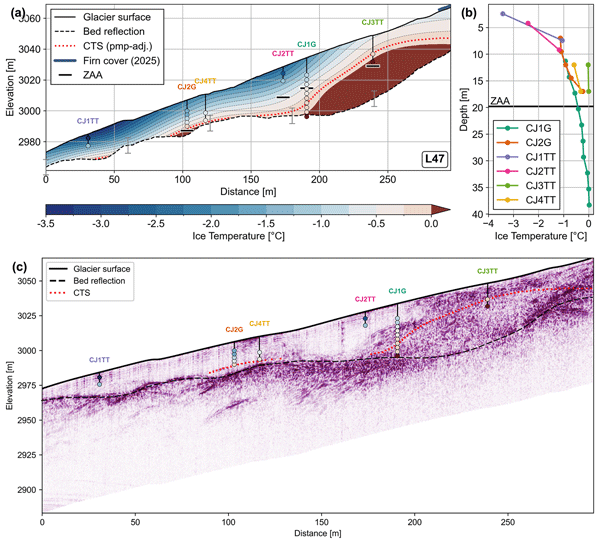
Janosch Beer, Mylène Jacquemart, Matthias Huss, Ilaria Santin, Gabriela Clara Racz, Christophe Ogier, Saskia Gindraux, Leo Hösli, Raphael Moser, James Irving, Mauro Fischer, and Daniel Farinotti
EGUsphere, https://doi.org/10.5194/egusphere-2026-3042, https://doi.org/10.5194/egusphere-2026-3042, 2026
This preprint is open for discussion and under review for The Cryosphere (TC).
Short summary
Short summary
Small Alpine glaciers can exhibit a mix of cold and temperate ice, a polythermal structure, which can promote hazardous conditions. We drilled into six small Swiss glaciers and measured ice temperatures in boreholes. We found polythermal conditions in three of six sites and show that the thermal structure is linked to firn cover loss. Our results suggest that polythermal glaciers may be more common in the Alps than previously recognised.
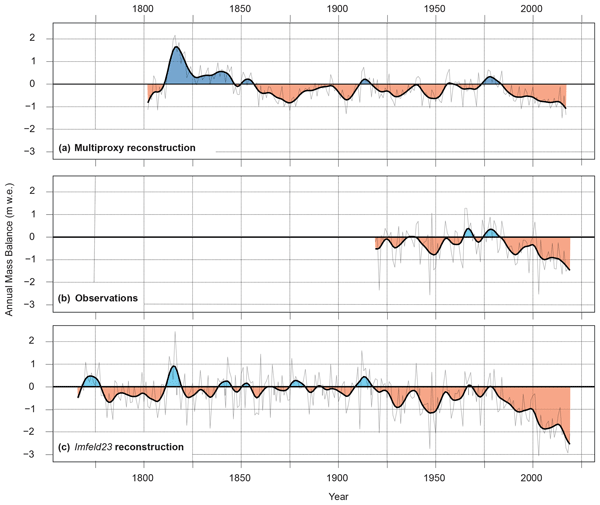
Jérôme Lopez-Saez, Christophe Corona, Lenka Slamova, Matthias Huss, Valérie Daux, Kurt Nicolussi, and Markus Stoffel
Clim. Past, 20, 1251–1267, https://doi.org/10.5194/cp-20-1251-2024, https://doi.org/10.5194/cp-20-1251-2024, 2024
Short summary
Short summary
Glaciers in the European Alps have been retreating since the 1850s. Monitoring glacier mass balance is vital for understanding global changes, but only a few glaciers have long-term data. This study aims to reconstruct the mass balance of the Silvretta Glacier in the Swiss Alps using stable isotopes and tree ring proxies. Results indicate increased glacier mass until the 19th century, followed by a sharp decline after the Little Ice Age with accelerated losses due to anthropogenic warming.
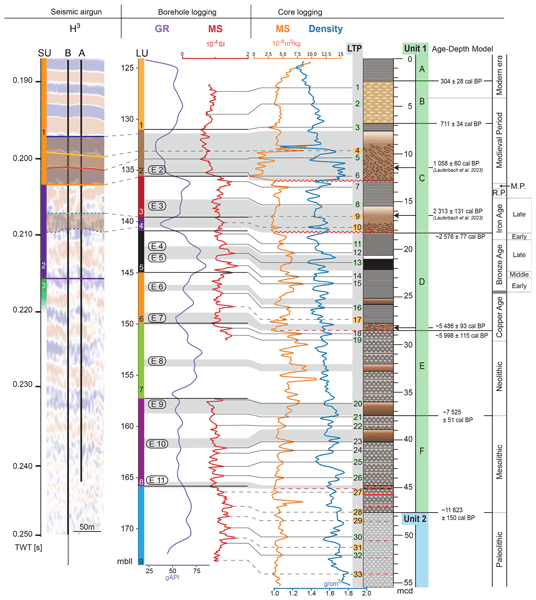
Marcel Ortler, Achim Brauer, Stefano C. Fabbri, Jean Nicolas Haas, Irka Hajdas, Kerstin Kowarik, Jochem Kueck, Hans Reschreiter, and Michael Strasser
Sci. Dril., 33, 1–19, https://doi.org/10.5194/sd-33-1-2024, https://doi.org/10.5194/sd-33-1-2024, 2024
Short summary
Short summary
The lake drilling project at Lake Hallstatt (Austria) successfully cored 51 m of lake sediments. This was achieved through the novel drilling platform Hipercorig. A core-log seismic correlation was created for the first time of an inner Alpine lake of the Eastern Alps. The sediments cover over 12 000 years before present with 10 (up to 5.1 m thick) instantaneous deposits. Lake Hallstatt is located within an UNESCO World Heritage area which has a rich history of human salt mining.
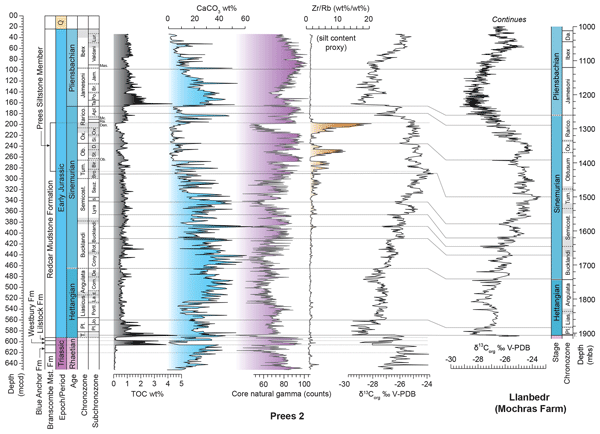
Stephen P. Hesselbo, Aisha Al-Suwaidi, Sarah J. Baker, Giorgia Ballabio, Claire M. Belcher, Andrew Bond, Ian Boomer, Remco Bos, Christian J. Bjerrum, Kara Bogus, Richard Boyle, James V. Browning, Alan R. Butcher, Daniel J. Condon, Philip Copestake, Stuart Daines, Christopher Dalby, Magret Damaschke, Susana E. Damborenea, Jean-Francois Deconinck, Alexander J. Dickson, Isabel M. Fendley, Calum P. Fox, Angela Fraguas, Joost Frieling, Thomas A. Gibson, Tianchen He, Kat Hickey, Linda A. Hinnov, Teuntje P. Hollaar, Chunju Huang, Alexander J. L. Hudson, Hugh C. Jenkyns, Erdem Idiz, Mengjie Jiang, Wout Krijgsman, Christoph Korte, Melanie J. Leng, Timothy M. Lenton, Katharina Leu, Crispin T. S. Little, Conall MacNiocaill, Miguel O. Manceñido, Tamsin A. Mather, Emanuela Mattioli, Kenneth G. Miller, Robert J. Newton, Kevin N. Page, József Pálfy, Gregory Pieńkowski, Richard J. Porter, Simon W. Poulton, Alberto C. Riccardi, James B. Riding, Ailsa Roper, Micha Ruhl, Ricardo L. Silva, Marisa S. Storm, Guillaume Suan, Dominika Szűcs, Nicolas Thibault, Alfred Uchman, James N. Stanley, Clemens V. Ullmann, Bas van de Schootbrugge, Madeleine L. Vickers, Sonja Wadas, Jessica H. Whiteside, Paul B. Wignall, Thomas Wonik, Weimu Xu, Christian Zeeden, and Ke Zhao
Sci. Dril., 32, 1–25, https://doi.org/10.5194/sd-32-1-2023, https://doi.org/10.5194/sd-32-1-2023, 2023
Short summary
Short summary
We present initial results from a 650 m long core of Late Triasssic to Early Jurassic (190–202 Myr) sedimentary strata from the Cheshire Basin, UK, which is shown to be an exceptional record of Earth evolution for the time of break-up of the supercontinent Pangaea. Further work will determine periodic changes in depositional environments caused by solar system dynamics and used to reconstruct orbital history.
Anika Donner, Paul Töchterle, Christoph Spötl, Irka Hajdas, Xianglei Li, R. Lawrence Edwards, and Gina E. Moseley
Clim. Past, 19, 1607–1621, https://doi.org/10.5194/cp-19-1607-2023, https://doi.org/10.5194/cp-19-1607-2023, 2023
Short summary
Short summary
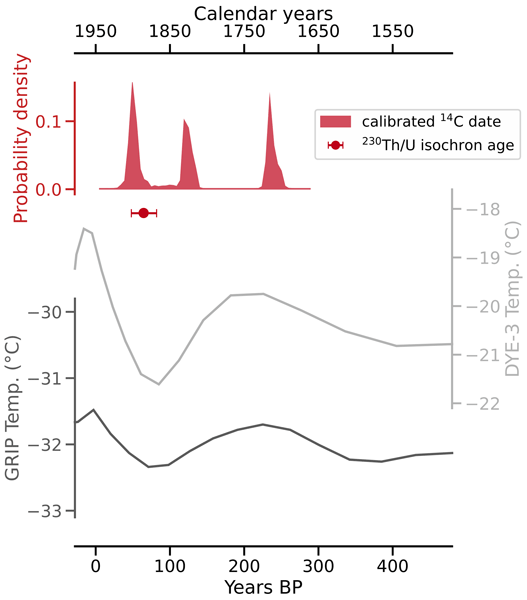
This study investigates the first finding of fine-grained cryogenic cave minerals in Greenland, a type of speleothem that has been notably difficult to date. We present a successful approach for determining the age of these minerals using 230Th / U disequilibrium and 14C dating. We relate the formation of the cryogenic cave minerals to a well-documented extreme weather event in 1889 CE. Additionally, we provide a detailed report on the mineralogical and isotopic composition of these minerals.
Valentina Beccari, Ahuva Almogi-Labin, Daniela Basso, Giuliana Panieri, Yizhaq Makovsky, Irka Hajdas, and Silvia Spezzaferri
J. Micropalaeontol., 42, 13–29, https://doi.org/10.5194/jm-42-13-2023, https://doi.org/10.5194/jm-42-13-2023, 2023
Short summary
Short summary
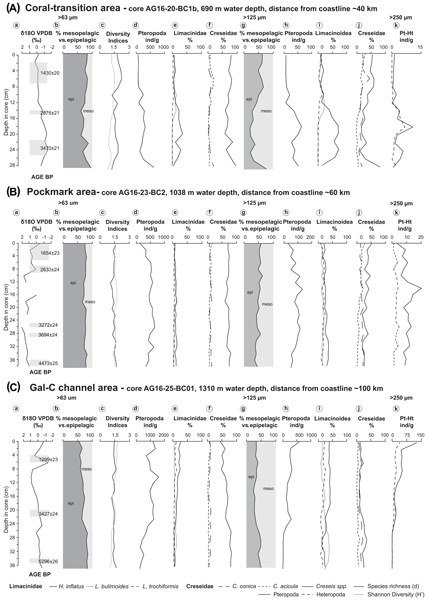
Planktonic gastropods (pteropods and heteropods) have been investigated in cores collected in the eastern Mediterranean along the Israeli coast in coral, pockmark, and channel areas. The sediment spans the last 5300 years. Our study reveals that neglecting the smaller fraction (> 63 µm) may result in a misinterpretation of the palaeoceanography. The presence of tropical and subtropical species reveals that the eastern Mediterranean acted as a refugium for these organisms.
Robin Fentimen, Eline Feenstra, Andres Rüggeberg, Efraim Hall, Valentin Rime, Torsten Vennemann, Irka Hajdas, Antonietta Rosso, David Van Rooij, Thierry Adatte, Hendrik Vogel, Norbert Frank, and Anneleen Foubert
Clim. Past, 18, 1915–1945, https://doi.org/10.5194/cp-18-1915-2022, https://doi.org/10.5194/cp-18-1915-2022, 2022
Short summary
Short summary
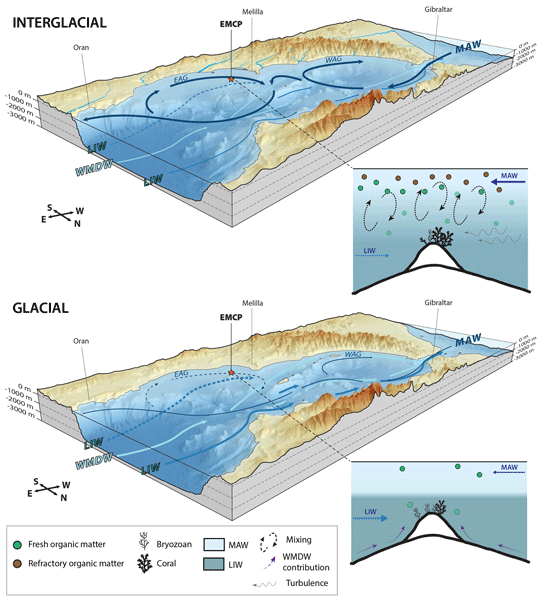
The investigation of a 9 m long sediment core recovered at ca. 300 m water depth demonstrates that cold-water coral mound build-up within the East Melilla Coral Province (southeastern Alboran Sea) took place during both interglacial and glacial periods. Based on the combination of different analytical methods (e.g. radiometric dating, micropaleontology), we propose that corals never thrived but rather developed under stressful environmental conditions.
Cited articles
Ivy-Ochs, S., Schlüchter, C., Kubik, P. W., Synal, H. A., Beer., J., and Kerrschner, H.: The exposure dating of an Egesen moraine at Julier Pass, Switzerland, measured with the cosmogenic radionuclides 10Be, 26Al and 36Cl, Eclogae Geol. Helv., 89, 1049–1063, 1996.
Kellerer-Pirkbauer, A. and Drescher-Schneider, R.: Glacier fluctuation and vegetation history during the Holocene at the largest glacier of the Eastern Alps (Pasterze Glacier, Austria): new insight based on recent peat findings, in: Proceedings of the 4th Symposium of the Hohe Tauern National Park for Research in Protected Areas, Kaprun, Austria, 17–19 September 2009, 151–155, https://www.parcs.at/npht/pdf_public/2018/35839_20180308_134628_NP_Hohe_Tauern_Conference_4_0151-0155.pdf (last access: 14 July 2026), 2009.
Le Roy, M., Nicolussi, K., and Schlüchter, C.: Tree-ring Dating of the Little Ice Age Maxima of Arolla Glaciers (Valais, Switzerland), Journal of Alpine Research/Revue de Géographie Alpine, 111-2, 23 pp., https://doi.org/10.4000/rga.12170, 2023.
Maisch, M., Burga, C. A., and Fitze, P.: Lebendiges Gletschervorfeld. Führer und Begleitbuch zum Gletscherpfad Morteratsch, Engadin-Press, Samedan, 138 pp., 1993.
Maisch, M., Brandova, D., Ivy-Ochs, S., and Kubik, P. W.: Exposure dating on moraines of the Morteratsch glacier (Bernina region, Upper Engadine, GR), in: Proceedings of the 3rd Swiss Geoscience Meeting, Zürich, Switzerland, 18–19 September 2005, Swiss Academy of Sciences, 181–182, https://geoscience-meeting.ch/sgm2005/SGM05_abstracts/05_Measuring_surf_process/05_PDF/Maisch_talk.pdf (last access: 14 July 2026), 2005.
Nicolussi, K., Le Roy, M., Schlüchter, C., Stoffel, M., and Wacker, L.: The glacier advance at the onset of the Little Ice Age in the Alps: New evidence from Mont Miné and Morteratsch glaciers, The Holocene, 32, 624–638, https://doi.org/10.1177/09596836221088247, 2022.
Nicolussi, K., Le Roy, M., Hajdas, I., Pichler, T., Wacker, L., and Schlüchter, C.: Chasing the melting ice: evidence for the first Holocene glacier minimum in the Alps and precise dating of the subsequent advance at the end of the Preboreal, Quaternary Sci. Rev., 388, 109962, https://doi.org/10.1016/j.quascirev.2026.109962, 2026.
Ostermayer, H.: Der “Wald” unter dem Mont-Miné-Gletscher. Festschrift, Schweiz. Stiftung für Alpine Forschung, Zürich, Switzerland, 132–136, ISBN 978-3-85515-107-3, 2014.
Patzelt, G.: Gletscher, Hatje Cantz, Berlin, Germany, 256 pp., ISBN 978-3-7757-4535-2, 2019.
Schlüchter, C.: Holz statt Eis. Veränderungen im Landschaftsbild der Alpen während der letzten 10,000 Jahre. Festschrift, Schweiz. Stiftung für Alpine Forschung, Zürich, Switzerland, 89–128, ISBN 978-3-85515-107-3, 2014.
Schürch, N., Hajdas, I., Schlüchter, B., Schlüchter, C., and Drescher-Schneider, R.: Fruits, beetles and the Unteraargletscher, Annual Report, Laboratory of Ion Beam Physics, ETH Zürich, p. 96, https://www.phys.ethz.ch/content/dam/ethz/special-interest/phys/particle-physics/ion-beam-physics-dam/documents/Annual_report_2015.pdf#page=96.10 (last access: 14 July 2026), 2015.
Walcott-George, C. K., Brown, N. D., Briner, J. P., Balter-Kennedy, A., Young, N. E., Kuhl, T., Moravec, E., Anandakrishnan, S., Stevens, N. T., Keisling, B., DeConto, R. M., Gkinis, V., MacGregor, J. A., and Schaefer, J. M.: Deglaciation of the Prudhoe Dome in northwestern Greenland in response to Holocene warming, Nat. Geosci., 19, 189–194, https://doi.org/10.1038/s41561-025-01889-9, 2026.
Zemp, M., Paul, F., Hoelzle, M., and Haeberli, W.: Glacier fluctuations in the European Alps, 1850–2000: an overview and spatio-temporal analysis of available data, in: Darkening Peaks: Glacier retreat, Science and Society, edited by: Orlove, B., Wiegandt, E., and Luckman, B. H., University of California Press Berkeley, USA, 152–167, https://doi.org/10.1525/9780520934245-012, 2008.
Short summary
We found Larix decidua at 2156 m altitude in front of the Morteratschgletscher (Engadin, CH) liberated recently from the ice. This tree stopped growing ~10 350 years ago. Another tree started to grow ~10 800 years ago (early Preboreal), which was ~800 years after the end of the Younger Dryas. At this time the glacier did not cover the sampling site. Thus, in the early Preboreal the terminus of the Morteratschgletscher was at much higher elevation in comparison to the present-day situation.
We found Larix decidua at 2156 m altitude in front of the Morteratschgletscher (Engadin, CH)...