
the Creative Commons Attribution 4.0 License.
the Creative Commons Attribution 4.0 License.
 | 28 Jul 2026
Tree growth at the beginning of the Holocene at an elevation of 2150 m in the Engadin Valley, Switzerland
Christian Schlüchter

Leo Hösli
Kurt Nicolussi
Christoph Korte
Irka Hajdas
- Article
(5885 KB) - Full-text XML
- BibTeX
- EndNote


Schlüchter, C., Hösli, L., Nicolussi, K., Korte, C., and Hajdas, I.: Tree growth at the beginning of the Holocene at an elevation of 2150 m in the Engadin Valley, Switzerland, E&G Quaternary Sci. J., 75, 163–167, https://doi.org/10.5194/egqsj-75-163-2026, 2026.
Hundreds of samples of subfossil organic detritus have been collected over the past 3 decades in the forefields of Alpine glaciers or in direct contact with the ice front. They range from small insects (Schürch et al., 2015) to disc-shaped clasts of compressed peat (e.g. Kellerer-Pirkbauer and Drescher-Schneider, 2009) and torn-up splinters of trees and logs of conifers of several metres in length and up to 60 cm in diameter. A small number of the samples have been analysed and dated so far. The original growing position of the subfossil wood has been a major scientific concern since the sampling location is not the site of the living trees. Sampled tree remnants were obviously transported to the glacier terminus sub- and englacially and released there through the meltwater system, in many cases by meltwater outbursts (Schlüchter, 2014).
Wood sample findings in glacier forefields increased during the early 1990s (Steingletscher, Unteraargletscher, among others), coinciding with the early decay phase of the most recent glacier advance since the Little Ice Age. The increase in subfossil wood and peat from underneath glaciers may have been triggered by the mechanism of this most recent advance from 1970 to 1990 (Zemp et al., 2008). This advance happened fast, with a strong initial push, as observed at Steingletscher, Unteraargletscher, Glacier de Mont Miné, and Tschiervagletscher. The mechanical power of the advance has resulted in subglacial erosion in parts of the glacier where its base rested on soft, deformable, and removable fluvial or lacustrine sediments from earlier times with restricted ice extent. Subglacial transport was verified broadly by typically deformed wood structures and by the very nature of the strongly compressed peat as a swamp deposit. Ultimate proof of a subglacial origin of the tree remnants is presented by Ostermayer (2014) with an excursion underneath Glacier de Mont Miné. However, despite his adventurous trip, the uncertainty about the true growing position of the trees remained. The missing link would be a subfossil tree in growing position, preferably in combination with a fossil soil. Considering the large number of samples and of trees in growing positions in lateral moraines (Le Roy et al., 2023, and references therein; Nicolussi et al., 2022), it would only be a matter of time until such a subglacial example would appear at a receding ice margin. In any case, the location of growth of the subfossil tree fragments found on glacier forefields naturally has to be further up valley. It is expected that further melting and retreat of the glaciers will expose more subfossil trees, eventually in an in situ growing position.
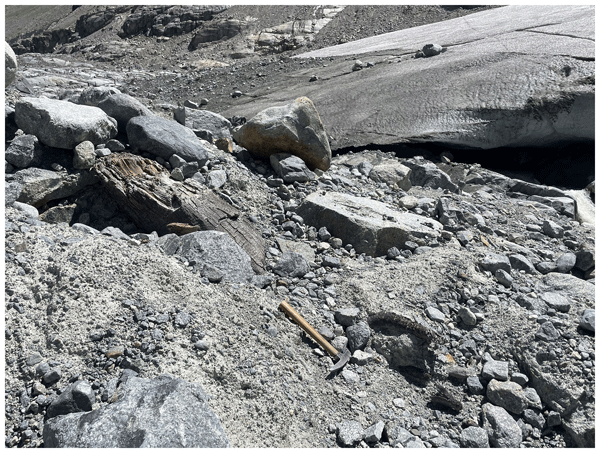
Morteratschgletscher drains the eastern catchment of the Bernina Massif, with elevations up to 4048 m of Piz Bernina (Fig. 1). During the yearly survey of the ice margin position in autumn of 2014 the first log, about 30 cm long, was reported. In contrast to observations on e.g. Unteraar-, Mont Miné-, or Steingletscher, this was a late discovery. However, this new occurrence has yielded some basic insights into the glacier–climate system. Since 2015 the glacier has melted back into a basin, leaving the dominant cross-valley bedrock ridge ice-free. This bedrock ridge acted as the mechanical obstacle to ice flow, generating a compressive flow regime, where most particles carried in the basal part of the glacier would be lodged. Substantial glacial morphological features are present, such as roches moutonnées, boulder alignments, fluted till surfaces, glacial striae, and irregular till patches smoothing the complex bedrock topography. These till patches contain organic clasts on their surface and at depth. A description is given here of one such prominent clast (Fig. 2a). A tree trunk of about 60 cm visible length is embedded in till and sheared off at the top. The roches moutonnées marking the skyline in the back is the obstacle controlling compressive flow (Fig. 2b). During the first visit on 24 June 2025 and some exploratory digging it was clear that this trunk still had roots attached (Fig. 2b). The surface of the trunk was not as smooth as is usually the case when exhumation (melting out) is carried out some weeks or months before subaerial discovery. However, the surface of this tree has the typical compressive-pressure-induced drying cracks and is very hard. The visible roots in Fig. 2b are part of the trunk. The roots on the backside, which was severely lodged into the till, were deformed and partially sheared off and displaced by the shearing drag of the glacier.

Figure 1(a) The Morteratschgletscher in the Engadin (Switzerland) is (b) framed from the Bernina Massif. (c) Positions of the glacial ice in summer 2025 (and 2022) and of collected wood are visible (photo: UAV imagery, Lander Van Tricht. Bottom left corner coordinates (LV95): 2791565.1, 1143651.4; top right corner coordinates: 2791923.2, 1143902.8).

Figure 2The truncated tree (MORT–25-01 = H2) was found at 2156 m altitude (a) in the till in front of the Morteratschgletscher in summer 2025. It was half-deracinated and tilted around 45° in the flow direction of the glacier. (b) Roots are still attached.
The preservation of the excavated tree trunk with roots attached (Fig. 2b) shows that it has not been dragged by the moving glacier for a long distance. The dislocation, if at all, may be on the order of a few metres to a few tens of metres only, as indicated by the preservation of the roots. It is also possible that it was run over and lodged at the site of growth and later on sheared to the place of excavation. The chaotic sediments with weathering around the roots make this latter scenario possible.
The coordinates of the excavated trunk are 2791652.51, 1143796.71. The detailed topographic map (Fig. 1c; see also Fig. 3) shows the proximity to the 2025 glacier terminus and the distribution of subfossil wood specimens on the surface. The sample MORT–25-01 (= H2 in Fig. 2) is Larix decidua Mill. The distance between sample MORT–25-01 (H2) and the ice margin was < 20 m at the time of excavation. Dendrochronological measurements provided 118 tree rings, with an estimated pith offset of 10 years.

Figure 3Extent of the Morteratschgletscher in summer 2025 with the locality of the discovered tree at 2156 m altitude (photo: Kai Zorn). (The arrow points to the sample site.)
The uncalibrated radiocarbon age of sample MORT–25-01 (= ETH-153201) is 9126 ± 29 years BP. The calibrated date corresponds to two intervals, 8454–8448 and 8431–8274 BCE (95.4 %), and a first dendrochronological analysis has established the end year for the tree at 8350 BCE, with 20 to 25 years uncertainty (Nicolussi et al., 2026). The year of 8350 BCE (or ca. 10 300 BP) must be considered to be the youngest possible end year (Fig. 4). A sample found earlier in the forefield of Morteratschgletscher (MORT–19-06) is ca. 200 years older. However, the sensitive palaeoglaciological information from tree MORT–25-01 (H2) is its lodging or growing close to or at its excavation position (Fig. 2; cf. Patzelt, 2019, pp. 182–183).

Figure 4Calibrated radiocarbon age (cal BP) of combined 14C ages for wood samples H1, H2, and H4 plotted together with the calibrated age of the oldest sample (H5).
MORT–25-01(H2) is the most prominent among a number of wood clasts at the sediment surface or slightly embedded in the till. A selected number of them were collected in early June during a survey of the ice front. These samples have been radiocarbon-dated with the following results.
-
MORT–25-H1 = ETH-152759: 9248 ± 28 years BP
-
MORT–25-H2 = ETH-152760: 9194 ± 28 years BP
(= second sample of tree MORT–25-01) -
MORT–25-H3 = ETH-152761: 120 ± 21 years BP
-
MORT–25-H4 = ETH-152762: 9206 ± 28 years BP
-
MORT–25-H5 = ETH-152763: 9437 ± 28 years BP
The results of these additional samples from the vicinity of tree MORT–25-01 (H2) demonstrate a consistent age group with a 14C mean value of three samples (H1, H2, and H4) of 9216 ± 17 years BP (χ2 test; df-2 T-2.1 (5 % 6.0)). However, MORT–25-H5 is even 200 radiocarbon years older than the other samples and possibly a piece of the oldest Preboreal tree at Morteratsch (and possibly the Alps in terms of oldest radiocarbon age so far), with calibration between 8792 and 8627 BCE (10 741–10 576 cal BP) (Fig. 4).
A detailed discussion of related dendrochronological and radiocarbon age determinations in an Alpine context is provided in Nicolussi et al. (2026), which includes an extended list of references on the subject. In addition, in a recent study on north-western Greenland, Walcott-George et al. (2026) document early Holocene warming comparable to our data from Morteratschgletscher.
We emphasize here the fact that tree MORT–25-01 (H2) has been found in a near-growing position. At the time of tree growth, Morteratschgletscher was not at the present-day position, but more retired. However, there is a sister tree which was excavated in August 2019 at about 500 m distance closer to the bedrock ridge and at ca. 15 m higher elevation and which contained relict root suckers and preserved bark around them and with till-containing soil fragments. This tree was completely laid down in a small depression and, again, not dragged on by the glacial ice for more than 15 m. The lab no. is MORT–19-06, with 337 counted rings and a radiocarbon age of 9198 ± 29 yr BP (ETH-110984). The calibrated age is 8540–8513 and 8483–8300 BCE (94.5%). Radiocarbon dating and dendrochronology for the tree 19-06 indicate an end year of ca. 8350 BCE. Both trees 25-01 and 19-06 stopped growing ca. 10 350 years ago. The tree 25-01 was found in a near-growing position, and the tree 19-06 started growth earlier. The seed it grew from was blown up to Morteratsch and started to grow around 10 800 years ago (in early Preboreal times; Fig. 4), which is only about 800 years after the end of the Younger Dryas, as dated by cosmogenic terrestrial nuclides at Julierpass about 16 km to the north in the Engadin Valley (Ivy-Ochs et al., 1996). At that time, the Morteratschgletscher front formed the end moraines at Pontresina (Maisch et al., 1993, 2005). The retreat in the earliest Preboreal times from the Younger Dryas position at Pontresina to the glacier front of 2025 and beyond was fast.
In late Preboreal times, Morteratschgletscher did not cover the site where the subfossil trees were found. During that time the glacier terminus may have been as far back as the confluence of Pers- and Morteratschgletscher.
The palaeoclimatic background provides insight into the climate at the Younger Dryas–Preboreal transition: the radiocarbon dates for both MORT–19-06 and MORT–25-01 fall within sensitive, well-defined segments of the radiocarbon calibration curve. However, two dates only do not allow the definition of a statistical plateau.
No data sets were used in this article.
CS designed the project and is responsible for the integrity of the study. LH undertook the first sampling. CS and CK conducted the main sampling in the field. IH generated the 14C age determination, and KN established the dendrochronology. CS mainly wrote the manuscript, with contributions by CK, IH, KN, and LH.
The contact author has declared that none of the authors has any competing interests.
Publisher's note: Copernicus Publications remains neutral with regard to jurisdictional claims made in the text, published maps, institutional affiliations, or any other geographical representation in this paper. The authors bear the ultimate responsibility for providing appropriate place names. Views expressed in the text are those of the authors and do not necessarily reflect the views of the publisher.
We acknowledge Kai Zorn, Karin Albust, Marianne and Jean-Michel Dafflon, and Doris Medl for helping to excavate the trunk. The Commune of Pontresina and the Museum Alpin have given permission to excavate and to transport the tree MORT–25-01 to the museum. We are very grateful to Lucyna Wasowicz for sample preparation, to the entire LIP team at ETH Zurich for AMS analysis, and to Lander Van Tricht and Kai Zorn for providing photos. We gratefully acknowledge the thorough review and linguistic streamlining of the manuscript by an anonymous reviewer.
This paper was edited by Ingmar Unkel and reviewed by one anonymous referee.
Ivy-Ochs, S., Schlüchter, C., Kubik, P. W., Synal, H. A., Beer., J., and Kerrschner, H.: The exposure dating of an Egesen moraine at Julier Pass, Switzerland, measured with the cosmogenic radionuclides 10Be, 26Al and 36Cl, Eclogae Geol. Helv., 89, 1049–1063, 1996.
Kellerer-Pirkbauer, A. and Drescher-Schneider, R.: Glacier fluctuation and vegetation history during the Holocene at the largest glacier of the Eastern Alps (Pasterze Glacier, Austria): new insight based on recent peat findings, in: Proceedings of the 4th Symposium of the Hohe Tauern National Park for Research in Protected Areas, Kaprun, Austria, 17–19 September 2009, 151–155, https://www.parcs.at/npht/pdf_public/2018/35839_20180308_134628_NP_Hohe_Tauern_Conference_4_0151-0155.pdf (last access: 14 July 2026), 2009.
Le Roy, M., Nicolussi, K., and Schlüchter, C.: Tree-ring Dating of the Little Ice Age Maxima of Arolla Glaciers (Valais, Switzerland), Journal of Alpine Research/Revue de Géographie Alpine, 111-2, 23 pp., https://doi.org/10.4000/rga.12170, 2023.
Maisch, M., Burga, C. A., and Fitze, P.: Lebendiges Gletschervorfeld. Führer und Begleitbuch zum Gletscherpfad Morteratsch, Engadin-Press, Samedan, 138 pp., 1993.
Maisch, M., Brandova, D., Ivy-Ochs, S., and Kubik, P. W.: Exposure dating on moraines of the Morteratsch glacier (Bernina region, Upper Engadine, GR), in: Proceedings of the 3rd Swiss Geoscience Meeting, Zürich, Switzerland, 18–19 September 2005, Swiss Academy of Sciences, 181–182, https://geoscience-meeting.ch/sgm2005/SGM05_abstracts/05_Measuring_surf_process/05_PDF/Maisch_talk.pdf (last access: 14 July 2026), 2005.
Nicolussi, K., Le Roy, M., Schlüchter, C., Stoffel, M., and Wacker, L.: The glacier advance at the onset of the Little Ice Age in the Alps: New evidence from Mont Miné and Morteratsch glaciers, The Holocene, 32, 624–638, https://doi.org/10.1177/09596836221088247, 2022.
Nicolussi, K., Le Roy, M., Hajdas, I., Pichler, T., Wacker, L., and Schlüchter, C.: Chasing the melting ice: evidence for the first Holocene glacier minimum in the Alps and precise dating of the subsequent advance at the end of the Preboreal, Quaternary Sci. Rev., 388, 109962, https://doi.org/10.1016/j.quascirev.2026.109962, 2026.
Ostermayer, H.: Der “Wald” unter dem Mont-Miné-Gletscher. Festschrift, Schweiz. Stiftung für Alpine Forschung, Zürich, Switzerland, 132–136, ISBN 978-3-85515-107-3, 2014.
Patzelt, G.: Gletscher, Hatje Cantz, Berlin, Germany, 256 pp., ISBN 978-3-7757-4535-2, 2019.
Schlüchter, C.: Holz statt Eis. Veränderungen im Landschaftsbild der Alpen während der letzten 10,000 Jahre. Festschrift, Schweiz. Stiftung für Alpine Forschung, Zürich, Switzerland, 89–128, ISBN 978-3-85515-107-3, 2014.
Schürch, N., Hajdas, I., Schlüchter, B., Schlüchter, C., and Drescher-Schneider, R.: Fruits, beetles and the Unteraargletscher, Annual Report, Laboratory of Ion Beam Physics, ETH Zürich, p. 96, https://www.phys.ethz.ch/content/dam/ethz/special-interest/phys/particle-physics/ion-beam-physics-dam/documents/Annual_report_2015.pdf#page=96.10 (last access: 14 July 2026), 2015.
Walcott-George, C. K., Brown, N. D., Briner, J. P., Balter-Kennedy, A., Young, N. E., Kuhl, T., Moravec, E., Anandakrishnan, S., Stevens, N. T., Keisling, B., DeConto, R. M., Gkinis, V., MacGregor, J. A., and Schaefer, J. M.: Deglaciation of the Prudhoe Dome in northwestern Greenland in response to Holocene warming, Nat. Geosci., 19, 189–194, https://doi.org/10.1038/s41561-025-01889-9, 2026.
Zemp, M., Paul, F., Hoelzle, M., and Haeberli, W.: Glacier fluctuations in the European Alps, 1850–2000: an overview and spatio-temporal analysis of available data, in: Darkening Peaks: Glacier retreat, Science and Society, edited by: Orlove, B., Wiegandt, E., and Luckman, B. H., University of California Press Berkeley, USA, 152–167, https://doi.org/10.1525/9780520934245-012, 2008.
- How to cite
- Introduction
- Morteratschgletscher in the Engadin Valley
- Sample MORT–25-01
- Details and age
- Additional samples
- Position of tree 25-01 (H2) and of supporting samples in Preboreal/late glacial climate ecology
- Data availability
- Author contributions
- Competing interests
- Disclaimer
- Acknowledgements
- Review statement
- References
- How to cite
- Introduction
- Morteratschgletscher in the Engadin Valley
- Sample MORT–25-01
- Details and age
- Additional samples
- Position of tree 25-01 (H2) and of supporting samples in Preboreal/late glacial climate ecology
- Data availability
- Author contributions
- Competing interests
- Disclaimer
- Acknowledgements
- Review statement
- References