Articles | Volume 75, issue 2
https://doi.org/10.5194/egqsj-75-191-2026
© Author(s) 2026. This work is distributed under
the Creative Commons Attribution 4.0 License.
https://doi.org/10.5194/egqsj-75-191-2026
© Author(s) 2026. This work is distributed under
the Creative Commons Attribution 4.0 License.
Ahead of its time: an interdisciplinary investigation of Lake Zurich's sediment fill (Zübo 80 project)

Lukas Gegg
CORRESPONDING AUTHOR
Institute of Earth and Environmental Sciences, University of Freiburg, 79104 Freiburg, Germany
Related authors
Johannes E. Pomper, Christian Zeeden, Frank Preusser, Ulrike Wielandt-Schuster, and Lukas Gegg
Sci. Dril., 35, 193–209, https://doi.org/10.5194/sd-35-193-2026, https://doi.org/10.5194/sd-35-193-2026, 2026
Short summary
Short summary
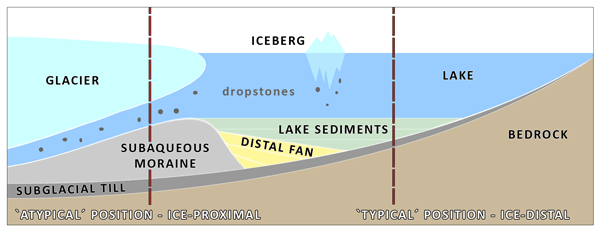
The research focuses on overdeepenings in the former Rhine glacier domain north from Lake Constance in southwestern Germany. We expand the current knowledge of the Quaternary stratigraphy of the Lake Constance Amphitheatre by revealing two new drill cores, both reaching the quaternary base of two different overdeepened basins. As a result, we show that our investigated sediment successions are quite atypical for alpine foreland overdeepenings.
Lukas Gegg
E&G Quaternary Sci. J., 74, 125–127, https://doi.org/10.5194/egqsj-74-125-2025, https://doi.org/10.5194/egqsj-74-125-2025, 2025
Short summary
Short summary
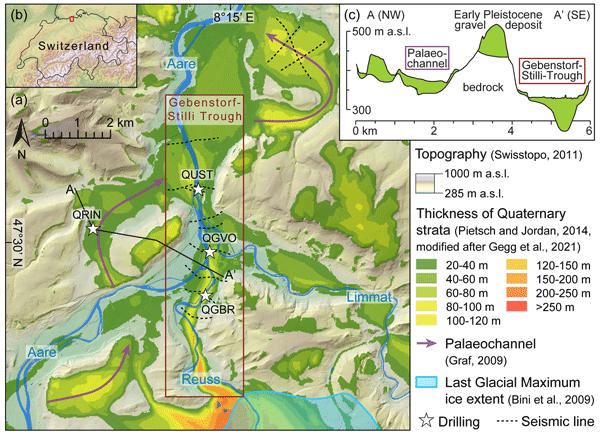
Drillings, outcrops, and seismic data provide insights into a glacial basin and a former river channel in northern Switzerland. Both are infilled with diverse (glacial, lacustrine, fluvial, colluvial) sediments attributed to three separate glaciations. The depth of the glacial basin depends strongly on the underlying rock type, which together with (hydro)fractures provides evidence on the conditions and erosion processes at the ice–rock interface.
Lukas Gegg, Felicitas A. Griebling, Nicole Jentz, and Ulrike Wielandt-Schuster
E&G Quaternary Sci. J., 73, 239–249, https://doi.org/10.5194/egqsj-73-239-2024, https://doi.org/10.5194/egqsj-73-239-2024, 2024
Short summary
Short summary
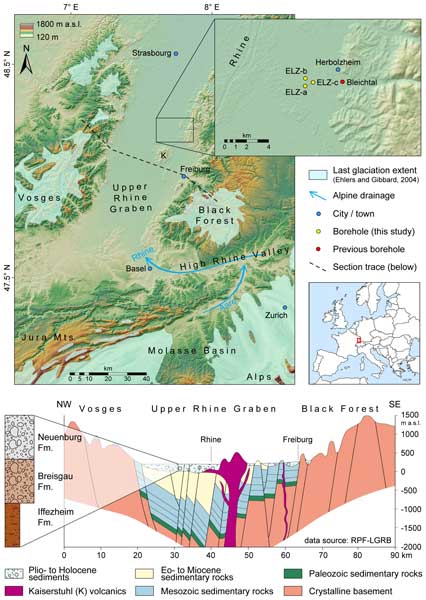
The subdivision and distinction of gravel units is an important tool in terrestrial Quaternary stratigraphy but can be challenging. Here, we investigate the glaciofluvial infill of the Upper Rhine Graben as an archive of recurring Alpine glaciations. With the help of statistical approaches, we identify differences in petrographic compositions, thereby differentiating two units that are likely representative of the last and penultimate glaciation, which have previously been difficult to pinpoint.
Bennet Schuster, Lukas Gegg, Sebastian Schaller, Marius W. Buechi, David C. Tanner, Ulrike Wielandt-Schuster, Flavio S. Anselmetti, and Frank Preusser
Sci. Dril., 33, 191–206, https://doi.org/10.5194/sd-33-191-2024, https://doi.org/10.5194/sd-33-191-2024, 2024
Short summary
Short summary
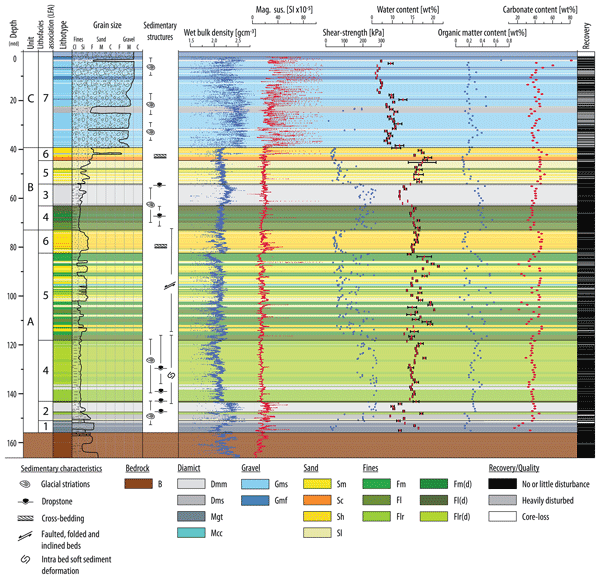
The Tannwald Basin, explored by drilling and formed by repeated advances of the Rhine Glacier, reveals key geological insights. Ice-contact sediments and evidence of deformation highlight gravitational and glaciotectonic processes. ICDP DOVE 5068_1_C core data define lithofacies associations, reflecting basin infill cycles, marking at least three distinct glacial advances. Integrating these findings aids understanding the broader glacial evolution of the Lake Constance amphitheater.
Felix Martin Hofmann, Claire Rambeau, Lukas Gegg, Melanie Schulz, Martin Steiner, Alexander Fülling, Laëtitia Léanni, Frank Preusser, and ASTER Team
Geochronology, 6, 147–174, https://doi.org/10.5194/gchron-6-147-2024, https://doi.org/10.5194/gchron-6-147-2024, 2024
Short summary
Short summary
We determined 10Be concentrations in moraine boulder surfaces in the southern Black Forest, SW Germany. We applied three independent dating methods to younger lake sediments. With the aid of independent age datasets, we calculated the growth of 10Be concentrations in moraine boulder surfaces.
Lukas Gegg and Johann Gegg
Sci. Dril., 32, 55–59, https://doi.org/10.5194/sd-32-55-2023, https://doi.org/10.5194/sd-32-55-2023, 2023
Short summary
Short summary
Geoscientists working with drill cores often struggle with proper photo documentation. We present a simple smartphone-based setup for acquiring high-resolution undistorted core pictures as an alternative to state-of-the-art commercial line scan imaging systems that are typically expensive and inflexible. It makes use of the phone's panoramic picture mode while being guided along the core in question on a rail, and the resulting images are of similar quality to classic line scan photos.
Lukas Gegg and Frank Preusser
E&G Quaternary Sci. J., 72, 23–36, https://doi.org/10.5194/egqsj-72-23-2023, https://doi.org/10.5194/egqsj-72-23-2023, 2023
Short summary
Short summary
Erosion processes below glacier ice have carved large and deep basins in the landscapes surrounding mountain ranges as well as polar regions. With our comparison, we show that these two groups of basins are very similar in their shapes and sizes. However, open questions still remain especially regarding the sediments that later fill up these basins. We aim to stimulate future research and promote exchange between researchers working around the Alps and the northern central European lowlands.
Cited articles
Allen, S. J.: Seismic method, Geophysics, 45, 1619–1633, https://doi.org/10.1190/1.1441053, 1980.
Anselmetti, F. S., Bavec, M., Crouzet, C., Fiebig, M., Gabriel, G., Preusser, F., Ravazzi, C., and DOVE scientific team: Drilling Overdeepened Alpine Valleys (ICDP-DOVE): quantifying the age, extent, and environmental impact of Alpine glaciations, Sci. Dril., 31, 51–70, https://doi.org/10.5194/sd-31-51-2022, 2022.
Firla, G., Lüthgens, C., Neuhuber, S., Schmalfuss, C., Kroemer, E., Preusser, F., and Fiebig, M.: Analyzing complex single grain feldspar equivalent dose distributions for luminescence dating of glacially derived sediments, Quat. Geochronol., 85, 101627, https://doi.org/10.1016/j.quageo.2024.101627, 2024.
Gegg, L. and Preusser, F.: Comparison of overdeepened structures in formerly glaciated areas of the northern Alpine foreland and northern central Europe, E&G Quaternary Sci. J., 72, 23–36, https://doi.org/10.5194/egqsj-72-23-2023, 2023.
Harms, U., Raschke, U., Anselmetti, F. S., Strasser, M., Wittig, V., Wessels, M., Schaller, S., Fabbri, S. C., Niederreiter, R., and Schwalb, A.: Hipercorig – an innovative hydraulic coring system recovering over 60 m long sediment cores from deep perialpine lakes, Sci. Dril., 28, 29–41, https://doi.org/10.5194/sd-28-29-2020, 2020.
Hays, J. D., Imbrie, J., and Shackleton, N. J.: Variations in the Earth's Orbit: Pacemaker of the Ice Ages: For 500,000 years, major climatic changes have followed variations in obliquity and precession, Science, 194, 1121–1132, https://doi.org/10.1126/science.194.4270.1121, 1976.
Hsü, K. J. and Kelts, K. R.: Seismic investigation of Lake Zurich. Part II, Geology, https://doi.org/10.5169/SEALS-163858, 1970.
Hsü, K. J. and Kelts, K. R. (Eds.): Quaternary Geology of Lake Zurich: An Interdisciplinary Investigation by Deep-Lake Drilling, Schweizerbart, Stuttgart, 210 pp., ISBN 3-510-57013-8, 1984.
Libby, W. F.: Radiocarbon Dating, Science, 133, 621–629, https://doi.org/10.1126/science.133.3453.621, 1961.
Lister, G., Giovanoli, F., Eberli, G., Finckh, P., Finger, W., He, Q., Heim, C., Hsü, K., Kelts, K., Peng, C., Sidler, C., and Zhao, X.: Late Quaternary Sediments in Lake Zürich, Switzerland, Environ. Geol., 5, 191–205, https://doi.org/10.1007/BF02414864, 1983.
Lister, G. S.: A 15,000-year isotopic record from Lake Zürich of deglaciation and climatic change in Switzerland, Quaternary Res., 29, 129–141, https://doi.org/10.1016/0033-5894(88)90056-7, 1988.
Schlüchter, C.: The Quaternary glaciations of Switzerland, with special reference to the Northern Alpine Foreland, Quaternary Sci. Rev., 5, 413–419, https://doi.org/10.1016/0277-3791(86)90206-4, 1986.
Schlüchter, C.: The most complete Quaternary record of the Swiss Alpine Foreland, Palaeogeogr. Palaeocl., 72, 141–146, https://doi.org/10.1016/0031-0182(89)90138-7, 1989.
Schuster, B., Mair, D., Schmid, T. C., Gegg, L., Büchi, M. W., Schaller, S., Anselmetti, F. S., and Preusser, F.: Automated X-ray computed tomography-based analysis of clast fabric in drill-cores of glacial diamicts using deep learning models, Boreas, 55, 57–72, https://doi.org/10.1111/bor.70023, 2026.
Strasser, M., Monecke, K., Schnellmann, M., and Anselmetti, F. S.: Lake sediments as natural seismographs: A compiled record of Late Quaternary earthquakes in Central Switzerland and its implication for Alpine deformation, Sedimentology, 60, 319–341, https://doi.org/10.1111/sed.12003, 2013.
Short summary
Reassessment of a lake-drilling project conducted in the early 1980s that succeeded in coring the full sediment fill of Lake Zurich. Despite not meeting the scientific expectations at the time, the project is acknowledged as one of the first large-scale interdisciplinary exploration campaigns, which set new research standards. The Zübo science team characterised the deglaciation of the lake in unprecedented detail but met similar geological challenges as those faced by current research programs.
Reassessment of a lake-drilling project conducted in the early 1980s that succeeded in coring...