
the Creative Commons Attribution 4.0 License.
the Creative Commons Attribution 4.0 License.
 | 05 Nov 2026
Ahead of its time: an interdisciplinary investigation of Lake Zurich's sediment fill (Zübo 80 project)
Lukas Gegg

- Article
(1832 KB) - Full-text XML
- BibTeX
- EndNote


Gegg, L.: Ahead of its time: an interdisciplinary investigation of Lake Zurich's sediment fill (Zübo 80 project), E&G Quaternary Sci. J., 75, 191–194, https://doi.org/10.5194/egqsj-75-191-2026, 2026.
The 1970s were an exciting time to be a Quaternary scientist. The “ice ages” had long been recognised but still remained rather elusive; however, several new developments paved the way for our modern understanding of the recent geological past and of the Earth's climate system. As an example, radiocarbon dating (Libby, 1961) had become widely available and routinely applied, allowing us to add precise ages to past events. Oxygen-isotope variations in deep-sea sediments were identified as a consequence of episodic ice build-up at the poles, the latter as a consequence of orbital forcing (Hays et al., 1976), paving the way for high-resolution global climatostratigraphy. In the meantime, the first major international and interdisciplinary geoscientific research programmes had assembled, such as the Deep Sea Drilling Project (DSDP) that continued to explore the oceans and seafloors. This exploration has always been closely linked with seismic imaging, which had become powerful and widely available thanks to the universal accessibility of computing power (Allen, 1980). In essence, the time was right to think big and holistically, and to start planning similarly large ambitious interdisciplinary projects also onshore.
Inspired by novel developments, especially the success story of the DSDP, a group of scientists from ETH Zurich went ahead and did exactly that, hopeful that “the melting of land and sea research methods […] will eventually solve riddles of peri-alpine Quaternary geology that dangle since the generation of Penck and Brückner” (Hsü and Kelts, 1984: preface). The riddles to tackle included the Quaternary climate and glaciation history of the Alps, the responses of the sedimentary systems, and the formation of the deep peri-alpine lake basins. Another significant issue was a discrepancy between geothermal-gradient measurements in deep boreholes and in the shallow subsurface of lake bottoms that sparked the interest of energy producers, justifying the approval of the necessary funds for a drilling project. Seismic exploration had revealed a thick and complex sediment fill with four presumed inlaid-basin generations within Lake Zurich (Hsü and Kelts, 1970), which was thus chosen for exploration (Fig. 1).
More than 20 (airgun- and pinger-) seismic lines were acquired and, on their basis, 47°16.91′ N, 8°35.87′ E was selected as the ideal coring location, at a water depth of 136 m. Drilling operations started in February 1980 from an anchored platform and, after some initial difficulties, terminated in July of the same year, having cored down to 201.5 m below lake bottom. With the use of protective liners, the preservation of sealed archive halves, and a borehole–geophysical survey (gamma and temperature logs), the operations still meet the standards of current state-of-the-art research drilling (e.g. Anselmetti et al., 2022). The relevance of an interdisciplinary investigation was stressed from the beginning, and cores and data were studied by specialists of different fields, from sedimentologists to palynologists and geophysicists, producing a wealth of legacy data. Lister et al. (1983) provided the lithostratigraphic backbone of the project, and their descriptions are supported with detailed sketches and high-resolution X-ray radiographic images. The entirety of the results was collected in Hsü and Kelts (1984), and Lister (1988) added geochemical and chronological data.
The succession recovered by the Zübo 80 team (Fig. 2) is a prototype of, and similar to many later-cored, overdeepening-fill sequences (Gegg and Preusser, 2023). Contrary to the original publication, it is here briefly reviewed in chronological bottom-up order. Unit D consists of the pre-Quaternary “Molasse” bedrock, and the trough base is located at a depth of 154.4 m below lake bottom. Following a sharp contact, Unit C begins with poorly recovered sand and gravel that is overlain by diamictic mud. Four proper till layers with erratic pebbles and subhorizontal shear planes follow, alternating with sand and mud, partly graded or laminated, with ample deformation structures. Altogether, Unit C reflects basal outwash and ice-marginal lacustrine deposits. The till layers mark episodes of repeated direct ice contact with sediment deformation and compaction that is visible, for example, by elevated P-wave velocity (Fig. 2).
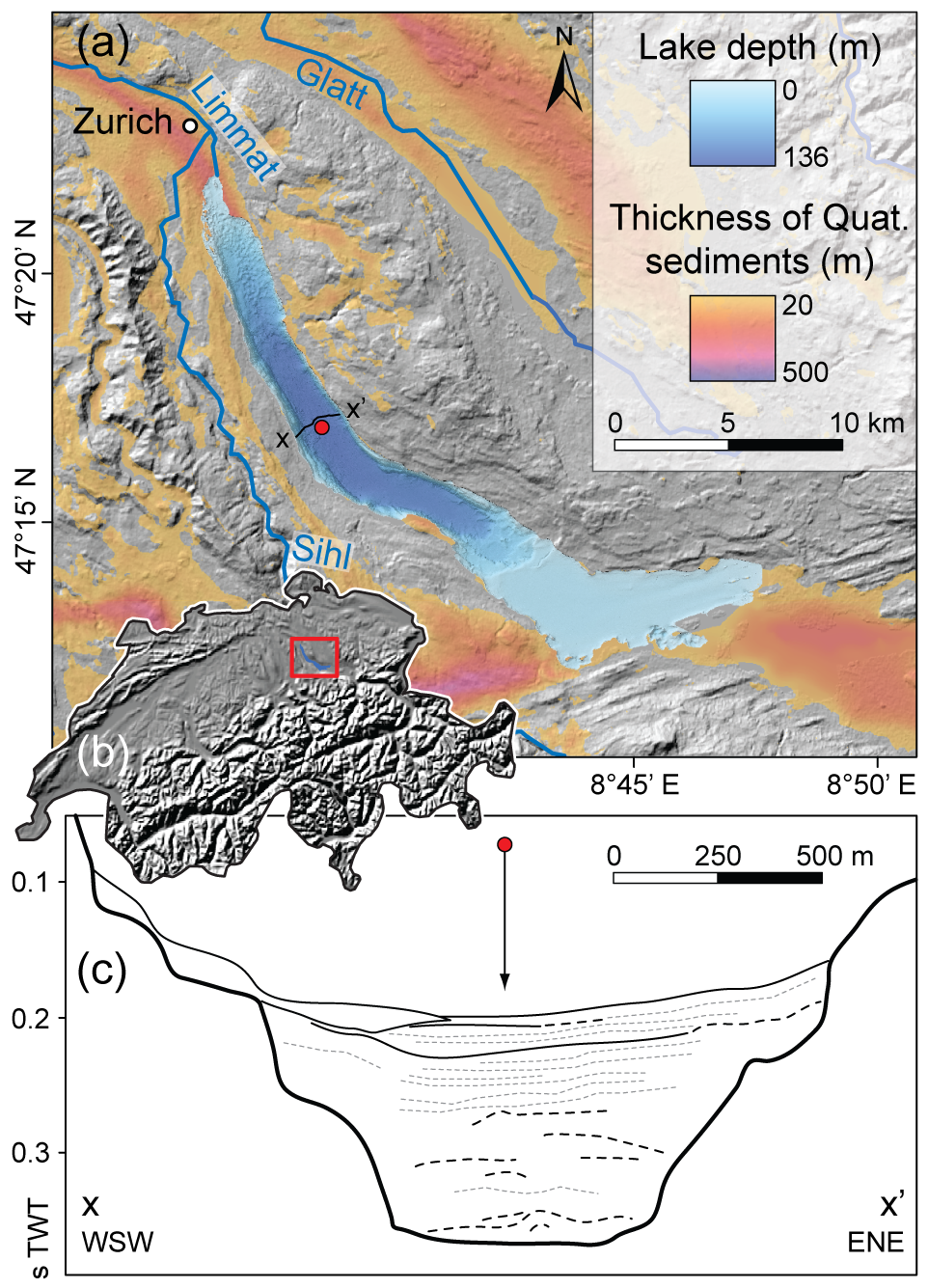
Figure 1The ZüBo 80 core (red dot) was collected in the depocentre of Lake Zurich (a) in north-eastern Switzerland (b). The exact coring location was determined based on a set of previously acquired seismic lines (c, reproduction of interpreted line AB; see panel (a) for location).
The following Unit B begins at 80.6 m with intensely deformed, poorly sorted mud with dropstones that vanish only at ∼ 45 m. With a layer of tilted, laminated mud at ∼ 30 m, the deformation structures disappear as well. The undeformed fines above are described as cyclic, with internally graded centimetre-thick but upward-thinning varves, interrupted by occasional turbidites. The authors interpret this unit as detrital sediments deposited in a pro- and later peri-glacial lake. This is consistent with pollen contents throughout the lower half of Unit B (and Unit C) that consist almost exclusively of allochthonous conifers. In its upper half, increasing quantities of herbal pollen indicate the emergence of a sparse local flora (Fig. 2). Unit A, finally, comprises 7.3 m of laminated, partly cyclic marls with significantly higher contents of, partly authigenic, carbonate and organic carbon, and diverse arboreal pollen assemblages. These are non-glacial lake deposits, and their base dates to ca. 14–15 ka (Fig. 2; Lister, 1988).
The goal of the Zübo 80 project had been to recover a core representing large parts of, if not the entire, Quaternary in order to reconstruct long-term regional climate development and the landscape response to it. In that regard, the scientists were “disappointed” (Sidler in Hsü and Kelts, 1984: p. 103) as they realised that the succession they had cored corresponded to the last glacial cycle in its entirety. The ∼ 100 m thick stack of quite uniform lake deposits of Units C and B had apparently accumulated in a few thousand years under deglacial conditions. Therefore, pollen contents, for example, allowed only the reconstruction of the last postglacial vegetation recovery that had largely been known before.
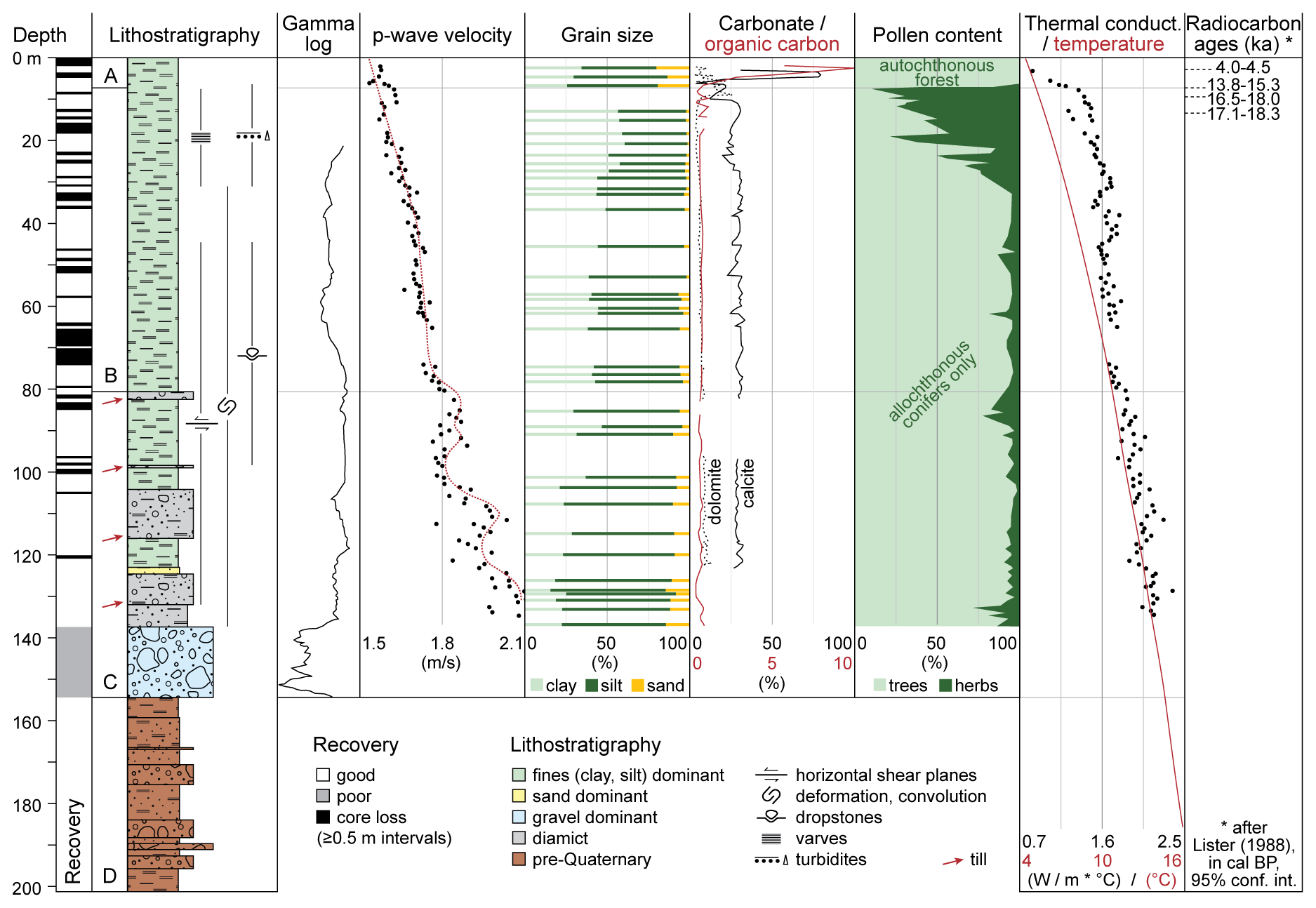
Figure 2The Zübo 80 succession with selected sediment properties (reproduced from Lister et al., 1983; Hsü and Kelts, 1984).
However, the holistic characterisation of this deglacial phase and of the sedimentary processes associated with it are remarkable. The lodgement-type till layers were attributed to a fluctuating ice margin during incipient glacier retreat, repeatedly grounding and compacting the sediments below, an effect that is visible in a variety of physical parameters including thermal conductivity (which was significantly greater than expected, accounting for the aforementioned discrepancies in geothermal-gradient measurements). The rapid transitions from till to lacustrine fines were explained by stagnation-zone retreat, meaning the fast decay and downwasting of an inactivated ice body instead of a slowly retreating active glacier front. The authors then linked the basinal sediments to different types of seafloor deposits in the Arctic Ocean based on granulometry, providing vivid modern analogues for the depositional setting. Overdeepened valley reaches further upstream intercepted the coarse fractions so that only fines were delivered to the basin, however, at deposition rates of up to 10 cm yr−1 and more, which made the material prone to slumping. Eventually, the glacially derived sediment input ceased and was replaced by short-distance transport from the surrounding “Molasse” highlands (Fig. 1a), visible by a slight colour change and an overall higher variability in the uppermost part of Unit B. Soil and vegetation development stabilised the landscape, reducing deposition rates drastically, to <1 mm yr−1 throughout Unit A.
Looking back some 40 years later, the Zübo 80 project is unique in successfully coring the entire sediment fill of a major Alpine lake, an undertaking that still proves highly challenging (Harms et al., 2020). However, not only the interdisciplinary approach and operations but also their results and interpretations have aged very well. The local stratigraphic framework constructed by the Zübo 80 team is still regarded as the state of the art (Strasser et al., 2013). Moreover, the proposed basin evolution by fast stagnation-zone retreat and rapid infilling by monotonous glaciolacustrine deposits, occasionally interrupted by brief readvances, has been confirmed as a general evolutionary model by a long list of subsequently cored, mostly mid-Pleistocene, overdeepened basins in the northern Alpine foreland (Gegg and Preusser, 2023). Only a few of the considerations that are presented in Hsü and Kelts (1984), such as a potential origin of the Lake Zurich basin from tectonic tilting of the Limmat Valley, would be excluded outright today – and it is a little comforting that there are some things that we definitely understand better now.
Over the last years, a new wave of Alpine-overdeepening research has culminated in the ICDP DOVE project (Anselmetti et al., 2022), which largely follows the same approach and quality standards as Zübo 80, which were in turn adopted from scientific ocean drilling. Methodical toolboxes have significantly advanced since then, for example regarding fabric analysis (Schuster et al., 2026) or the dating of the basin infills (Firla et al., 2024). However, some of these recent studies encountered the same “stratigraphic `vacuum' of central valley fills” (Schlüchter, 1986), meaning that the stratigraphic reach of the preserved sediment stacks was often much shorter, i.e. the basal strata younger, than previously assumed (e.g. Firla et al., 2024). This suggests that extensive glaciations, such as the last glacial maximum at Lake Zurich, may have a greater capacity to re-excavate overdeepened basins and obliterate older infills than generally assumed. However, to finish on a positive note, it should be added that the Swiss Quaternary scientists did find the sought-after long and old sediment profile, reaching back to at least ∼ 400 ka, only a few years later at the Thalgut site in the central Aare Valley (Schlüchter, 1989).
Figure 1 is based on NASA Shuttle Radar Topography Mission 1 arcsec digital elevation data (https://earthexplorer.usgs.gov/, last access: 4 August 2026), swissBATHY3D lake bathymetric data (https://www.swisstopo.admin.ch/en/height-model-swissbathy3d, last access: 4 August 2026), and the swissBEDROCK3D Quaternary sediment-thickness model (https://www.swisstopo.admin.ch/en/3d-swissbedrock-en, last access: 4 August 2026). The lithostratigraphic key of Fig. 2 is based on that used by the Swiss National Cooperative for the Disposal of Radioactive Waste (https://www.nagra.ch/en/reports/arbeitsbericht-nab-19-11, last access: 4 August 2026).
The author has declared that there are no competing interests.
Publisher's note: Copernicus Publications remains neutral with regard to jurisdictional claims made in the text, published maps, institutional affiliations, or any other geographical representation in this paper. The authors bear the ultimate responsibility for providing appropriate place names. Views expressed in the text are those of the authors and do not necessarily reflect the views of the publisher.
The author thanks F. Martin Hofmann and the two reviewers for their constructive recommendations.
This open-access publication was funded by the University of Freiburg.
This paper was edited by Michael Zech and reviewed by two anonymous referees.
Allen, S. J.: Seismic method, Geophysics, 45, 1619–1633, https://doi.org/10.1190/1.1441053, 1980.
Anselmetti, F. S., Bavec, M., Crouzet, C., Fiebig, M., Gabriel, G., Preusser, F., Ravazzi, C., and DOVE scientific team: Drilling Overdeepened Alpine Valleys (ICDP-DOVE): quantifying the age, extent, and environmental impact of Alpine glaciations, Sci. Dril., 31, 51–70, https://doi.org/10.5194/sd-31-51-2022, 2022.
Firla, G., Lüthgens, C., Neuhuber, S., Schmalfuss, C., Kroemer, E., Preusser, F., and Fiebig, M.: Analyzing complex single grain feldspar equivalent dose distributions for luminescence dating of glacially derived sediments, Quat. Geochronol., 85, 101627, https://doi.org/10.1016/j.quageo.2024.101627, 2024.
Gegg, L. and Preusser, F.: Comparison of overdeepened structures in formerly glaciated areas of the northern Alpine foreland and northern central Europe, E&G Quaternary Sci. J., 72, 23–36, https://doi.org/10.5194/egqsj-72-23-2023, 2023.
Harms, U., Raschke, U., Anselmetti, F. S., Strasser, M., Wittig, V., Wessels, M., Schaller, S., Fabbri, S. C., Niederreiter, R., and Schwalb, A.: Hipercorig – an innovative hydraulic coring system recovering over 60 m long sediment cores from deep perialpine lakes, Sci. Dril., 28, 29–41, https://doi.org/10.5194/sd-28-29-2020, 2020.
Hays, J. D., Imbrie, J., and Shackleton, N. J.: Variations in the Earth's Orbit: Pacemaker of the Ice Ages: For 500,000 years, major climatic changes have followed variations in obliquity and precession, Science, 194, 1121–1132, https://doi.org/10.1126/science.194.4270.1121, 1976.
Hsü, K. J. and Kelts, K. R.: Seismic investigation of Lake Zurich. Part II, Geology, https://doi.org/10.5169/SEALS-163858, 1970.
Hsü, K. J. and Kelts, K. R. (Eds.): Quaternary Geology of Lake Zurich: An Interdisciplinary Investigation by Deep-Lake Drilling, Schweizerbart, Stuttgart, 210 pp., ISBN 3-510-57013-8, 1984.
Libby, W. F.: Radiocarbon Dating, Science, 133, 621–629, https://doi.org/10.1126/science.133.3453.621, 1961.
Lister, G., Giovanoli, F., Eberli, G., Finckh, P., Finger, W., He, Q., Heim, C., Hsü, K., Kelts, K., Peng, C., Sidler, C., and Zhao, X.: Late Quaternary Sediments in Lake Zürich, Switzerland, Environ. Geol., 5, 191–205, https://doi.org/10.1007/BF02414864, 1983.
Lister, G. S.: A 15,000-year isotopic record from Lake Zürich of deglaciation and climatic change in Switzerland, Quaternary Res., 29, 129–141, https://doi.org/10.1016/0033-5894(88)90056-7, 1988.
Schlüchter, C.: The Quaternary glaciations of Switzerland, with special reference to the Northern Alpine Foreland, Quaternary Sci. Rev., 5, 413–419, https://doi.org/10.1016/0277-3791(86)90206-4, 1986.
Schlüchter, C.: The most complete Quaternary record of the Swiss Alpine Foreland, Palaeogeogr. Palaeocl., 72, 141–146, https://doi.org/10.1016/0031-0182(89)90138-7, 1989.
Schuster, B., Mair, D., Schmid, T. C., Gegg, L., Büchi, M. W., Schaller, S., Anselmetti, F. S., and Preusser, F.: Automated X-ray computed tomography-based analysis of clast fabric in drill-cores of glacial diamicts using deep learning models, Boreas, 55, 57–72, https://doi.org/10.1111/bor.70023, 2026.
Strasser, M., Monecke, K., Schnellmann, M., and Anselmetti, F. S.: Lake sediments as natural seismographs: A compiled record of Late Quaternary earthquakes in Central Switzerland and its implication for Alpine deformation, Sedimentology, 60, 319–341, https://doi.org/10.1111/sed.12003, 2013.