
Articles | Volume 75, issue 1
https://doi.org/10.5194/egqsj-75-73-2026
© Author(s) 2026. This work is distributed under
the Creative Commons Attribution 4.0 License.
the Creative Commons Attribution 4.0 License.
https://doi.org/10.5194/egqsj-75-73-2026
© Author(s) 2026. This work is distributed under
the Creative Commons Attribution 4.0 License.
the Creative Commons Attribution 4.0 License.
Research article
| 
18 Mar 2026
Research article |
| 18 Mar 2026
| 18 Mar 2026
Environmental reconstruction of the younger loess sequences of the Petrovaradin Fortress Palaeolithic site (Novi Sad, Serbia)
Slobodan B. Marković
Division of Geochronology and Environmental Isotopes, Institute of Physics – Centre for Science and Education, Silesian University of Technology, Konarskiego 22B, Gliwice 44-100, Poland
Department of Geography, Tourism and Hotel Management, Faculty of Science, University of Novi Sad, Trg Dositeja Obradovića 3, 21000 Novi Sad, Serbia
Serbian Academy of Arts and Sciences, Knez Mihajlova 35, 11000 Belgrade, Serbia
Institute for interdisciplinary and multidisciplinary studies, University of Montenegro, Cetinjska 2, 81000 Podgorica, Montenegro
Dušan Mihailović
Department of Archaeology, Faculty of Philosophy, Belgrade University, Čika Ljubina 18-20, 11000 Belgrade, Serbia
Milica G. Bosnić
Department of Geography, Tourism and Hotel Management, Faculty of Science, University of Novi Sad, Trg Dositeja Obradovića 3, 21000 Novi Sad, Serbia
Petar Krsmanović
Department of Geography, Tourism and Hotel Management, Faculty of Science, University of Novi Sad, Trg Dositeja Obradovića 3, 21000 Novi Sad, Serbia
Philip D. Hughes
Department of Geography, School of Environment, Education and Development (SEED), University of Manchester, Manchester M13 9PL, UK
Aleksandar Pilipović
Department of Geoinformatics, Physical and Environmental Geography, University of Szeged, Egyetem str 2-6, Szeged, 6722, Hungary
Mirjana Roksandić
Department of Anthropology, University of Winnipeg, 515 Portage Avenue, Winnipeg, MB, R3B 2E9, Canada
Qingzhen Hao
Key Laboratory of Cenozoic Geology and Environment, Institute of Geology and Geophysics, Chinese Academy of Sciences, Beijing 100029, China
Luo Wang
Key Laboratory of Cenozoic Geology and Environment, Institute of Geology and Geophysics, Chinese Academy of Sciences, Beijing 100029, China
Jelena Kolundžija
Department of Geography, Tourism and Hotel Management, Faculty of Science, University of Novi Sad, Trg Dositeja Obradovića 3, 21000 Novi Sad, Serbia
Dušan Puhar
Department of Geography, Tourism and Hotel Management, Faculty of Science, University of Novi Sad, Trg Dositeja Obradovića 3, 21000 Novi Sad, Serbia
Rastko S. Marković
Department for Geography and Tourism, Faculty of Sciences, Višegradska 33, University of Niš, Niš, Serbia
Tin Lukić
Department of Geography, Tourism and Hotel Management, Faculty of Science, University of Novi Sad, Trg Dositeja Obradovića 3, 21000 Novi Sad, Serbia
Department of Geology, Lund University, Sölvegatan 12, SE-223 62, Lund, Sweden
Related authors
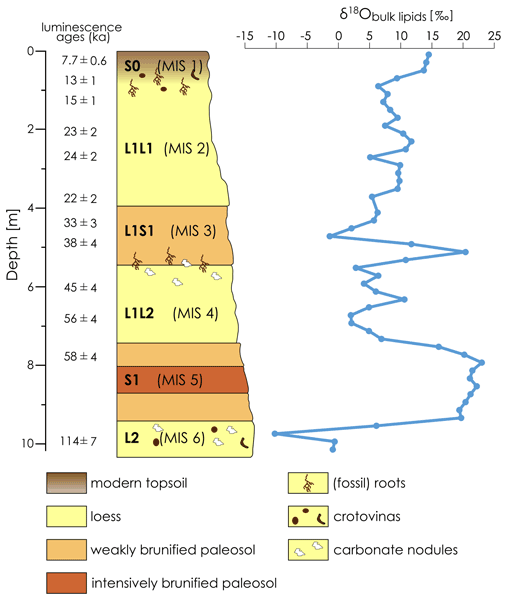
Jakob Labahn, Lucas Bittner, Philip Hirschmann, Christopher-Bastian Roettig, Diana Burghardt, Bruno Glaser, Slobodan B. Marković, and Michael Zech
E&G Quaternary Sci. J., 71, 83–90, https://doi.org/10.5194/egqsj-71-83-2022, https://doi.org/10.5194/egqsj-71-83-2022, 2022
Jakob Labahn, Lucas Bittner, Philip Hirschmann, Christopher-Bastian Roettig, Diana Burghardt, Bruno Glaser, Slobodan B. Marković, and Michael Zech
E&G Quaternary Sci. J., 71, 83–90, https://doi.org/10.5194/egqsj-71-83-2022, https://doi.org/10.5194/egqsj-71-83-2022, 2022
Cited articles
Allard, J. L., Hughes, P. D., Woodward, J. C., Fink, D., Simon, K., and Wilcken, K. M.: Late Pleistocene glaciers in Greece: A new 36Cl chronology, Quat. Sci. Rev., 245, 106528, https://doi.org/10.1016/j.quascirev.2020.106528, 2020.
Buggle, B., Glaser, B., Hambach, U., Gerasimenko, N., and Marković, S.: An evaluation of geochemical weathering indices in loess–paleosol studies, Quat. Int., 240, 12–21, https://doi.org/10.1016/j.quaint.2010.07.019, 2011.
Chu, W., Lengyel, G., Zeeden, C., Péntek, A., Kaminská, L'., and Mester, Z.: Early Upper Paleolithic surface collections from loess-like sediments in the northern Carpathian Basin, Quat. Int., 485, 167–182, https://doi.org/10.1016/j.quaint.2017.06.018, 2018.
Crann, C. A., Murseli, S., St-Jean, G., Zhao, X., Clark, I. D., and Kieser, W. E.: First status report on radiocarbon sample preparation techniques at the AE Lalonde AMS Laboratory (Ottawa, Canada), Radiocarbon, 59, 695–704, https://doi.org/10.1017/RDC.2016.56, 2017.
Frechen, M., Oches, E. A., and Kohfeld, K. E.: Loess in Europe-mass accumulation rates during the Last Glacial Period, Quat. Sci. Rev., 22, 1835–1857, https://doi.org/10.1016/S0277-3791(03)00140-6, 2003.
Gavrilović, B., Sümegi, P., Ćirić, M., Radaković, M. G., Gavrilov, M. B., Mladjen, D., and Marković, S. B.: The Middle and Late Pleniglacial (Weichselian) malacofauna of the Zemun loess–paleosol sequence, Serbia, PalZ, 1–13, https://doi.org/10.1007/s12542-024-00663-8, 2020.
Gojšina, V., Vesović, N., Ćurčić, S., Karan-Žnidaršič, T., Mitrović, B., and Dedov, I.: A review of the genus Vitrea Fitzinger, 1833 (Gastropoda, Eupulmonata, Pristilomatidae) in Serbia: diversity, distribution and the description of a new species, ZooKeys, 1200, 245–269, https://doi.org/10.3897/zookeys.1200.111097, 2024.
Hughes, P. D.: Concept and global context of the glacial landforms from the Last Glacial Maximum, in: European Glacial Landscapes, 355–358, Elsevier, https://doi.org/10.1016/B978-0-12-813134-4.00019-4, 2022.
IUSS Working Group WRB: World Reference Base for Soil Resources. International soil classification system for naming soils and creating legends for soil maps, 4th edn., International Union of Soil Sciences (IUSS), Vienna, Austria, https://files.isric.org/public/documents/WRB_fourth_edition_2022-12-18.pdf (last access: 11 March 2026), 2022.
Juřičková, L., Ložek, V., Horáčková, J., Tlachač, P., and Horáček, I.: Holocene succession and biogeographical importance of mollusk fauna in the Western Sudetes (Czech Republic), Quat. Int., 353, 210–224, https://doi.org/10.1016/j.quaint.2013.07.012, 2014.
Krsmanović, P., Perić, Z. M., Thompson, W., Radaković, M. G., Ryan, C. S., Schaetzl, R. J., Hao, Q., Lukić, T., Alexanderson, H., and Marković, S. B.: Loess provenance in the westernmost part of the lower Danube Basin, Serbia: Geochemical insights from the Velika Vrbica fluvial–eolian section, Quat. Int., 748, 109969, https://doi.org/10.1016/j.quaint.2025.109969, 2025.
Laag, C., Lagroix, F., Kreutzer, S., Chapkanski, S., Zeeden, C., and Guyodo, Y.: Measuring and evaluating colorimetric properties of samples from loess-paleosol sequences, MethodsX, 10, 102159, https://doi.org/10.1016/j.mex.2023.102159, 2023.
Lehmkuhl, F., Bösken, J., Hošek, J., Sprafke, T., Marković, S. B., Obreht, I., and Lindner, H.: Loess distribution and related Quaternary sediments in the Carpathian Basin, J. Maps, 14, 661–670, https://doi.org/10.1080/17445647.2018.1527404, 2018.
Lehmkuhl, F., Nett, J., Pötter, S., Schulte, P., Sprafke, T., Jary, Z., Antoine, P., Wacha, L., Wolf, D., Zerboni, A., Hošek, J., Marković, S., Sümegi, P., Veres, D., Zeeden, C., Boemke, B., Schaubert, V., Viehweger, J., and Hambach, U.: Geodata of European loess domains, CRC806-Database [data set], https://doi.org/10.5880/SFB806.58, 2020.
Ložek, V.: Quartärmollusken der Tschechoslowakei, Geol. Zentr. Veröff., 31, 1–374, 1964.
Lukić, T., Radaković, M., Marković, R., Thompson, W., Micić Ponjiger, T., Basarin, B., Tomić, N., Tomović, V., Popov Raljić, J., and Gavrilov, M.: Initial results of the colourimetric indices of the oldest exposed pedocomplex (Titel loess plateau, Serbia), Geol. Croat., 76, 73–85, https://doi.org/10.4154/gc.2023.17, 2023.
Marković, S. and Bosnić, M.: City Museum of Novi Sad (Petrovaradin) Loess palaeosol sequences PT1 and PT2, Serbia (XRF, COLOR, MS, SHELLS), Zenodo [data set], https://doi.org/10.5281/zenodo.18268625, 2026.
Marković, S., Bosnić, M., Marković, R., Krsmanović, P., Kolundžija, J., Pilipović, A., and Puhar, D.: Mišeluk 2 loess palaeosol sequence, Serbia (XRF, COLOR), Zenodo [data set], https://doi.org/10.5281/zenodo.17334484, 2025.
Marković, S. B., Oches, E. A., Jovanović, M., Gaudenyi, T., Hambach, U., Zöller, L., and Sümegi, P.: Paleoclimate record in the Late Pleistocene loess-paleosol sequence at Mišeluk (Vojvodina, Serbia), Quaternaire, 15, 361–368, 2004a.
Marković, S. B., Mihailović, D., Oches, E. A., Jovanović, M., and Gaudenyi, T.: The last glacial climate, environment and evidence of palaeolithic occupation in Vojvodina province, Serbia: an overview, Antaeus, 26, 307–317, 2004b.
Marković, S. B., McCoy, W. D., Oches, E. A., Savić, S., Gaudenyi, T., Jovanović, M., Stevens, T., Walther, R., Ivanišević, P., and Galović, Z.: Paleoclimate record in the Late Pleistocene loess-paleosol sequence at Petrovaradin Brickyard (Vojvodina, Serbia), Geol. Carpath., 56, 483–491, 2005.
Marković, S. B., Oches, E. A., McCoy, W. D., Gaudenyi, T., and Frechen, M.: Malacological and sedimentological evidence for “warm” climate from the Irig loess sequence (Vojvodina, Serbia), Geophys. Geochem. Geosyst., 8, Q09008, https://doi.org/10.1029/2007GC001724, 2007.
Marković, S. B., Bokhorst, M. P., Vandenberghe, J., McCoy, W. D., Oches, E. A., Hambach, U., Gaudenyi, T., Jovanović, M., Zöller, L., and Stevens, T.: Late Pleistocene loess-paleosol sequences in the Vojvodina region, North Serbia, J. Quat. Sci., 23, 73–84, https://doi.org/10.1002/jqs.1128, 2008.
Marković, S. B., Stevens, T., Kukla, G. J., Hambach, U., Fitzsimmons, K. E., Gibbard, P., Buggle, B., Zech, M., Guo, Z., and Hao, Q.: The Danube loess stratigraphy – new steps towards the development of a pan-European loess stratigraphic model, Earth Sci. Rev., 148, 228–258, https://doi.org/10.1016/j.earscirev.2015.06.005, 2015.
Marković, S. B., Sümegi, P., Stevens, T., Schaetzl, R. J., Obreht, I., Chu, W., Buggle, B., Zech, M., Zech, R., Zeeden, C., Gavrilov, M. B., Perić, Z., Svirčev, Z., and Lehmkuhl, F.: The Crvenka loess-paleosol sequence: A record of continuous grassland domination in the southern Carpathian Basin during the Late Pleistocene, Palaeogeogr. Palaeoclimatol. Palaeoecol, 509, 33–46, https://doi.org/10.1016/j.palaeo.2018.03.019, 2018.
Marković, S. B., Vandenberghe, J., Stevens, T., Mihailović, D., Gavrilov, M. B., Radaković, M. G., Zeeden, C., Obreht, I., Perić, Z. M., and Nett, J. J.: Geomorphological evolution of the Petrovaradin Fortress Palaeolithic site (Novi Sad, Serbia), Quat. Res., 103, 21–34, https://doi.org/10.1017/qua.2021.4, 2021.
Markovic, S., Bosnić, M., Marković, R., Krsmanović, P., Kolundžija, J., Pilipović, A., and Puhar, D.: Mišeluk 2 loess palaeosol sequence, Serbia (XRF, COLOR), Zenodo [data set], https://doi.org/10.5281/zenodo.17334484, 2025.
Mihailović, D.: Middle Palaeolithic Settlement at Petrovaradin Fortress. Petrovaradin Edition, Vol. II, The City Museum of Novi Sad, Novi Sad, https://www.academia.edu/1176665/Mihailovic_D_2009_Middle_Palaeolithic_Settlement_at_Petrovaradin_Fortress_Petrovaradin_Edition_Vol_II_The_City_Museum_of_Novi_Sad_Novi_Sad (last access: 11 March 2026), 2009.
Mihailović, D., Marković, S. B., Kuhn, S. L., Dragosavac, S., Mihailović, B., and Roksandić, M.: Middle and Upper Paleolithic of the southern Pannonian Basin: lithic assemblages from Petrovaradin Fortress (Novi Sad, Serbia), Quat. Int., 746, 109950, https://doi.org/10.1016/j.quaint.2025.109950, 2025.
Millard, A. R.: Conventions for reporting radiocarbon determinations, Radiocarbon, 56, 555–559, https://doi.org/10.2458/56.17455, 2014.
Murseli, S., Middlestead, P., St-Jean, G., Zhao, X., Jean, C., Crann, C. A., Kieser, W. E., and Clark, I. D.: The preparation of water (DIC, DOC) and gas (CO2, CH4) samples for radiocarbon analysis at AEL-AMS, Ottawa, Canada, Radiocarbon, 61, 1563–1571, https://doi.org/10.1017/RDC.2019.137, 2019.
Nett, J. J., Chu, W., Fischer, P., Hambach, U., Klasen, N., Zeeden, C., Obreht, I., Obrocki, L., Pötter, S., and Gavrilov, M. B.: The Early Upper Paleolithic Site Crvenka-At, Serbia–The First Aurignacian Lowland Occupation Site in the Southern Carpathian Basin, Front. Earth Sci., 9, 599986, https://doi.org/10.3389/feart.2021.599986, 2021.
Radaković, M. G., Oches, E. A., Hughes, P. D., Marković, R. S., Hao, Q., Perić, Z. M., Gavrilović, B., Ludwig, P., Lukić, T., Gavrilov, M. B., and Marković, S. B.: Reconstructed malacothermometer July paleotemperatures from the last nine glacials over the South-Eastern Carpathian Basin (Serbia), Atmosphere, 14, 791, https://doi.org/10.3390/atmos14050791, 2023.
Radaković, M. G., Gavrilović, B., Gavrilov, M. B., Marković, R. S., Hao, Q., Schaetzl, R. J., Zeeden, C., Cai, B., Perić, Z. M., Antić, A., Lukić, T., and Marković, S. B.: A Glacial – Interglacial Malacofauna Record from the Titel Loess Plateau, Serbia, between ∼350 and 250 ka, Quaternary, 7, 28, https://doi.org/10.3390/quat7020028, 2024a.
Radaković, M. G., Gavrilović, B., and Marković, S.: Changes in the diversity of loess mollusks in Serbia during the last nine ice ages, Geoconcept J., 1, 103–115, 2024b.
Ramsey, C. B.: Bayesian analysis of radiocarbon dates, Radiocarbon, 51, 337–360, https://doi.org/10.1017/S0033822200033865, 2009.
Reimer, P. J., Austin, W. E., Bard, E., Bayliss, A., Blackwell, P. G., Ramsey, C. B., Butzin, M., Cheng, H., Edwards, R. L., and Friedrich, M.: The IntCal20 Northern Hemisphere radiocarbon age calibration curve (0–55 cal kBP), Radiocarbon, 62, 725–757, https://doi.org/10.1017/RDC.2020.41, 2020.
Rousseau, D. D.: Loess biostratigraphy: new advances and approaches in mollusk studies, Earth-Sci. Rev., 54, 157–171, https://doi.org/10.1016/S0012-8252(01)00045-1, 2001.
Sprafke, T., Schulte, P., Meyer-Heintze, S., Händel, M., Einwögerer, T., Simon, U., Peticzka, R., Schäfer, C., and Lehmkuhl, F.: Paleoenvironments from robust loess stratigraphy using high-resolution colour and grain-size data of the last glacial Krems-Wachtberg record (NE Austria), Quat. Sci. Rev., 248, 106602, https://doi.org/10.1016/j.quascirev.2020.106602, 2020.
Sümegi, P. and Krolopp, E.: Quatermalacological analyses for modeling of the Upper Weichselian palaeoenvironmental changes in the Carpathian Basin, Quat. Int., 91, 53–63, https://doi.org/10.1016/S1040-6182(01)00099-7, 2002.
Sümegi, P., Marković, S. B., Molnár, D., Sávai, S., Náfrádi, K., Szelepcsényi, Z., and Novák, Z.: Črvenka loess-paleosol sequence revisited: local and regional Quaternary biogeographical inferences of the southern Carpathian Basin, Open Geosci., 8, 390–404, https://doi.org/10.1515/geo-2016-0031, 2016.
Sysoev, A. and Shileyko, A.: Land snails and slugs of Russian and adjacent countries, Pensoft Publ., Sofia – Moscow, 312 pp., https://dokumen.pub/land-snails-and-slugs-of-russia-and-adjace nt-countries-faunistica-9546424749-9789546424747.html (last access: 11 March 2026), 2009.
Vandenberghe, J., Huijzer, B. S., Mücher, H., and Laan, W.: Short climatic oscillations in a western European loess sequence (Kesselt, Belgium), J. Quat. Sci., 13, 471–485, https://doi.org/10.1002/(SICI)1099-1417(1998090)13:5<471::AID-JQS415>3.0.CO;2-V, 1998.
Welter-Schultes, F. W.: European non-marine molluscs, a guide for species identification, Planet Poster Editions, 1–679, https://www.pemberleybooks.com/product/european-non-marin e-molluscs-a-guide-for-species-identification/23712/ (last access: 11 March 2026), 2012.
Wilson, L.: The role of geoarchaeology in extending our perspective, Geological Society of London, https://doi.org/10.1144/SP352.1, 2011.
Zeeden, C., Hilgen, F., Röhl, U., Seelos, K., and Lourens, L.: Sediment color as a tool in cyclostratigraphy – a new application for improved data acquisition and correction from drill cores, Newsl. Stratigr., 48, 277–285, https://doi.org/10.1127/nos/2015/0064, 2015.
Zeeden, C., Krauß, L., Kels, H., and Lehmkuhl, F.: Digital image analysis of outcropping sediments: Comparison to photospectrometric data from Quaternary loess deposits at Şanoviţa (Romania) and Achenheim (France), Quat. Int., 429, 100–107, https://doi.org/10.1016/j.quaint.2016.02.047, 2017.
Short summary
This study explores past environments at a key archaeological site in Serbia to understand how climate and landscape influenced early human life. By analysing soil layers, fossils, and other natural markers, we found that the area offered a mix of habitats and stable conditions during the last ice age. These findings suggest that the region was an important refuge for people and animals, helping us to better understand human survival in changing climates.
This study explores past environments at a key archaeological site in Serbia to understand how...


