
Articles | Volume 75, issue 1
https://doi.org/10.5194/egqsj-75-33-2026
© Author(s) 2026. This work is distributed under
the Creative Commons Attribution 4.0 License.
the Creative Commons Attribution 4.0 License.
Special issue:
https://doi.org/10.5194/egqsj-75-33-2026
© Author(s) 2026. This work is distributed under
the Creative Commons Attribution 4.0 License.
the Creative Commons Attribution 4.0 License.
Research article
| 
16 Feb 2026
Research article |
| 16 Feb 2026
| 16 Feb 2026
Historical clay extraction from paleo-channel deposits of the late-glacial Bergstraßenneckar in the Upper Rhine Graben, southwestern Germany
Felix Henselowsky
CORRESPONDING AUTHOR

Institute of Geography, Johannes Gutenberg University Mainz, Johannes-Joachim-Becher-Weg 21, 55099 Mainz, Germany
Annette Kadereit
CORRESPONDING AUTHOR
Institute of Geography, Heidelberg University, Im Neuenheimer Feld 348, 69120 Heidelberg, Germany
Manuel Herzog
Institute of Geography, Heidelberg University, Im Neuenheimer Feld 348, 69120 Heidelberg, Germany
Barbara Tuczek
Hessisches Staatsarchiv Darmstadt, Hessisches Landesarchiv, Karolinenplatz 3, 64289 Darmstadt, Germany
Heinrich Thiemeyer
Institute for Physical Geography, Goethe University Frankfurt, Altenhöferallee 1, 60438 Frankfurt am Main, Germany
Olaf Bubenzer
Institute of Geography, Heidelberg University, Im Neuenheimer Feld 348, 69120 Heidelberg, Germany
Institute of Geography, Heidelberg University, Im Neuenheimer Feld 348, 69120 Heidelberg, Germany
Related authors
Felix Henselowsky, Peter Fischer, Elena Appel, Barbara Jäger, Nicolai Hillmus, Helen Sandbrink, Thomas Becker, Roland Prien, Gerrit Jasper Schenk, Bertil Mächtle, Udo Recker, Olaf Bubenzer, and Andreas Vött
E&G Quaternary Sci. J., 75, 1–18, https://doi.org/10.5194/egqsj-75-1-2026, https://doi.org/10.5194/egqsj-75-1-2026, 2026
Short summary
Short summary
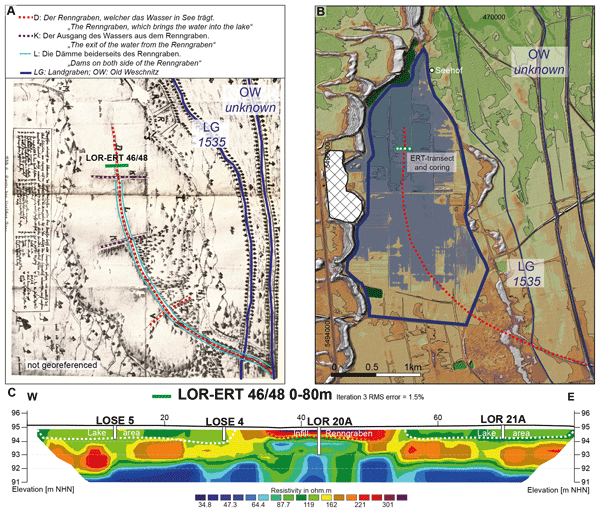
The historical Lake Lorsch in the Upper Rhine Graben (Germany) is a good example of how humans have changed the fluvial and hydrological systems in the area for at least 500 years. Interdisciplinary research from geomorphology and historical sciences have reconstructed the history based on old maps, digital elevation models and drillings. The results show a sophisticated system of artificial in- and outflows, which partly still exist today, and represent long-term changes in the Weschnitz floodplain.
Max Engel, Felix Henselowsky, Fabian Roth, Annette Kadereit, Manuel Herzog, Stefan Hecht, Susanne Lindauer, Olaf Bubenzer, and Gerd Schukraft
E&G Quaternary Sci. J., 71, 213–226, https://doi.org/10.5194/egqsj-71-213-2022, https://doi.org/10.5194/egqsj-71-213-2022, 2022
Short summary
Short summary
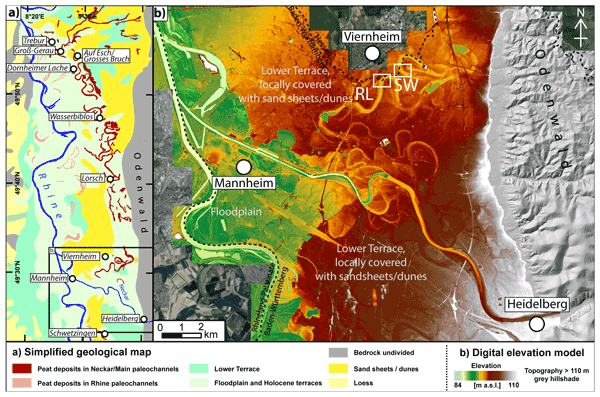
The late-glacial Bergstraßenneckar is a former course of the Neckar River in the Upper Rhine Graben of southwest Germany at a time when the confluence with the Rhine river was 50 km further to the north. The former river bends are still visible in topographic maps and satellite imagery. Sediment cores and geophysical measurements from the former river channels let us reconstruct the shift from a running river to silting-up meanders and permit us to date this to ca. 11 000 to 10 500 years ago.
Andreas Peffeköver, Max Engel, Stephan Opitz, Anja Zander, Maarten Van Daele, Pedro J. M. Costa, Sue Dawson, Rikza N. F. An Nahar, Juliane Scheder, Vanessa M. A. Heyvaert, Marc De Batist, and Dominik Brill
EGUsphere, https://doi.org/10.5194/egusphere-2026-3279, https://doi.org/10.5194/egusphere-2026-3279, 2026
This preprint is open for discussion and under review for Geochronology (GChron).
Short summary
Short summary
We present the first chronology for offshore tsunami evidence from the Shetland Islands (United Kingdom) based on luminescence dating, addressing critical methodological challenges. Our results confirm sedimentary evidence of both the Storegga tsunami and a late-Holocene tsunami event. Our study demonstrates both the potential of luminescence dating for offshore tsunami deposits and the benefits of the associated chronologies for tsunami hazard assessment for the North Sea region.
Robin Schweikert, Ron Eric Stein, Neil Bogs, Olaf Bubenzer, Camilo del Río, Dörte Harpke, Simon Matthias May, Alexander Siegmund, Alexandra Stoll, Dietmar Quandt, and Marcus A. Koch
EGUsphere, https://doi.org/10.64898/2026.02.23.707457, https://doi.org/10.64898/2026.02.23.707457, 2026
Short summary
Short summary
We exemplify unimodal regional wind systems facilitating sand transport toward Tillandsiales. Tillandsiales show a low-energy wind system allowing sand accumulation of predominant grain sizes available at each site. Thereby Tillandsia landbeckii modifies and maintains its own microenvironment. Genomic data reveal high clonality and excess of heterozygosity promoting fitness in a hyperarid environment, and abiotic factors drive the selection of diverse and adaptive Tillandsia phenotypes.
Felix Henselowsky, Peter Fischer, Elena Appel, Barbara Jäger, Nicolai Hillmus, Helen Sandbrink, Thomas Becker, Roland Prien, Gerrit Jasper Schenk, Bertil Mächtle, Udo Recker, Olaf Bubenzer, and Andreas Vött
E&G Quaternary Sci. J., 75, 1–18, https://doi.org/10.5194/egqsj-75-1-2026, https://doi.org/10.5194/egqsj-75-1-2026, 2026
Short summary
Short summary
The historical Lake Lorsch in the Upper Rhine Graben (Germany) is a good example of how humans have changed the fluvial and hydrological systems in the area for at least 500 years. Interdisciplinary research from geomorphology and historical sciences have reconstructed the history based on old maps, digital elevation models and drillings. The results show a sophisticated system of artificial in- and outflows, which partly still exist today, and represent long-term changes in the Weschnitz floodplain.
Annette Kadereit, Mariana Sontag-González, Sebastian Kreutzer, Marco Colombo, Christoph Schmidt, and Paul R. Hanson
EGUsphere, https://doi.org/10.5194/egusphere-2025-5978, https://doi.org/10.5194/egusphere-2025-5978, 2025
Short summary
Short summary
Infrared-stimulated luminescence (IRSL) dating of feldspar is an essential tool for dating sediments. Two major challenges of the IRSL signal are its “anomalous” instability potentially leading to age underestimation and its slow bleaching by sunlight which may cause age overestimation. Here we propose a progressively elevated temperature (PET) IRSL single aliquot regenerative (SAR) procedure to isolate a potentially stable IRSL signal from a set of best bleached subsamples.
Rónadh Cox, Mary C. Bourke, Max Engel, Andrew B. Kennedy, Annie Lau, Serge Suanez, Sarah J. Boulton, Maria Alexandra Oliveira, Raphaël Paris, Dimitra Salmanidou, Michaela Spiske, Wayne Stephenson, Storm Roberts, Adam D. Switzer, Nadia Mhammdi, Niamh D. Cullen, and Masashi Watanabe
Nat. Hazards Earth Syst. Sci., 25, 4203–4226, https://doi.org/10.5194/nhess-25-4203-2025, https://doi.org/10.5194/nhess-25-4203-2025, 2025
Short summary
Short summary
Coastal boulder deposits record extreme wave events, both storm and tsunami. Fully understanding hazards as recorded in these deposits requires high-quality data for comparison among sites and over time. We analysed methodologies and constructed a comprehensive set of field measurements to improve data consistency and reproducibility. We aim to help geomorphologists produce of data that can be widely shared and used to build extensive analytic understanding of coastal boulder deposits.
Elena Appel, Thomas Becker, Dennis Wilken, Peter Fischer, Timo Willershäuser, Lea Obrocki, Henrik Schäfer, Markus Scholz, Olaf Bubenzer, Bertil Mächtle, and Andreas Vött
E&G Quaternary Sci. J., 73, 179–202, https://doi.org/10.5194/egqsj-73-179-2024, https://doi.org/10.5194/egqsj-73-179-2024, 2024
Short summary
Short summary
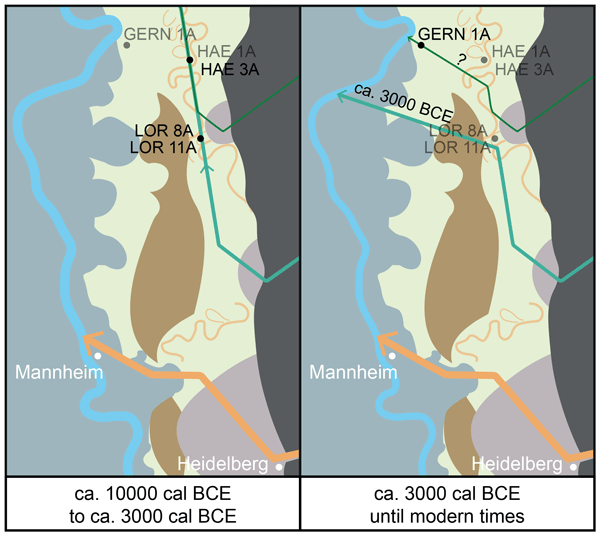
Human intervention in the natural drainage system of the Hessische Ried (Germany) resulted in the transformation of a large wetland into a cultural landscape. In this study, we reconstruct the river network that was used by Romans for transportation and security. We found that the Romans collected water from several smaller rivers to establish the river Landgraben as a navigable waterway. Unexpectedly, larger rivers did not contribute any water to the Landgraben system during Roman times.
Nora Pfaffner, Annette Kadereit, Volker Karius, Thomas Kolb, Sebastian Kreutzer, and Daniela Sauer
E&G Quaternary Sci. J., 73, 1–22, https://doi.org/10.5194/egqsj-73-1-2024, https://doi.org/10.5194/egqsj-73-1-2024, 2024
Short summary
Short summary
We present results of the Baix loess–palaeosol sequence, SE France. Reconstructed intense soil formation under warm, moist conditions before and into the last ice age and less intense soil formations in warm (temporarily moist) phases during the generally cold, dry ice age were validated with laboratory and dating techniques. This is particularly relevant as Baix is located in the temperate–Mediterranean climate transition zone, a sensitive zone that is susceptible to future climate changes.
Max Engel, Felix Henselowsky, Fabian Roth, Annette Kadereit, Manuel Herzog, Stefan Hecht, Susanne Lindauer, Olaf Bubenzer, and Gerd Schukraft
E&G Quaternary Sci. J., 71, 213–226, https://doi.org/10.5194/egqsj-71-213-2022, https://doi.org/10.5194/egqsj-71-213-2022, 2022
Short summary
Short summary
The late-glacial Bergstraßenneckar is a former course of the Neckar River in the Upper Rhine Graben of southwest Germany at a time when the confluence with the Rhine river was 50 km further to the north. The former river bends are still visible in topographic maps and satellite imagery. Sediment cores and geophysical measurements from the former river channels let us reconstruct the shift from a running river to silting-up meanders and permit us to date this to ca. 11 000 to 10 500 years ago.
Thomas Kolb, Konrad Tudyka, Annette Kadereit, Johanna Lomax, Grzegorz Poręba, Anja Zander, Lars Zipf, and Markus Fuchs
Geochronology, 4, 1–31, https://doi.org/10.5194/gchron-4-1-2022, https://doi.org/10.5194/gchron-4-1-2022, 2022
Short summary
Short summary
The µDose system is an innovative analytical instrument developed for the cost- and time-efficient determination of environmental radionuclide concentrations required for the calculation of sedimentation ages in palaeo-environmental and geo-archaeological research. The results of our study suggest that accuracy and precision of µDose measurements are comparable to those of well-established methods and that the new approach shows the potential to become a standard tool in environmental dosimetry.
Cited articles
Ad-hoc AG Boden: Bodenkundliche Kartieranleitung, 5th ed., Schweizerbart, Hannover, 2005.
Ad-hoc AG Boden: Bodenkundliche Kartieranleitung, 6th ed., two volumes, Schweizerbart, Hannover, 2024.
Appel, E., Becker, T., Wilken, D., Fischer, P., Willershäuser, T., Obrocki, L., Schäfer, H., Scholz, M., Bubenzer, O., Mächtle, B., and Vött, A.: The Holocene evolution of the fluvial system of the southern Hessische Ried (Upper Rhine Graben, Germany) and its role for the use of the river Landgraben as a waterway during Roman times, E&G Quaternary Sci. J., 73, 179–202, https://doi.org/10.5194/egqsj-73-179-2024, 2024.
Barsch, D. and Mäusbacher, R.: Erläuterungen zur Geomorphologischen Karte 1:25 000 der Bundesrepublik Deutschland – GMK 25 Blatt 3, 6417 Mannheim-Nordost, in: GMK Schwerpunktprogramm, Geomorphologische Detailkartierung in der Bundesrepublik Deutschland, edited by: Barsch, D., Fränzle, O., Leser, H., Liedtke, H., and Stäblein, G., Berlin, 1–56, 1979.
Barsch, D. and Mäusbacher, R.: Zur fluvialen Dynamik beim Aufbau des Neckarschwemmfächers, Berlin. Geogr. Abh. , 47, 119–128, https://doi.org/10.23689/fidgeo-3194, 1988.
Beckenbach, E.: Geologische Interpretation des hochauflösenden digitalen Geländemodells von Baden-Württemberg, PhD thesis, University of Stuttgart, Germany, https://doi.org/10.18419/opus-8846, 2016.
Bertrand, S., Tjallingii, R., Kylander, M. E., Wilhelm, B., Roberts, S. J., Arnaud, F., Brown, E., and Bindler, R.: Inorganic geochemistry of lake sediments: A review of analytical techniques and guidelines for data interpretation, Earth Sci. Rev., 249, 104639, https://doi.org/10.1016/j.earscirev.2023.104639, 2024.
Blott, S. J. and Pye, K.: GRADISTAT: a grain size distribution and statistics package for the analysis of unconsolidated sediments, Earth Surf. Processes Landforms, 26, 1237–1248, https://doi.org/10.1002/esp.261, 2001.
Bos, J. A. A., Dambeck, R., Kalis, A. J., Schweizer, A., and Thiemeyer, H.: Palaeoenvironmental changes and vegetation history of the northern Upper Rhine Graben (southwestern Germany) since the Lateglacial, Neth. J. Geosci., 87, 67–90, https://doi.org/10.1017/S0016774600024057, 2008.
Bøtter-Jensen, L., Bulur, E., Duller, G. A. T., and Murray, A. S.: Advances in luminescence instrument systems, Radiat. Meas., 32, 523–528, https://doi.org/10.1016/S1350-4487(00)00039-1, 2000.
Burow, C.: calc_CentralDose(): Apply the central age model (CAM) after Galbraith et al. (1999) to a given De distribution. Function version 1.4.1, in: Luminescence: Comprehensive Luminescence Dating Data Analysis. R package version 0.9.21, edited by: Kreutzer, S., Burow, C., Dietze, M., Fuchs, M. C., Schmidt, C., Fischer, M., Friedrich, J., Mercier, N., Philippe, A., Riedesel, S., Autzen, M., Mittelstrass, D., Gray, H. J., Galharret, J., Colombo, M., Steinbuch, L., and de Boer, A., CRAN, https://doi.org/10.32614/CRAN.package.Luminescence, 2023a.
Burow, C.: calc_MinDose(): Apply the (un-)logged minimum age model (MAM) after Galbraith et al. (1999) to a given De distribution. Function version 0.4.4, in: Luminescence: Comprehensive Luminescence Dating Data Analysis. R package version 0.9.21, edited by: Kreutzer, S., Burow, C., Dietze, M., Fuchs, M. C., Schmidt, C., Fischer, M., Friedrich, J., Mercier, N., Philippe, A., Riedesel, S., Autzen, M., Mittelstrass, D., Gray, H. J., Galharret, J., Colombo, M., Steinbuch, L., and de Boer, A., CRAN, https://doi.org/10.32614/CRAN.package.Luminescence, 2023b.
Burow, C.: calc_CosmicDoseRate(): Calculate the cosmic dose rate. Function version 0.5.2, in: Luminescence: Comprehensive Luminescence Dating Data Analysis. R package version 0.9.21, edited by: Kreutzer, S., Burow, C., Dietze, M., Fuchs, M. C., Schmidt, C., Fischer, M., Friedrich, J., Mercier, N., Philippe, A., Riedesel, S., Autzen, M., Mittelstrass, D., Gray, H. J., Galharret, J., Colombo, M., Steinbuch, L., and de Boer, A., CRAN, https://doi.org/10.32614/CRAN.package.Luminescence, 2024.
Claughton, P.: Clay, in: The Archaeology of Mining and Quarrying in England – A Research Framework for the Archaeology of the Extractive Industries in England. Resource Assessment and Research Agenda, edited by: Newman, P., National Association of Mining History Organisations, Derbyshire, 127–141, 2016.
Dambeck, R.: Beiträge zur spät- und postglazialen Fluss- und Landschaftsgeschichte im nördlichen Oberrheingraben, PhD thesis, University of Frankfurt/Main, Germany, 2005.
Dambeck, R. and Thiemeyer, H.: Fluvial history of the northern Upper Rhine River (southwestern Germany) during the Lateglacial and Holocene times, Quaternary Int., 93–94, 53–63, https://doi.org/10.1016/S1040-6182(02)00006-X, 2002
Dambeck, R. and Bos, J. A. A.: Lateglacial and Early Holocene landscape evolution of the northern Upper Rhine River valley, south-western Germany, Z. Geomorph. Suppl., 128, 101–127, 2002.
Davies, S. J., Lamb, H. F., and Roberts, S. J.: Micro-XRF core scanning in palaeolimnology: recent developments, in: Micro-XRF Studies of Sediment Cores, edited by: Croudace, I. W. and Rothwell, R. G., Springer, Dordrecht, 189–226, https://doi.org/10.1007/978-94-017-9849-5_7, 2015.
Dister, E., Gomer, D., Obrdlik, P., Petermann, P., and Schneider, E.: Water management and ecological perspectives of the upper Rhine's floodplains, Regul. River., 5, 1–15, https://doi.org/10.1002/rrr.3450050102, 1990.
DTU Physics: The Risø TL/OSL reader, https://physics.dtu.dk/-/media/institutter/fysik/nutech/produkter-og-services/radiation_measurement_instruments/tl_osl_reader/manuals/reader.pdf, (last access: 26 February 2025), 2021.
Duller, G. A. T.: Distinguishing quartz and feldspar in single grain luminescence measurements, Radiat. Meas., 37, 161–165, https://doi.org/10.1016/S1350-4487(02)00170-1, 2003.
Duller, G. A. T.: The Analyst software package for luminescence data: overview and recent improvements, Ancient TL, 33, 35–42, 2015.
Eckoldt, M.: Schiffahrt auf kleinen Flüssen. T. 2, Gewässer im Bereich des “Odenwaldneckars” im ersten Jahrtausend n. Chr. Dt. Schiffahrtsarch., 8, 101–116, 1985
Engel, M., Henselowsky, F., Roth, F., Kadereit, A., Herzog, M., Hecht, S., Lindauer, S., Bubenzer, O., and Schukraft, G.: Fluvial activity of the late-glacial to Holocene “Bergstraßenneckar” in the Upper Rhine Graben near Heidelberg, Germany – first results, E&G Quaternary Sci. J., 71, 213–226, https://doi.org/10.5194/egqsj-71-213-2022, 2022.
Fuchs, M.: The Upper Rhine Graben: A diverse landscape shaped by endogenic and exogenic processes, in: Landscapes and Landforms of Germany, edited by: Lehmkuhl, F., Böse, M., and Krautblatter, M., Springer, Cham, 287–299, https://doi.org/10.1007/978-3-031-77876-6_16, 2025.
Galbraith, R. F., Roberts, R. G., Laslett, G. M., Yoshida, H., and Olley, J. M.: Optical dating of single grains of quartz from Jinmium rock shelter, northern Australia. Part I: experimental design and statistical models, Archaeometry, 41, 339–364, https://doi.org/10.1111/j.1475-4754.1999.tb00987.x, 1999.
Gibling, M. R.: River systems and the Anthropocene: A Late Pleistocene and Holocene timeline for human influence, Quaternary, 1, 21, https://doi.org/10.3390/quat1030021, 2018.
Godfrey-Smith, D. I., Huntley, D. J., and Chen, W.-H.: Optical dating studies of quartz and feldspar sediment extracts, Quat. Sci. Rev., 7, 373–380, https://doi.org/10.1016/0277-3791(88)90032-7, 1988.
Goemaere, E., Sosnowska, P., Golitko, M., Goovaerts, T., and Leduc, T.: Archaeometric and archaeological characterization of the fired clay brick production in the Brussels Capital Region between the XIV and the third quarter of the XVIII centuries (Belgium), ArcheoSciences, 43, 107–132, https://doi.org/10.4000/archeosciences.6429, 2019.
Greyer, W., Kandt, K., Kokes, I., and Schuler, H.: Die Römische Sumpfbrücke bei Bickenbach (Kreis Darmstadt), Saalburg-Jahrb., 34, 42–77, 1977.
Günther, J.: Torf als (nachwachsender) Rohstoff?, TELMA Beih. Ber. Dt. Ges. Moor- u. Torfk., 6, 369–379, 2020.
Hammer, Ø., Harper, D. A. T., and Ryan, P.D.: PAST: paleontological statistics software package for education and data analysis, Palaeontol. Electron., 4, 2001.
Heiri, O., Lotter, A. F., and Lemcke, G.: Loss on ignition as a method for estimating organic and carbonate content in sediments: reproducibility and comparability of results, J. Paleolimnol., 25, 101–110, https://doi.org/10.1023/A:1008119611481, 2001.
Holzhauer, I., Kadereit, A., Schukraft, G., Kromer, B., and Bubenzer, O.: Spatially heterogeneous relief changes, soil formation and floodplain aggradation under human impact – geomorphological results from the Upper Rhine Graben (SW Germany), Z. Geomorph., 61, 121–158, https://doi.org/10.1127/zfg_suppl/2017/0357, 2017.
Hutton, J. T. and Prescott, J. R.: Field and laboratory measurements of low-level thorium, uranium and potassium, Int. J. Radiat. Appl. Instr. D, 20, 367–370, https://doi.org/10.1016/1359-0189(92)90066-5, 1992.
Kalis, A. J., Merkt, J., and Wunderlich, J.: Environmental changes during the Holocene climatic optimum in central Europe – human impact and natural causes, Quat. Sci. Rev., 22, 33–79, https://doi.org/10.1016/S0277-3791(02)00181-6, 2003.
Kasse, C., Hoek, W. Z., Bohncke, S. J. P., Konert, M., Weijers, J. W. H., Cassee, M. L., and Van Der Zee, R. M.: Late Glacial fluvial response of the Niers-Rhine (western Germany) to climate and vegetation change, J. Quaternary Sci., 20, 377–394, https://doi.org/10.1002/jqs.923, 2005.
Kneisel, C.: Electrical resistivity tomography as a tool for geomorphological investigations – some case studies, Z. Geomorph. Suppl., 132, 37–49, 2003.
Kolb, T., Tudyka, K., Kadereit, A., Lomax, J., Poręba, G., Zander, A., Zipf, L., and Fuchs, M.: The μDose system: determination of environmental dose rates by combined alpha and beta counting – performance tests and practical experiences, Geochronology, 4, 1–31, https://doi.org/10.5194/gchron-4-1-2022, 2022.
König, P.: Eine vorgeschichtliche und frühmittelalterliche Siedlung von Heddesheim, Rhein-Neckar-Kreis, Fundber. Baden-Württemb., 35, 141–204, https://doi.org/10.11588/fbbw.2015.0.44523, 2015.
Kottek, M., Grieser, J., Beck, C., Rudolf, B., and Rubel, F.: World map of the Köppen-Geiger climate classification updated, Meteorol. Z., 15, 259–263, https://doi.org/10.1127/0941-2948/2006/0130, 2006.
Kreutzer, S., Schmidt, C., Fuchs, M. C., Dietze, M., Fischer, M., and Fuchs, M.: Introducing an R package for luminescence dating analysis, Ancient TL, 30, 1–8, https://doi.org/10.26034/la.atl.2012.457, 2012.
Lang, A.: Die Infrarot-Stimulierte-Lumineszenz als Datierungsmethode für holozäne Lössderivate. Ein Beitrag zur Chronometrie kolluvialer, alluvialer und limnischer Sedimente in Südwestdeutschland, Heidelb. Geogr. Arb., 103, 1–137, 1996.
Lehouck, A.: The very beginning of brick architecture north of the Alps: the case of the Low Countries in the question of the Cistercian origin, in: L'industrie cistercienne (XIIe–XXIe siècle), edited by: Baudin, A., Benoit, P., Rouillard, J., and Rouzeau, B., Somogy Éditions d'Art, Paris, 41–56, 2019.
Liang, P. and Yang, X.: Grain shape evolution of sand-sized sediments during transport from mountains to dune fields, J. Geophys. Res. Earth, 128, e2022JF006930, https://doi.org/10.1029/2022JF006930, 2023.
Löscher, M.: Die quartären Ablagerungen auf der Mannheimer Gemarkung, in: Mannheim vor der Stadtgründung. Teil 1, Band 1, edited by: Probst, H., Friedrich Pustet Verlag, Regensburg, 28–47, 2007.
Löscher, M. and Haag, T.: Zum Alter der Dünen im nördlichen Oberrheingraben bei Heidelberg und zur Genese ihrer Parabraunerden, E&G Quaternary Sci. J., 39, 98–108, https://doi.org/10.3285/eg.39.1.10, 1989.
LUBW (Landesanstalt für Umwelt Baden-Württemberg): Digitales Geländemodell 1 Meter (DGM1), Object ID: 271f9e5b-6f12-4fc9-b692-cb7828e8c170, https://rips-metadaten.lubw.de/startseite (last access: 28 February 2025), 2024
LUBW (Landesanstalt für Umwelt Baden-Württemberg): Abfluss-BW – regionalisierte Abfluss-Kennwerte Baden-Württemberg, https://udo.lubw.baden-wuerttemberg.de/projekte/ (last access: 28 Febrary 2025), 2025a.
LUBW (Landesanstalt für Umwelt Baden-Württemberg): Klima der Vergangenheit, https://www.klimaatlas-bw.de/ (last access: 16 June 2025), 2025b.
Maggetti, M. and Galetti, G.: Die Baukeramik von Augusta Raurica – eine mineralogisch-chemisch-technische Untersuchung, Jahresber. Augst Kaiseraugst, 14, 199–225, 1993.
Mangold, A.: Die alten Neckarbetten in der Rheinebene, Abh. Großherzogl. Hess. Geol. Landesanst. Darmstadt, 2, 75–114, 1892.
Mone, F. J.: Ueber den alten Flußlauf im Oberrheintal, Badisch. Arch. z. Vaterlandsk. in allseit. Hinsicht, 1, 1–47, 1826.
Munsell Color Company: Munsell Soil Color Chart, New Windsor, 2000.
Murray, A. S. and Wintle, A. G.: The single aliquot regenerative dose protocol: potential for improvements in reliability, Radiat. Meas., 37, 377–381, https://doi.org/10.1016/S1350-4487(03)00053-2, 2000.
Nickel, E. and Fettel, M.: Odenwald – Vorderer Odenwald zwischen Darmstadt und Heidelberg, Sammlung Geologischer Führer Vol. 65, Bornträger, Stuttgart, 1979.
Obrocki, L., Becker, T., Mückenberger, K., Finkler, C., Fischer, P., Willershäuser, T., and Vött, A.: Landscape reconstruction and major flood events of the River Main (Hesse, Germany) in the environs of the Roman fort at Großkrotzenburg, Quaternary Int., 538, 94–109. https://doi.org/10.1016/j.quaint.2018.08.009, 2020.
Pflanz, D., Kunz, A., Hornung, J., and Hinderer, M.: New insights into the age of aeolian sand deposition in the northern Upper Rhine Graben (Germany), Quaternary Int., 625, 1–13, https://doi.org/10.1016/j.quaint.2022.03.019, 2022.
Prescott, J. R. and Hutton, J. T.: Cosmic ray and gamma ray dosimetry for TL and ESR, Int. J. Radiat. Appl. Instr. D, 14, 223–227, https://doi.org/10.1016/1359-0189(88)90069-6, 1988.
Przyrowski, R. and Schäfer, A.: Quaternary fluvial basin of northern Upper Rhine Graben, Z. Dt. Ges. Geowiss., 166, 71–98, https://doi.org/10.1127/1860-1804/2014/0080, 2015.
Roth, F.: Lithofazielle Differenzierung zur Aktivität und Verlandung ehemaliger Flussschleifen im Oberrheingraben – ein Beitrag zur Landschaftsgeschichte des südlichen Bergstraßenneckars, MSc thesis, Heidelberg University, 2020.
Scalenghe, R., Barello, F., Saiano, F., Ferrara, E., Fontaine, C., Caner, L., Olivetti, E., Boni, I., and Petit, S.: Material sources of the Roman brick-making industry in the I and II century A.D. from Regio IX, Regio XI and Alpes Cottiae, Quaternary Int., 357, 189–206, https://doi.org/10.1016/j.quaint.2014.11.026, 2015.
Stordeur, D. and Khawam, R.: Les crânes surmodelés de Tell Aswad (PPNB, Syrie), Premier regard sur l'ensemble, premières réflexions, Syria, 87, 5–32, https://doi.org/10.4000/syria.321, 2007.
Tasche, H.: Kurzer Ueberblick über das Berg-, Hütten- und Salinen-Wesen im Grossherzogthum Hessen, G. Jonghaus, 1858.
Tolksdorf, J. F., Turner, F., Kaiser, K., Eckmeier, E., Stahlschmidt, M., Housley, R. A., Breest, K., and Veil, S.: Multiproxy analyses of stratigraphy and palaeoenvironment of the late Palaeolithic Grabow floodplain site, northern Germany, Geoarchaeology, 28, 50–65, https://doi.org/10.1002/gea.21429, 2013.
Toonen, W. H. J., Kleinhans, M. G., and Cohen, K. M.: Sedimentary architecture of abandoned channel fills, Earth Surf. Processes Landforms, 37, 459–472, https://doi.org/10.1002/esp.3189, 2012.
Tudyka, K., Miłosz, S., Adamiec, G., Bluszcz, A., Poręba, G., Paszkowski, Ł., and Kolarczyk, A.: μDose: A compact system for environmental radioactivity and dose rate measurement, Radiat. Meas., 118, 8–13, https://doi.org/10.1016/j.radmeas.2018.07.016, 2018.
Van Beek, G. W. and Van Beek, O.: Glorious Mud! Ancient and Contemporary Earthen Design and Construction in North Africa, Western Europe, the Near East, and South Asia, Smithsonian Institution Scholarly Press, Washington, 2008.
Van Dinter, M.: The Roman Limes in the Netherlands: how a delta landscape determined the location of the military structures, Neth. J. Geosci., 92, 11–32, https://doi.org/10.1017/S0016774600000251, 2013.
Vanzani, F., Fontana, A., Vinci, G., and Ventura, P.: The legacy of the Roman pottery production in the alluvial landscape in Italy: traces of relict clay pits and their ancient environmental impact, Archaeol. Anthropol. Sci., 17, 91, https://doi.org/10.1007/s12520-025-02202-w, 2025.
Wagner, P. (Ed.): Die Holzbrücken bei Riedstadt-Goddelau, Kreis Groß-Gerau, Mater. Vor- und Frühgesch. Hessen, 5, 1–180, 1990.
Werther, L., Mehler, N., Schenk, G. J., and Zielhofer, C.: On the way to the Fluvial Anthroposphere–Current limitations and perspectives of multidisciplinary research, Water, 13, 2188, https://doi.org/10.3390/w13162188, 2021.
Wirth, K.: Ein Bohlenweg oder eine Sumpfbrücke aus römischer Zeit in Mannheim-Straßenheim, in: Archäologie der Brücken, Vorgeschichte, Antike, Mittelalter, Neuzeit, edited by: Pflederer, T. and Sommer, C., Friedrich Pustet Verlag, Regensburg, 102–105, 2011.
Wójcicki, K. J.: The oxbow sedimentary subenvironment: its value in palaeogeographical studies as illustrated by selected fluvial systems in the Upper Odra catchment, southern Poland, Holocene, 16, 589–603, https://doi.org/10.1191/0959683606hl953rp, 2006.
Short summary
The marshy, silted-up channel of the Late Glacial Bergstraßenneckar near Mannheim provided a rare source of clay in the sand- and gravel-dominated environment of the Rhine river. Based on satellite images, sedimentological, geophysical, and historical data, as well as optical dating, we identify a plot of sand-filled trenches where clay was mined around 1865 CE, which was only possible after groundwater lowering resulting from large-scale river regulation starting in the early 19th century.
The marshy, silted-up channel of the Late Glacial Bergstraßenneckar near Mannheim provided a...


Special issue